





Walk
A Town With Two Faces
Auray, France
Walk
A Town With Two Faces
Auray, France
2.4 km
Distance
1h00
Durée
19
Audios
Loop
Parcours
Ji-Elle, CC BY-SA 3.0 <https://creativecommons.org/licenses/by-sa/3.0>, via Wikimedia Commons
As you walked up Rue Saint-Sauveur, you probably noticed two bell towers standing almost side by side. No, Saint-Goustan didn’t build two churches because it couldn’t make up its mind! The two buildings simply date from very different periods and reflect two very different forms of devotion.
Let’s start with Saint-Sauveur Church, the older of the two. It has stood above the neighborhood since the 15th century, although much of what you see today is more recent. In 1886, a devastating fire swept through the building, leaving only the porch of the original church intact.
Take a moment to look at its stonework and carvings: they survived when almost everything else had to be rebuilt. The church reopened two years later, with wood paneling and furnishings in the Neo-Gothic style. But the real treasure is waiting inside.
If the doors are open, step in and look up at the ceiling. You should see an impressive ship suspended overhead. This is the Orion, and at 2.67 meters, or about 8 feet 9 inches long, it is often described as the largest maritime ex-voto in Brittany.
An ex-voto is an offering left in a religious place either to ask for protection or to give thanks after escaping danger. In a neighborhood of sailors, what could be more fitting than a ship? The Orion, however, was never originally intended for a church.
This model battleship is thought to have been made in the workshops of the French Navy in Lorient, probably as a study model. It only became an ex-voto in 1908. And this ship has had something of an identity crisis over the years: it was known in turn as Saint-Goustan, Le Goustannais, and Le Bigorneau before receiving its current name during restoration work in the 1990s.
Before you head back outside, look for a depiction of Saint Goustan as well. He should be easy to recognize: as the protector of sailors and fishermen, he is shown with his famous magical fish. Now let’s turn to the second bell tower.
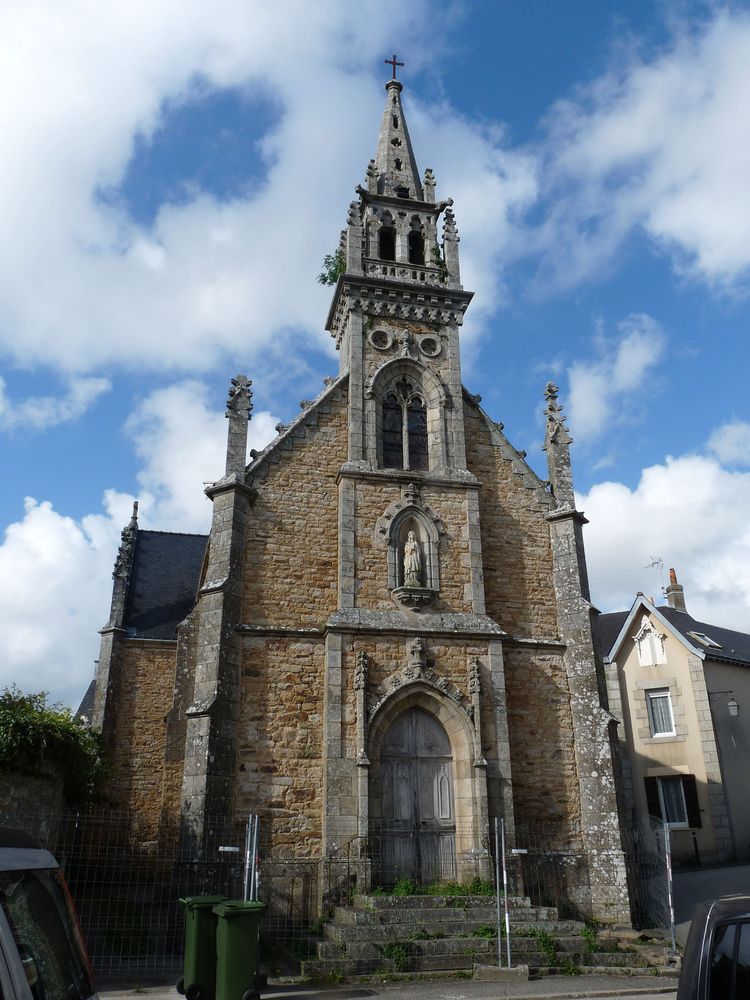
It belongs to Notre-Dame-de-Lourdes Chapel, built much later, at the end of the 19th century. Its Neo-Gothic design was inspired by the Upper Basilica at the Sanctuary of Lourdes, but with a distinctly Breton touch. Look up at its slender bell tower and finely carved stone spire: they were inspired by the traditional church towers of Cornouaille, in Finistère.
The chapel’s construction reflects the enormous wave of devotion that spread across France after the reported apparitions at Lourdes in 1858. If you’re lucky enough to find the chapel open, its nine stained-glass windows and reconstructed grotto will take you into the story of Bernadette Soubirous and Our Lady of Lourdes. Two very different buildings, then, but together they offer a remarkable glimpse into both Auray’s maritime traditions and Breton religious devotion.
Aucun avis pour le moment
