
Walk
The Secret Capital
Munich, Germany
Walk
The Secret Capital
Munich, Germany
Distance
6.5 kmDurée
2h40Audios
27Parcours
Loop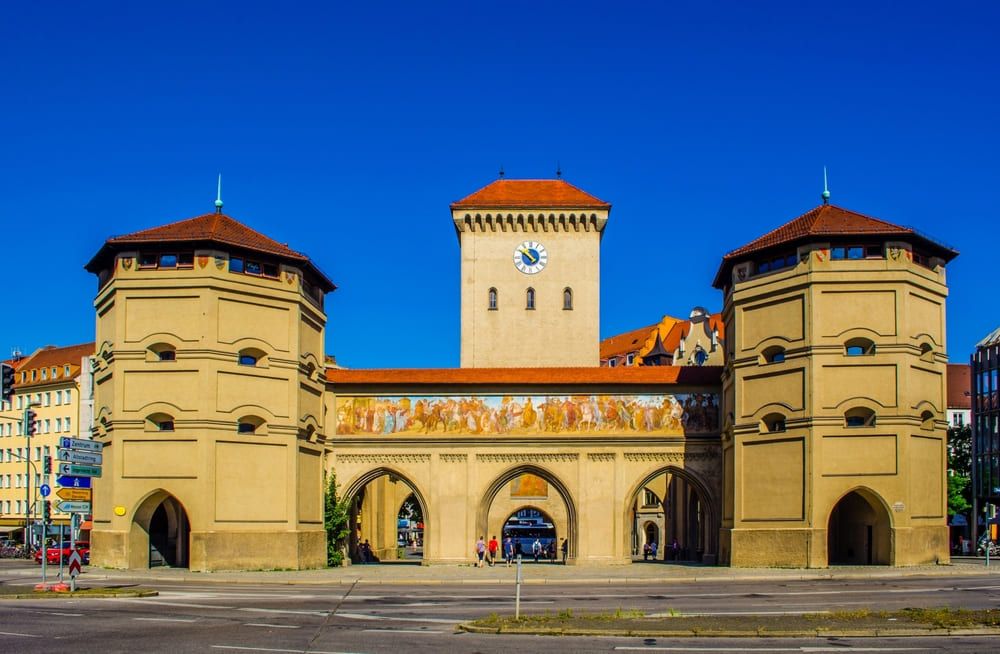
Shutterstock
The Isartor gate marks one of the entrances to the historic centre of Munich. In the Middle Ages, it was part of the wall that protected the city. The Munich audio-guided tour stops here to evoke this medieval vestige, one of the last great gates of the city still standing, to the east of the old town.
Built in 1337 in the eastern part of Munich, the Isartor gate takes its name from the river Isar, towards which it opens. It was part of the second fortified wall of the city, of which a few gates still survive, such as the Karlstor and the Sendlinger Tor. Well preserved, the Isartor today houses a museum and remains a precious witness of medieval Munich.
The gate, with its central tower and its frescoes, testifies to the medieval defensive system of Munich. It houses a museum and marks the passage towards the old town from the east. It is a stop for lovers of history, recalling the era when Munich was a fortified town, girdled with ramparts and gates.
The Isartor gate lies to the east of the historic centre of Munich, reachable on foot and by public transport. It is a monument that you pass through and admire freely from the public space; the museum it houses can be visited according to its own hours and conditions, to be checked before coming.
In 1337, in the eastern part of Munich; it was part of the medieval wall and takes its name from the river Isar.
Among the medieval gates still standing are the Isartor, the Karlstor and the Sendlinger Tor, vestiges of the old fortifications of the city.
Aucun avis pour le moment