





Walk
Open to the World
Hamburg, Germany
Walk
Open to the World
Hamburg, Germany
8 km
Distance
3h10
Durée
25
Audios
Loop
Parcours
Shutterstock
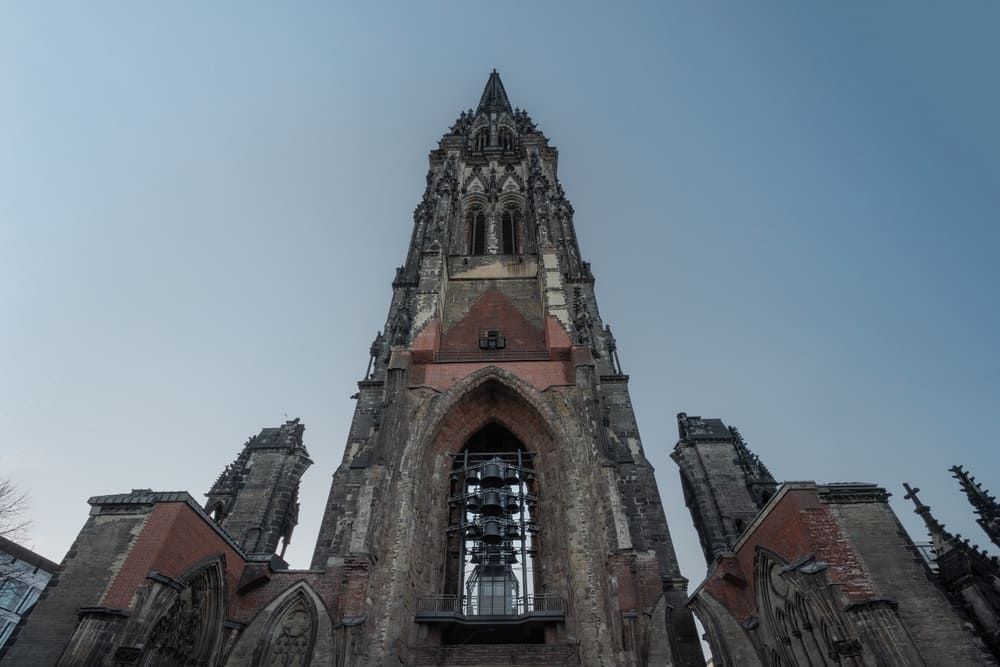
The Church of St Nicholas of Hamburg is now only a ruin, deliberately preserved as a memorial against war. The Hamburg audio-guided tour stops here, with respect and contemplation, to evoke this deeply moving place of memory, destroyed during the bombings of the Second World War.
You are here inside the Church of St Nicholas, even if there only remains around you ruins. This choice to have kept the walls and the high tower comes from a will of memory: the site has been transformed into a memorial. Formerly one of the largest churches of Hamburg, endowed at one time with the highest spire of the world, St Nicholas was almost entirely destroyed during the Allied bombings of the Second World War, notably Operation Gomorrah of the summer of 1943, which ravaged the town and made tens of thousands of victims. Rather than rebuild the building, the town chose to keep its ruins as a warning against the horrors of war. Today survive the spire, which remains one of the highest of the town, as well as the crypt, where a memorial retraces this tragic history. A place of memory laden with gravity and a call to peace, the Church of St Nicholas is discovered with respect and contemplation.
Here you discover, with respect and contemplation, the ruins of the Church of St Nicholas, formerly one of the largest of Hamburg and endowed with the highest spire of the world, almost entirely destroyed during the bombings of 1943, kept as a memorial against war, with its surviving spire and its crypt that retraces this tragic history. The Church of St Nicholas is a place of memory of Hamburg. It is a stop to be discovered with respect and contemplation.
The Church of St Nicholas lies in the heart of the old town of Hamburg, reachable on foot. It is a memorial whose spire and crypt can be visited with respect; access follows its own hours and conditions, which vary. It is best to check them before coming and to observe the contemplation due to the place.
Because it was almost entirely destroyed during the Allied bombings of the Second World War, notably Operation Gomorrah of 1943; rather than rebuild it, the town chose to keep its ruins as a memorial against war, with its spire and its crypt.
In the heart of the old town of Hamburg, in Germany.
Aucun avis pour le moment
