

Walk
When the Minotaur meets the Venetians
Iraklio, Grèce
Walk
When the Minotaur meets the Venetians
Iraklio, Grèce
Distance
4.2 kmDurée
1h50Audios
19Parcours
Loop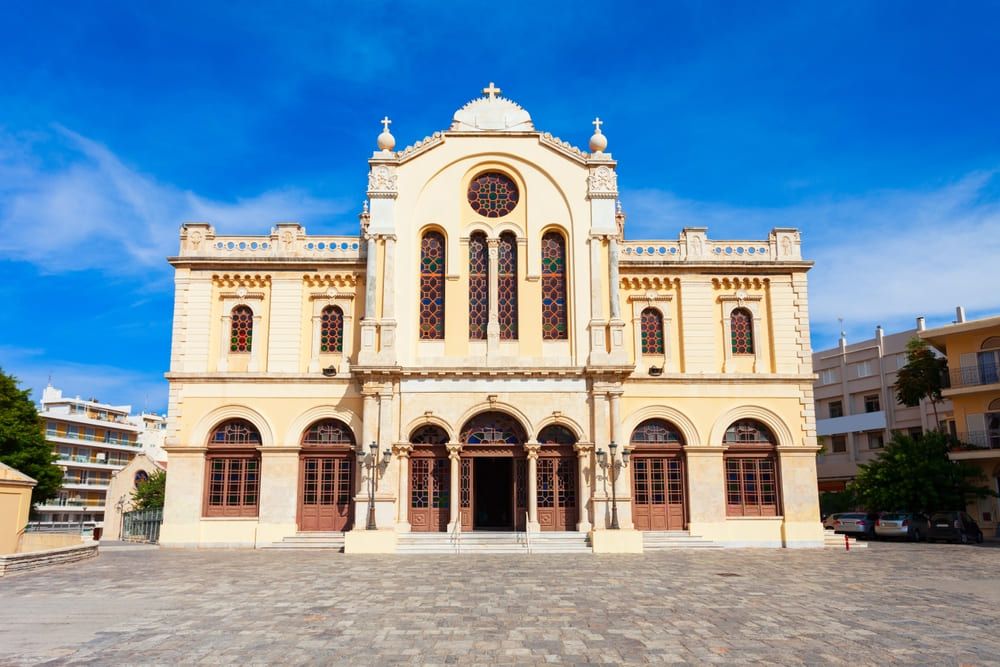
Shutterstock
Step closer to Agios Minas Cathedral and take a moment to appreciate its immense scale. With its vast dome and twin bell towers, it rises above the centre of Heraklion and immediately announces itself as one of the island’s most important religious landmarks. But to truly understand this place, we need to go back in time. When the city fell under Ottoman control in 1669 after a long siege, Orthodox Christians became a minority in what was often a tense environment. Just beside you on the right, don’t miss the much smaller older church, built in 1735. For many years, this modest building served as the heart of the Orthodox community. Several important events took place there, including outbreaks of violence in the early 19th century, but it was also where devotion to Saint Minas — the protector of Heraklion — grew especially strong. According to local legend, in 1826 an attack on the city was miraculously halted by the appearance of an armed rider identified as Saint Minas himself. Since then, his image has remained deeply rooted in the memory of the city’s inhabitants. By the 19th century, the Christian population had expanded, and the small church was no longer sufficient. In 1862, plans were made to build a great cathedral here on this very site. The project carried powerful symbolic meaning: asserting the presence of Orthodoxy in a city that was still under Ottoman rule. Construction lasted for more than thirty years, repeatedly interrupted by Cretan uprisings against the Ottoman Empire. Eventually, the cathedral was inaugurated in 1895, only a few years before Ottoman rule on the island finally came to an end. Now, take the time to step inside Agios Minas Cathedral, because the interior is truly worth seeing. From the moment you enter, the cross-shaped layout combined with the three-aisled structure creates an extraordinary sense of openness and height, amplified by the great dome above you, so characteristic of Orthodox churches. Your eyes are naturally drawn upward, then toward the walls entirely covered in religious imagery. These paintings follow the tradition of Byzantine iconography, where every image carries precise meaning. They are not merely decorative — they tell biblical stories and make sacred figures present within the space. Directly ahead, you’ll notice one of the defining features of any Orthodox church: the iconostasis. This large screen covered in icons separates the congregation from the holiest part of the church where the liturgy takes place. Here, the iconostasis is made entirely of marble. And if the sunlight happens to stream through the stained-glass windows at the right moment, the entrance fills with an extraordinary burst of colour.
Aucun avis pour le moment