
Walk
When the Minotaur meets the Venetians
Iraklio, Grèce
Walk
When the Minotaur meets the Venetians
Iraklio, Grèce
Distance
4.2 kmDurée
1h50Audios
19Parcours
Loop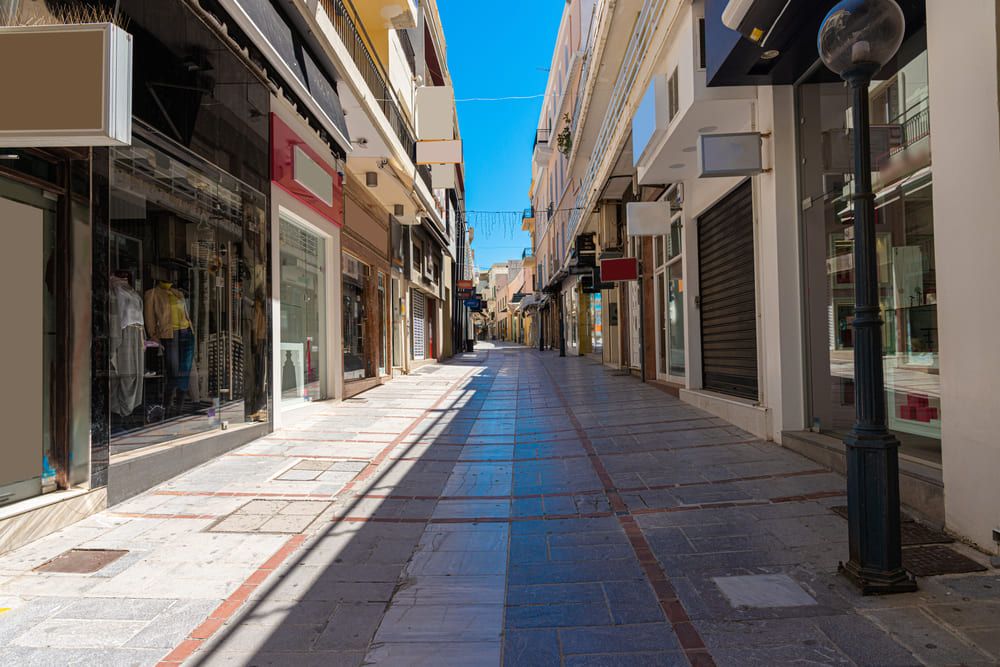
Shutterstock
The lively energy around you is exactly what defines Dedalou Street, one of Heraklion’s main pedestrian shopping streets. Yet beneath the modern cafés, storefronts, and constant movement lies a route with remarkably ancient origins. As early as antiquity, the first settled area of Heraklion is believed to have developed here. Later, during the Arab and Byzantine periods, this road followed the line of the old fortifications, marking what was once almost the southern edge of the city. Over the centuries, the street changed dramatically. Under Ottoman rule, Dedalou was a narrow lane filled with small shops, carrying the scent of roasted coffee and hookah smoke. After the destruction of the Second World War, the city centre was rebuilt, giving the street the broader, more open appearance you see today. But the name “Dedalou” takes us far beyond the streets of modern Heraklion and deep into Greek mythology. It comes from Daedalus, one of the great mythical figures associated with Crete. Daedalus was known as a brilliant craftsman and inventor, capable of designing mechanisms and structures beyond the imagination of ordinary people. His most famous creation was the Labyrinth, built for King Minos. And this Labyrinth was far more than a complicated building — it was a prison designed to contain the Minotaur, the terrifying half-man, half-bull creature born from a divine curse within the royal family. In the myth, the danger does not come only from the monster itself, but from the Labyrinth as well. A person could wander endlessly inside without ever even encountering the Minotaur. To reinforce his power over Athens, King Minos regularly sent fourteen young Athenians into the maze to be sacrificed. So when Theseus entered the Labyrinth to kill the creature, escaping afterward seemed almost impossible. Only Ariadne’s famous thread allowed him to find his way back out. Without it, defeating the Minotaur would have meant nothing — he would still have remained trapped inside the maze. In ancient tradition, the Labyrinth is usually linked to the Palace of Knossos, the real archaeological site located a few kilometres south of Heraklion. With its maze-like corridors and complex layout, the palace likely helped inspire the image of a place impossible to fully understand or navigate. But the Labyrinth itself, as described in mythology, belongs above all to the world of imagination. Daedalus occupies a fascinating role in this story. His intelligence allows him to solve impossible problems, yet his talents also help create them in the first place. He becomes involved in the chain of events leading to the birth of the Minotaur, then builds the Labyrinth to imprison it, and later, by helping Theseus and Ariadne, indirectly sets in motion the tragedy that leads to the death of his own son, Icarus. By giving this street the name Dedalou, Heraklion reminds us just how deeply Crete remains connected to the world of Greek mythology.
Aucun avis pour le moment