

Walk
When the Minotaur meets the Venetians
Iraklio, Grèce
Walk
When the Minotaur meets the Venetians
Iraklio, Grèce
Distance
4.2 kmDurée
1h50Audios
19Parcours
Loop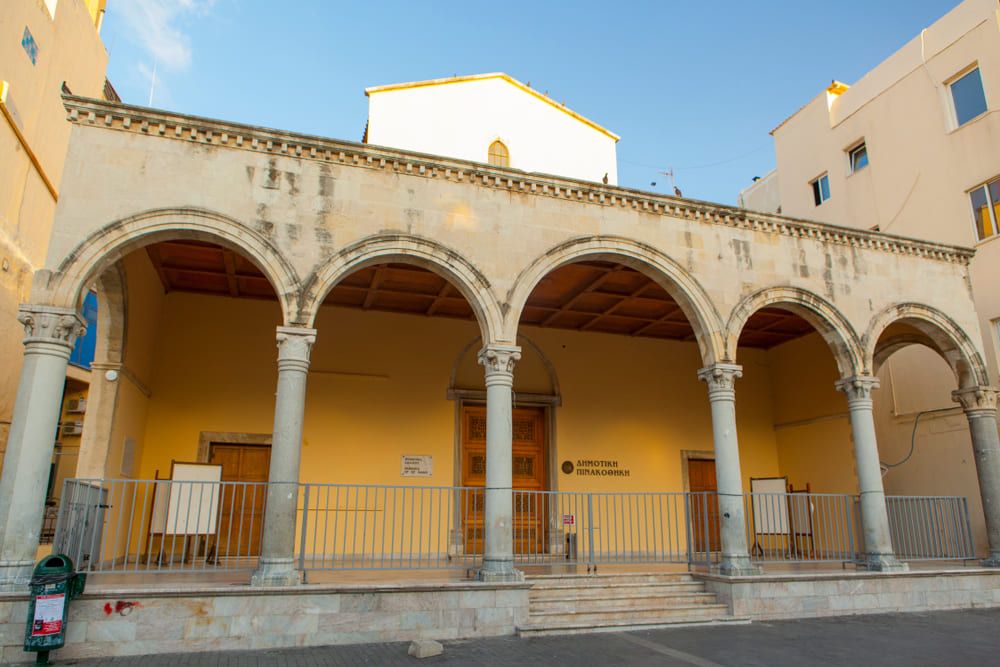
Shutterstock
The building on your right, easily recognised by its five arches, is St. Mark’s Basilica. Its prominent position in the middle of the square is no coincidence. It reflects the central role Heraklion — known at the time as Candia — once played within Venice’s vast maritime empire. After the Fourth Crusade in the early 13th century, the Venetians took control of Crete to secure their trade routes across the eastern Mediterranean. Heraklion soon became the capital of the Kingdom of Candia, serving as a major commercial, military, and administrative centre. It was in this context that the basilica was built, beginning in 1239, and dedicated to Saint Mark, the patron saint of Venice, clearly asserting Venetian authority at the heart of the city. But the basilica was never just a religious building. It also served as an official ceremonial space where representatives of Venetian power assumed office, and where members of the Venetian elite were buried. At the time, a tall bell tower with a clock — inspired by Venice’s famous campanile — rose from the south-west corner of the square, further reinforcing the city’s connection to Venice. The building you see today, however, has gone through many transformations. Heraklion has long been exposed to earthquakes, destruction, and rebuilding. After the Ottoman conquest in 1669, the basilica was converted into the Defterdar Mosque. The bell tower was demolished and replaced with a minaret, while several Christian features disappeared. Then, in the 20th century, following the end of Ottoman rule, the building changed purpose once again. Restored from 1956 onward, it became Heraklion’s Municipal Art Gallery. Today, it hosts exhibitions and cultural events, while also standing as a fascinating witness to the city’s layered history — from Venetian rule to the Ottoman era and finally its modern revival.
Aucun avis pour le moment