



Walk
A Maze of Pirates and Heroines
Mykonos, Grèce
Walk
A Maze of Pirates and Heroines
Mykonos, Grèce
Distance
2 kmDurée
1h00Audios
19Parcours
Loop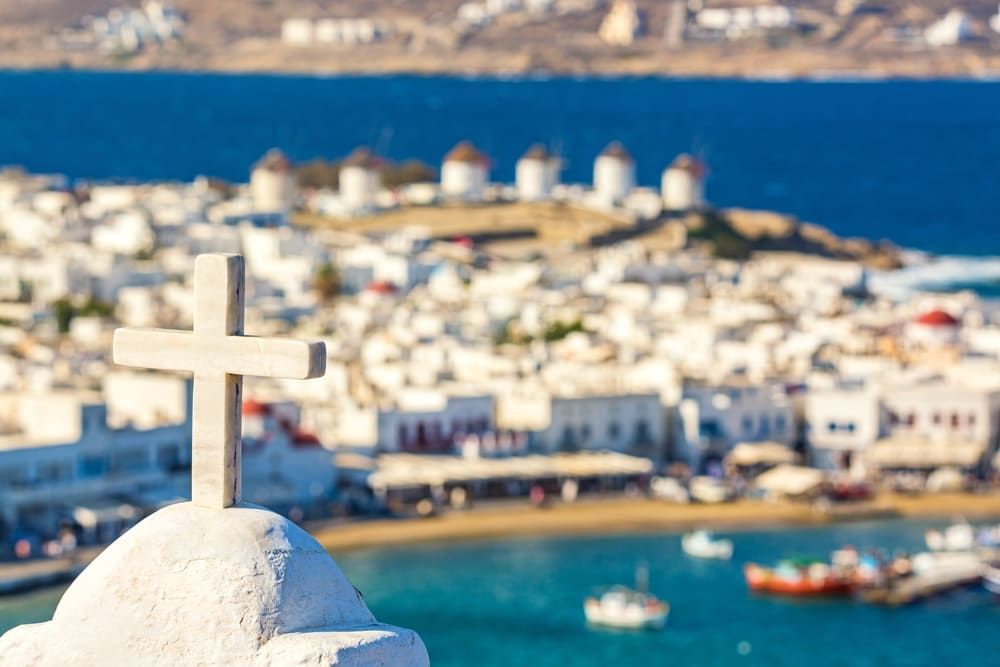
Shutterstock
Have you noticed the little crosses on top of the buildings to your right? They might look like ordinary houses, but they're actually churches! And as you've wandered through Chora's narrow streets, you've probably noticed something rather surprising: there seem to be little churches and chapels around every corner. In fact, there are more than seventy of them across town! Why are there so many? The answer lies in two fascinating traditions: the practice of making religious offerings and an old custom of keeping the bones of deceased family members within the walls of churches. To understand how these traditions developed, we need to look at the island's seafaring culture and its Greek Orthodox faith. For centuries, life on Mykonos revolved around the sea and its perils. Sailors and their families would make offerings to God, the Virgin Mary, or a saint, asking for healing or protection, or giving thanks for a miracle. And on Mykonos, these offerings went far beyond the little metal votive objects traditionally hung beside religious icons. The ultimate expression of gratitude was to build an entire chapel, or take responsibility for maintaining one. That's how dozens of family chapels came to be, each one a lasting symbol of gratitude. Now, before you start imagining skeletons hanging from the ceilings or walls covered in skulls, don't worry! The tradition was actually a deeply respectful way of honoring deceased family members. In the Greek Orthodox world, limited cemetery space meant that bodies were often exhumed after a few years. The bones were then washed, perfumed, and placed in an ossuary. On Mykonos, families passed this custom down through generations, keeping their ancestors' remains in small, dedicated spaces inside their private chapels or built into the chapel walls. So far from being something morbid, these ossuaries were considered sacred places that kept the memory of deceased loved ones close to the family. And these little churches were, and still are, important centers of community life. During the panigiria, traditional religious festivals celebrating each chapel's patron saint, the living gather together to honor the memory of their ancestors. The walls are freshly whitewashed, tables are set out, and the whole community comes together to share food, wine, music, and dancing.
Aucun avis pour le moment
