
Walk
When the Minotaur meets the Venetians
Iraklio, Grèce
Walk
When the Minotaur meets the Venetians
Iraklio, Grèce
Distance
4.2 kmDurée
1h50Audios
19Parcours
Loop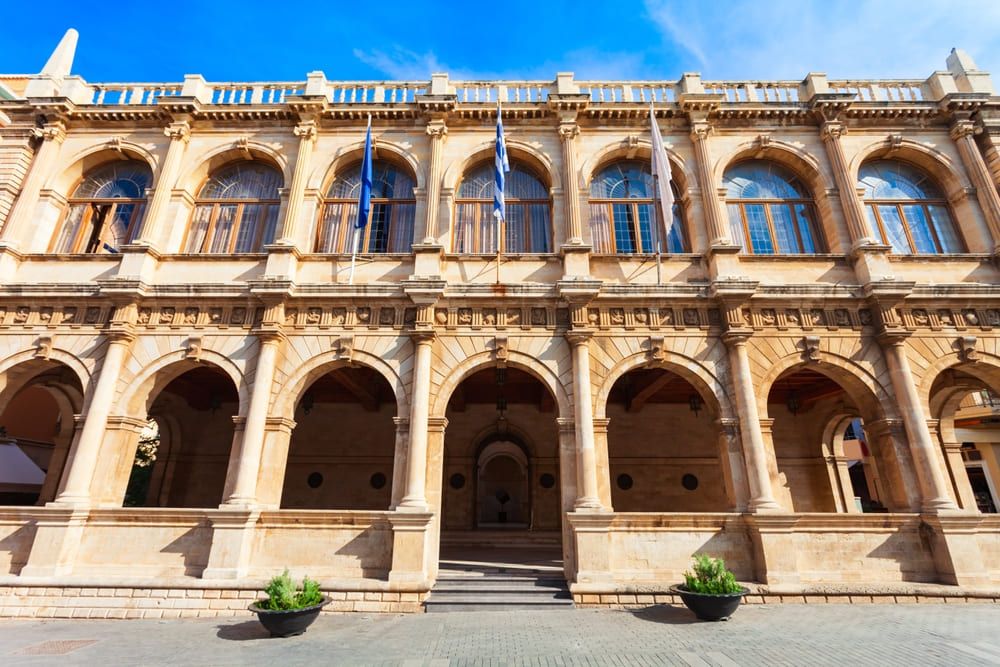
Shutterstock
Right in front of you stands the Venetian Loggia of Heraklion, one of the most elegant buildings inherited from the Venetian era. Located on what is now 25th of August Street, just a short walk from the Morosini Fountain and the central square, it already occupied a strategic position at the heart of public life in Candia. In the Venetian world, a loggia was far more than a simple administrative building. It was an exclusive meeting place for the elite, where political, commercial, and economic matters were discussed. You can think of it as both an official institution and a social club — a place where the ruling class gathered to make decisions while also displaying their status and influence. The building you see today dates from the early 17th century, around 1628, during the administration of Francesco Morosini, one of the leading Venetian figures in Crete at the time. Architecturally, the Loggia is a beautiful example of Palladian Renaissance design, heavily inspired by classical antiquity. Take a moment to notice the details: on the ground floor, sturdy and restrained Doric columns; above them, more refined Ionic columns with decorative touches. The contrast creates the balanced elegance so characteristic of Venetian architecture from this period. Originally, the building was also adorned with sculptures and Venetian symbols, including the Lion of Saint Mark, a reminder of Venice’s authority over the city. After the Ottoman conquest, however, the Loggia lost its prestigious role. It was reused for administrative purposes and, like many monuments in Heraklion, gradually fell into decline, undergoing alterations, damage, and even partial demolitions in the early 20th century. A major restoration effort finally began in the second half of the century, carried out with such care that the project received the Europa Nostra award in 1987, recognising exceptional achievements in heritage preservation. Today, the Loggia has regained a role surprisingly close to its original purpose: it now serves as Heraklion’s Town Hall. The upper floor is still used for official meetings and ceremonies, and if you’d like, you can step inside to discover its peaceful shaded courtyard.
Aucun avis pour le moment