





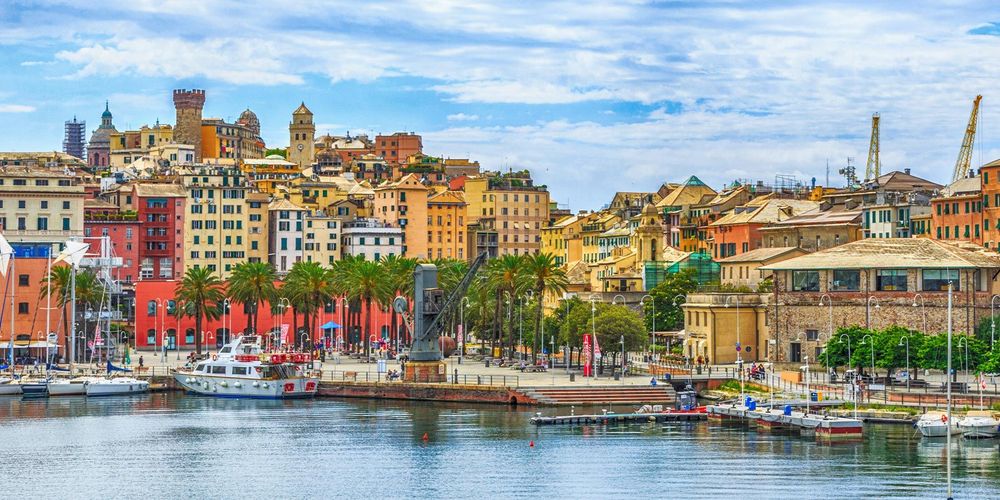
Walk
La Superba of Italy
Genoa, Italy
Walk
La Superba of Italy
Genoa, Italy
4.6 km
Distance
1h50
Durée
22
Audios
Loop
Parcours

Let’s take a quick break to tell you about some other points of interest that couldn’t be included in the itinerary. To the west of the historic centre, you can take a detour through the Principe and Prè districts. Just a heads-up, this part of the city isn’t the most polished or welcoming, but don’t let that put you off!
Here, you’ll discover three architectural gems, Villa del Principe, Palazzo Reale, and the University of Genoa. Villa del Principe was built in the early 16th century as Andrea Doria’s private residence, the legendary Genoese admiral and military commander. Beyond its grand Renaissance architecture and lavish interiors, the villa is surrounded by magnificent Italian gardens.
These gardens once stretched all the way to the sea, offering a floral welcome to Doria, his returning warships, and his distinguished guests arriving by private dock. Still owned by the Doria family today, the villa is now a museum. Then there’s Palazzo Reale, built in the 17th century for the powerful Balbi family, it later became an official residence of the House of Savoy, the future kings of Italy.
Today, it houses a museum of Baroque and Rococo art. Lastly, you’ll see the University of Genoa, housed in a neoclassical palace since 1775. Before that, the building served as a Jesuit college.
Thanks to their beauty and historical value, both Palazzo Reale and the university were added to UNESCO’s list of Genoa’s 42 Palazzi dei Rolli in 2006. You could also check out the old Darsena district, where you’ll find the largest maritime museum in the Mediterranean, the Galata, also known as the Sea Museum. The exhibits are laid out in chronological order, guiding visitors through Genoa’s maritime history, from its origins to the present day.
It includes the old arsenal, the dockyard armoury, Christopher Columbus’ personal items, a reconstructed shipyard, and stories of Italian emigration to the Americas in the early 20th century. There’s far too much to list, just know it’s worth a visit. After wandering the maze of the old town’s caruggi, where getting lost is half the fun, make your way to Piazza della Vittoria.
Even with the traffic, the view is worth the stroll. You’ll see the Arco dei Caduti, dedicated to Genoese fallen in World War I, and the floral arrangement of the Scalinata delle Caravelle, depicting three of Columbus’s ships. Much further east, we recommend a stroll along Corso Italia.
It’s the go-to Sunday walk for locals. Stretching a little over 2 kilometres, the seafront path is flanked by the sea on one side and elegant landmarks on the other, such as the church of Santi Pietro e Bernardo and Fort San Giuliano. This beautiful walk leads to Boccadasse, a charming old fishing village, full of brightly coloured houses, fishing boats, and waterfront restaurants serving regional dishes.
If you want to explore even more, consider heading further along the coast to Nervi, Camogli, Santa Margherita, or Portofino. All are within an hour’s drive from Genoa and promise a string of romantic, colourful little towns clinging to the cliffs of the Riviera di Levante. That same coastline will eventually lead you further south to the unmissable Cinque Terre.
If any of these places caught your interest, check out the Genoa travel tips section on our website for more info.
Aucun avis pour le moment
