






Walk
See Naples and Die
Naples, Italy
Walk
See Naples and Die
Naples, Italy
3.8 km
Distance
1h30
Durée
19
Audios
Loop
Parcours
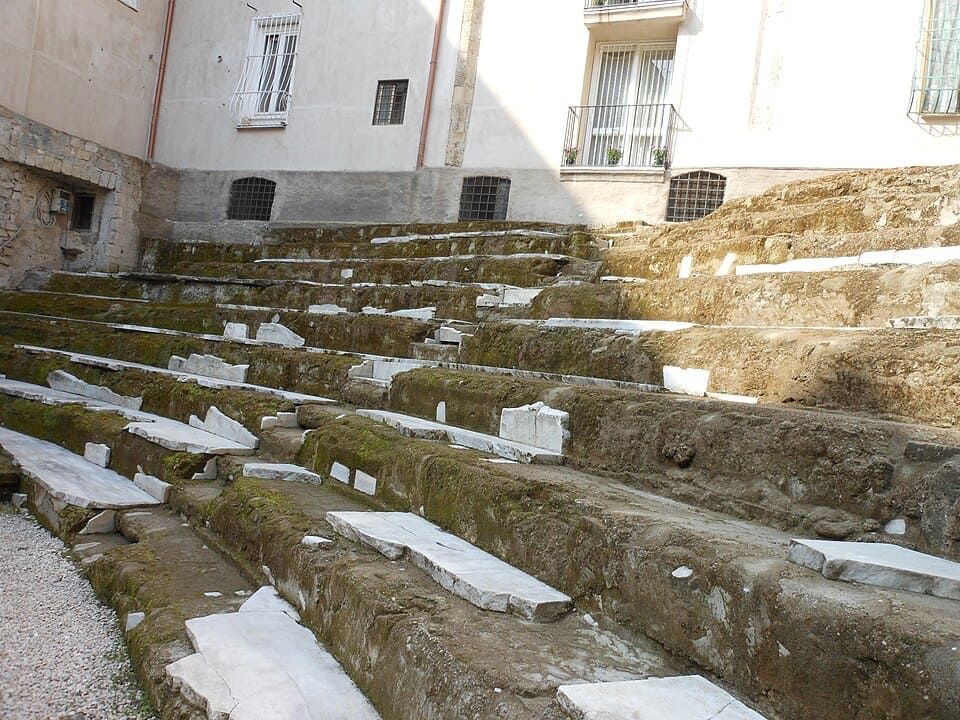
©CityClass CC BY-SA 3.0. <https://creativecommons.org/licenses/by-sa/3.0/deed.fr>via Wikipedia Commons
The Naples audio-guided tour points out to you the unusual curve of Via San Paolo, compared to the ancient grid of the city. It is explained by the presence, on either side, of ancient theatres now swallowed up in the modern urban fabric.
Invisible at first glance, these theatres are nonetheless there, behind the facades of the buildings. On the left stood a large open theatre, able to hold up to five thousand spectators; on the right, an odeon, a smaller covered theatre, probably intended for musical and poetic performances. It is thought that they were built on Greek remains linked to the political and cultural life of Neapolis.
Little remains of the odeon, but remains of the great Roman theatre, of the Augustan era, survive and are revealed during guided tours, sometimes even in the cellars and basements of neighbouring homes. It was here, it is said, that the emperor Nero performed. These swallowed-up theatres bear witness to the richness of ancient Naples, beneath today's city.
The ancient theatres are around Via San Paolo, in the historic centre of Naples, largely integrated into the modern fabric. Their discovery is mainly on guided tours, whose hours and conditions vary; it is best to check in advance. The curve of the street can be seen freely from the outside.
Because it follows the outline of the ancient theatres swallowed up beneath the buildings, breaking with the regular grid of the city.
Remains of the great Roman theatre survive, sometimes in the cellars of neighbouring homes, and are discovered on guided tours.
Aucun avis pour le moment
