
Créé par Emilie, le 17 nov. 2026
Votre guide Ryo
Naples, Italy
See Naples and Die
Parcours audioguidé pour visiter Naples en 1 jour
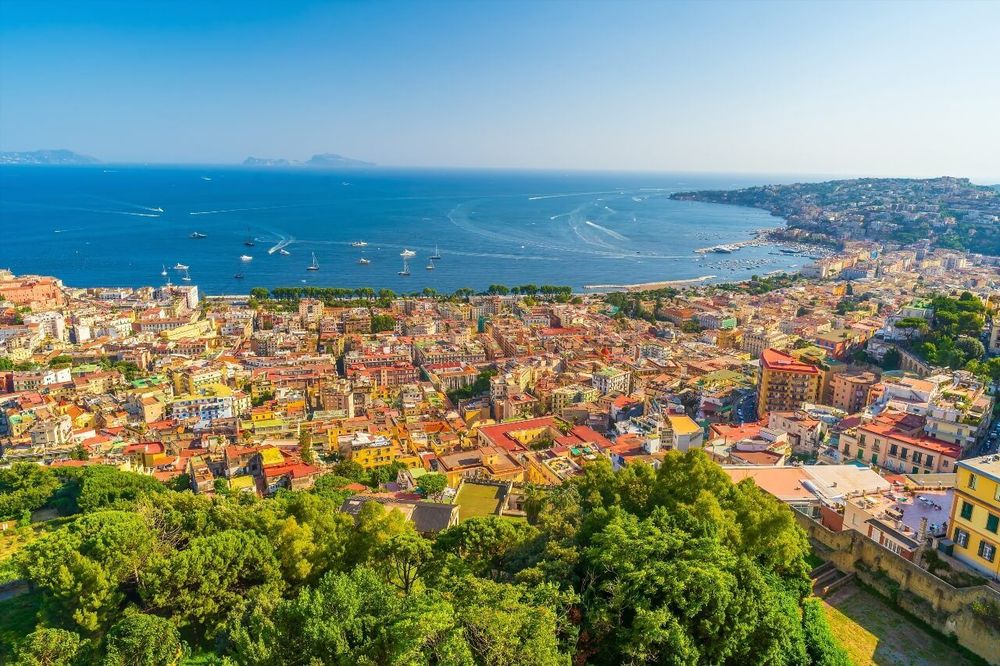
Facing Mount Vesuvius, Naples reveals an intense, captivating city shaped by more than two millennia of history and cultural influences. Its UNESCO-listed historic center unfolds as a maze of lively streets, where heritage, long-standing traditions, and everyday local energy come together. As you make your way through it, you’ll encounter an atmosphere that feels raw and deeply authentic, firmly rooted in the spirit of Italy.
Quand partir à Naples ?
Jan.
12°
9
Feb.
12°
8
March
14°
9
April
17°
9
May
21°
9
June
25°
6
July
28°
4
Aug.
28°
4
Sept.
25°
6
Oct.
20°
9
Nov.
15°
10
Dec.
13°
9
Naples has a Mediterranean climate with hot, dry summers and mild, rainy winters. In summer, the sea breeze helps keep things cooler. July and August are the hottest months, with average highs around 32°C and lows around 22°C. November and December tend to be the rainiest. The best time to visit Naples is between April and October.
Départ conseillé
No need to worry about where to begin! Our tours are designed as a loop, so you can jump in wherever you are. The navigation system and audio-guide will automatically adjust to your location. However, if you happen to be nearby, we do have a preferred starting point: : Piazza Dante / Métro Dante
Parking à proximité
Parcheggio Napoli Centrale / Piazza Garibaldi n°137
If you’ve decided to rent or drive a car in Naples to explore the area (good choice!), you’ll need to think about parking. While Naples’ chaotic vibe is part of its charm, it’s a different story behind the wheel. Street parking, whether free or paid, isn’t really recommended—unless you’re a zen master, expert driver, and totally relaxed about your car’s fate. The best option is to use a private indoor car park and pay for peace of mind. And if you want to avoid driving in the city center altogether, go for the ANM park-and-ride lots outside the core, connected to public transport.
À savoir
We haven’t listed any public restrooms on this tour, but stopping at a café is all part of the Naples experience. Just use the toilets in bars, restaurants, or museums along the way.
Découvrez 19 lieux d'intérêt pour visiter Naples





What to see in Naples on your 1h30 tour?
This 3.8 km loop takes about an hour and a half and links 18 sights. From Piazza Dante it crosses the baroque heart of the historic centre, past churches, palaces and the famous nativity-scene street, before dipping into ancient underground Naples and skirting the Duomo on the way to Piazza Bellini. With the Ryo app in your ears, every church, statue and legend tells 2,500 years of Neapolitan history, at your own pace.
Information checked in October 2026 and subject to change.
1 - Piazza Dante

This square started life as a market, built outside the walls as the city expanded toward its new seat of power. In 1757, Charles of Bourbon had a semi-circular portico erected, decorated with 26 statues glorifying his own virtues. An equestrian statue was meant to stand at the centre, but the Parthenopean Republic ruled otherwise: an arch of liberty, then Napoleon, stood there before Dante finally took the spot for good — fitting, for the man who wrote his Divine Comedy in Tuscan rather than Latin.
Free entry
2 - Gesù Nuovo Church
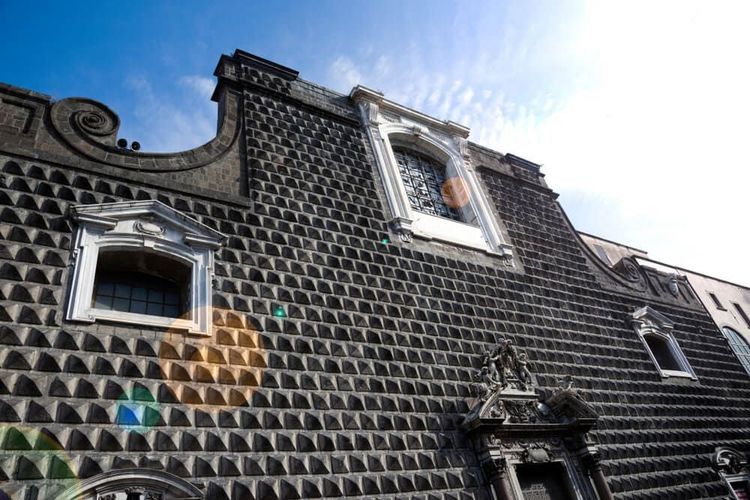
This 1470 palace, built for Prince Sanseverino, became a church when the Jesuits acquired it in 1584, after an heir's estate was confiscated following his exile. Only its pyramid-bossed façade survived, a unique case in Naples: seven symbols are carved into it, long mistaken for stonemasons' marks before being identified as Aramaic letters. Inside, polychrome marble walls display centuries of accumulated artworks. On the square outside, admire the Spire of the Immaculate Conception, 30 metres tall.
Free entry
3 - Santa Chiara Basilica
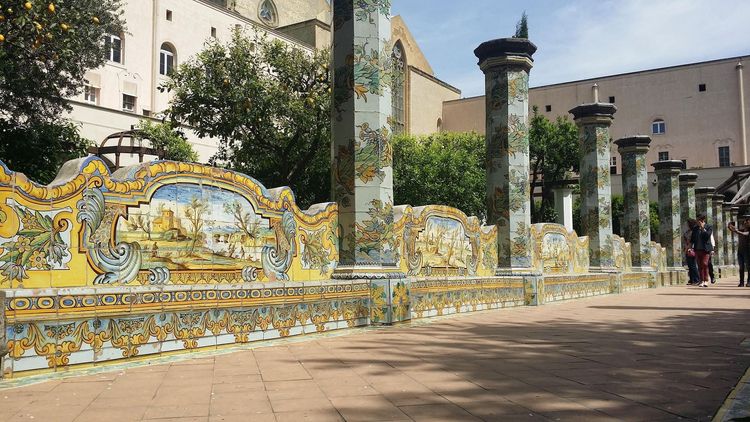
Behind this Gothic façade, the largest basilica in Naples, lies the pantheon built for the House of Anjou, its tombs carved by Tuscan masters. Bombed in 1943, it was later restored to its original look. But the real gem hides at the back: the Cloister of the Poor Clares, lined with 72 columns and painted ceramic benches, where a playful nun can be spotted stroking a cat among biblical scenes. The colours of sky, lemon and wisteria give the courtyard the feel of a sweetened Garden of Eden.
Paid entry (about €7)
4 - Piazza San Domenico Maggiore

This square marks the old edge of the Greek city walls and takes its name from the neighbouring church, entered, curiously, through its apse rather than its main façade. Headquarters of the Dominicans and a place of worship for the Aragonese nobility, it even welcomed Saint Thomas Aquinas. Its sacristy once held the hearts of several kings in silver urns, which vanished in the early 19th century, along with masterpieces now scattered between Capodimonte and the Prado. At its centre, an obelisk thanks Saint Dominic for ending a plague outbreak.
Free entry
5 - Sansevero Chapel
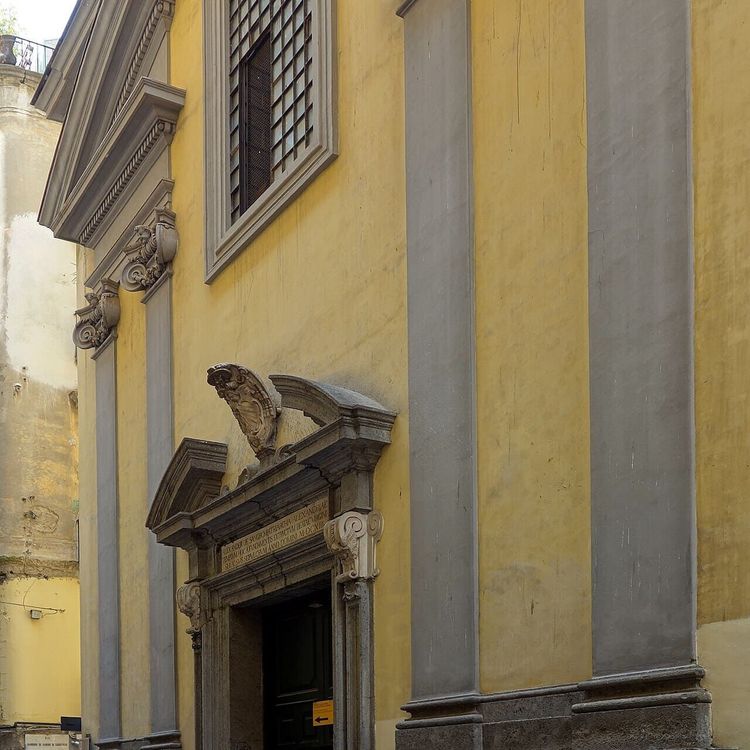
This unassuming chapel holds some thirty marble sculptures. Two stand above the rest, draped in stone cloth so fine it looks real: a veiled female figure embodying modesty, and a Christ lying beneath a transparent shroud. Its original sculptor, Corradini, died leaving only a clay sketch; Giuseppe Sanmartino finished it, producing one of the world's most celebrated works. Legend has it that the patron, a Freemason and alchemist, passed on to the artist a secret for turning real fabric into stone — a claim later disproved by letters and analysis.
Paid entry (about €12)
6 - Nile God Statue
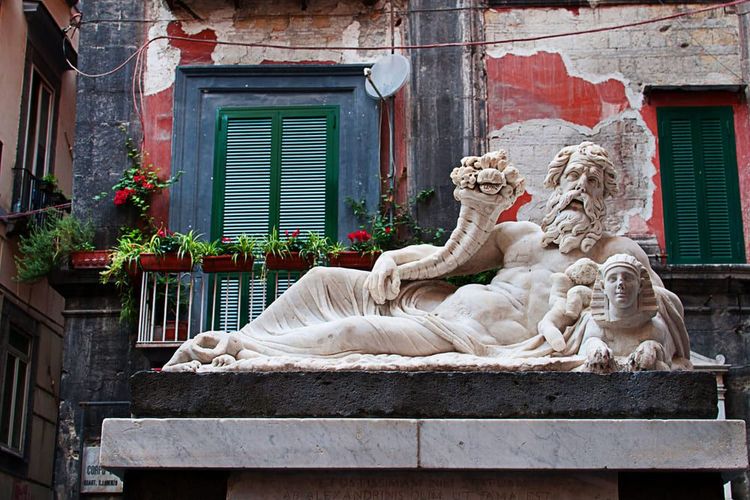
This Roman statue, from the 2nd–3rd centuries, is said to have been erected by an Egyptian community from Alexandria living in Naples, honouring the Nile as a fertility god. Left headless from the 15th century, it was long mistaken for a female allegory of the nurturing city, until a sculptor added, in 1657, a male head, a crocodile at its feet and a sphinx under its arm. Partly stolen in the 1950s, it regained its sphinx's head, traced to Austria in 2013, and its full form in 2015.
Free entry
7 - Palazzo Diomede Carafa
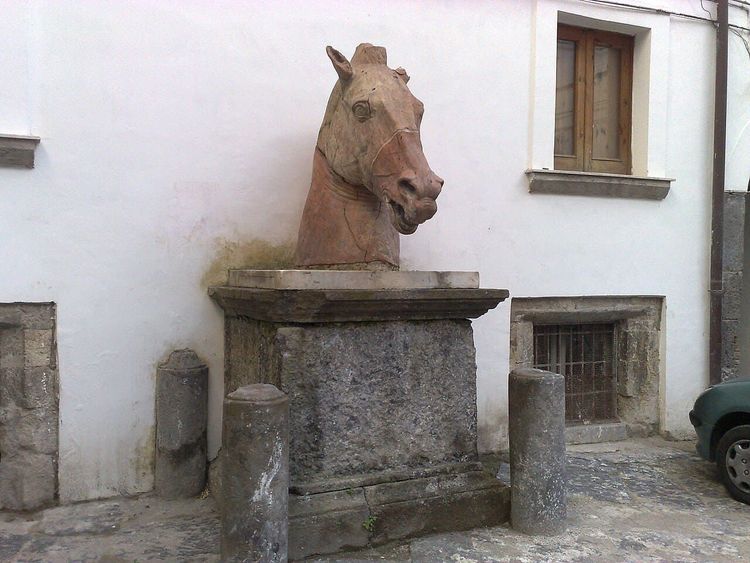
This Renaissance palace, a cardinal's home before becoming a museum in the 19th century, hides a horse's head three times life-size in its courtyard. Legend has it that it came from a bronze statue revered for magical powers, melted down in 1322 when the Angevins arrived to cast the Duomo's bells. More likely: an unfinished piece by Donatello, meant for an arch at Castel Nuovo and abandoned on his death, later ending up with the Carafa family, a leading house in the city.
Free entry
8 - San Gregorio Armeno Street

This street takes its name from the neighbouring church, built around 930, but it's nicknamed Christmas Alley: its artisan workshops carry on a craft born here as early as 1205, on an old Roman temple where tiny terracotta figures were once left as offerings. Its golden age, in the 18th century, saw the nobility compete to create the most elaborate scenes. The church itself, one of the city's finest Baroque ensembles, hides a coffered ceiling and a cloister planted with lemon trees.
Free entry
9 - San Lorenzo Maggiore Basilica

This basilica, one of the oldest in Naples, rises over the former Greek agora and later Roman forum. Its current façade, from the 13th century, hides a Gothic interior ranked among the finest in southern Italy, despite a later Baroque addition. But the real marvel lies underground: a Greco-Roman archaeological site uncovered over more than 25 years of excavation, revealing 2,500 years of history on the remains of the Neapolis forum, on a ticketed visit that continues into the adjoining museum.
Paid entry
10 - Underground Naples

At the end of the street, this basilica rests on a Roman sanctuary devoted to twin deities, but the nearby entrance to underground Naples steals the show: 80 kilometres of tunnels and nearly 5,000 chambers, carved as early as the 5th century BC by the Greeks to quarry the tuff that fortified Neapolis. The Romans later used them as cisterns, until an 1884 cholera outbreak turned them into a dump; the war finally gave them new purpose, sheltering 200,000 people.
Paid entry (about €18) · Allow 1 h
11 - Cathedral of Santa Maria Assunta (Il Duomo)

Among Naples' 500 churches, none rivals this one. It stands on ground sacred since antiquity, where a first basilica was built in the 4th century over the foundations of a Greek temple. Later, an Angevin king had the current Gothic cathedral built here, absorbing parts of the older Santa Restituta basilica and its baptistery, the oldest still open to visitors in Europe. Above all, it holds the relics of the city's patron saint: three times a year, his dried blood liquefies before worshippers.
Free entry
12 - Piazza Sisto Riario Sforza
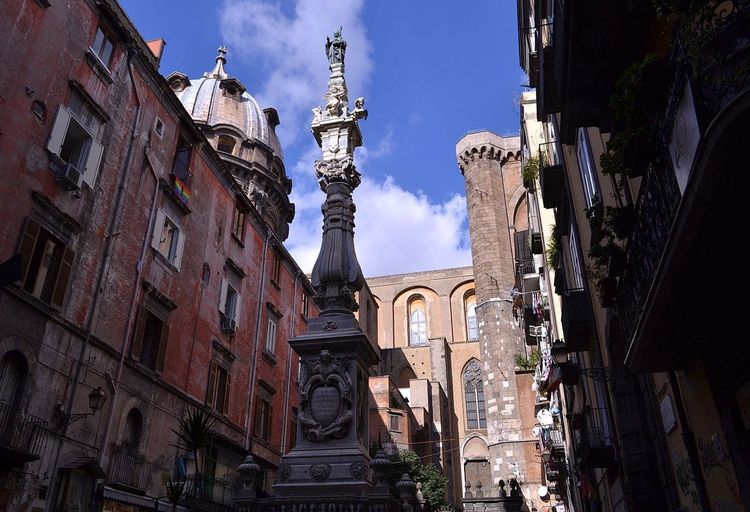
This small square holds the oldest obelisk in Naples, commissioned in 1636 after the Vesuvius eruption to safeguard the city's heritage. Disagreements were so numerous that it wasn't finished until 1660, topped with a statue of Saint Januarius. Legend has it that the column replaced an ancient giant horse statue with supernatural powers, torn down once Catholicism put an end to pagan rites — the horse's head can be seen, as it happens, in the courtyard of Palazzo Diomede Carafa.
Free entry
13 - Capuano Castle
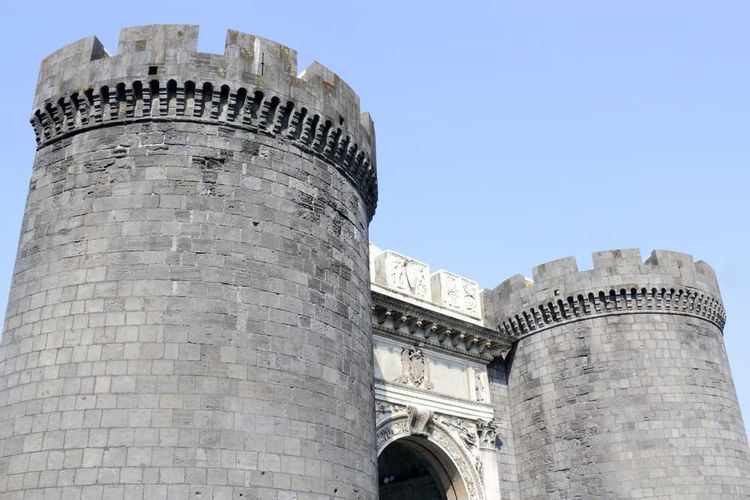
This 12th-century castle, built by William I the Bad, son of Roger II of Sicily, takes its name from the road to Capua it once guarded. The street leading there follows the ancient route of the decumanus maximus, a main axis of Greek and Roman Naples. In the 16th century, the viceroy moved every court here for five centuries, turning its cellars into a prison. Visitors can see, free, the Hall of Busts, scene of the murder of minister Sergianni Caracciolo, lover of a queen famed for her affairs.
Free entry
14 - Ancient Theaters
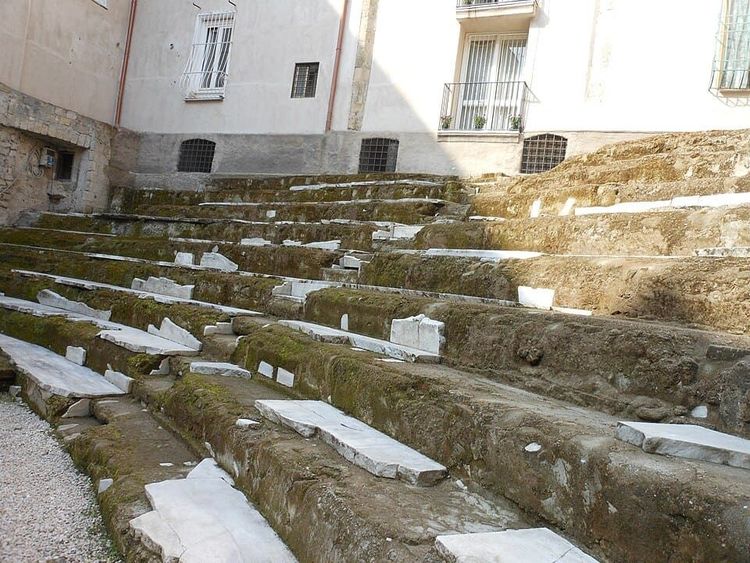
Notice the unusual curve of this street, squeezed between two ancient theatres now swallowed by the modern city. To the left stood a large open-air theatre, one of the biggest in the region; to the right, a smaller covered odeon, reserved for music and poetry. Built over Greek remains tied to political and cultural life, little of them survives today — except for the theatre that the underground Naples tour still lets you explore, right beneath your feet.
Free entry
15 - The Cult of the Souls of Purgatory
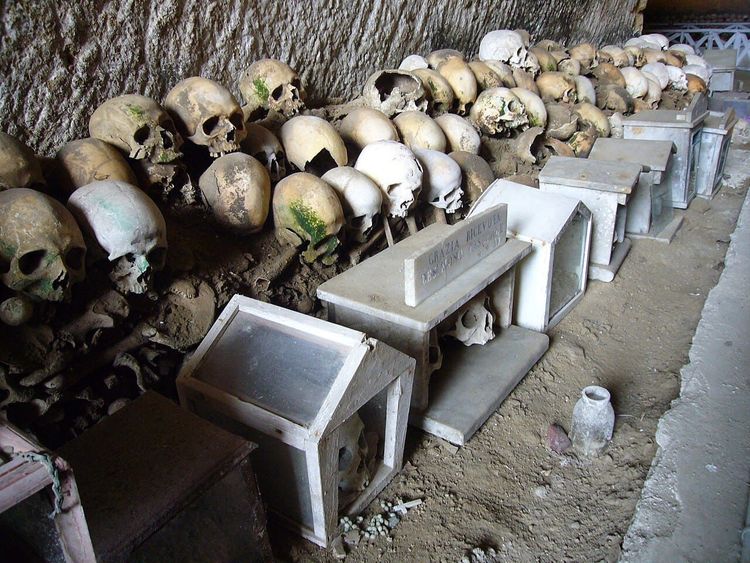
This small church, dedicated to the souls of purgatory, emerged in the 17th century, when the Vesuvius eruption and a terrible plague decimated the population and overwhelmed the cemeteries. The anonymous dead, left without graves, gave rise to a cult unique to Naples: the anime pezzentelle, begging souls whose skulls are venerated. Women adopt an abandoned skull, dedicate an altar to it and pray for its salvation, in exchange for favours. The most famous, Lucia's, who died right after her wedding, is crowned like a bride.
Paid entry (about €8) · Allow 45 min
16 - La Pietrasanta
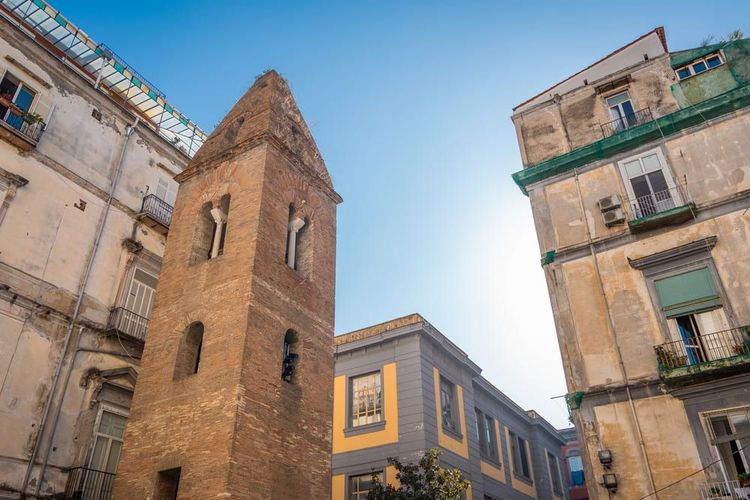
This church, whose history goes back to the consecration of an earlier basilica in 535, hides one of Italy's oldest bell towers: a Romanesque campanile built of red laterite stone. Turned into a fire station in 1803, then damaged by the 1943 bombings, it only regained its current look in 1976. Today it hosts exhibitions and concerts. Next door, the Water Museum takes you 35 metres underground, into cavities first carved by the Greeks and later turned into a reservoir by the Romans.
Free entry
17 - Piazza Bellini
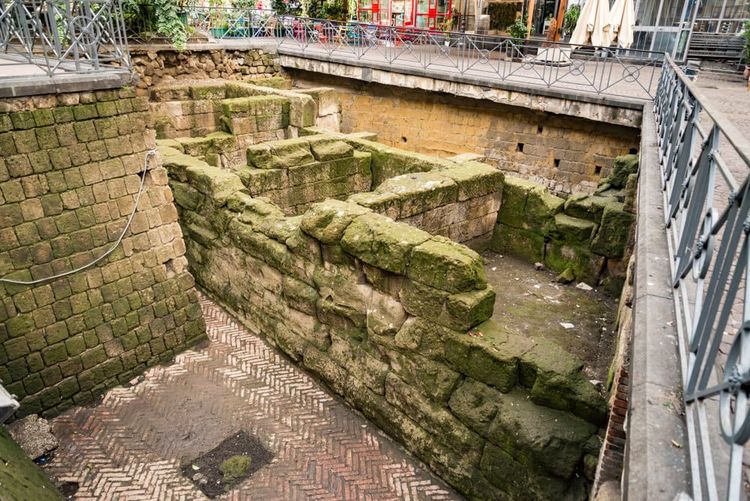
Colourful façades, café terraces and Greco-Roman ruins: this square sums up Naples' simple pleasures. It already existed in the 17th century, ringed by grand mansions and a monastery that today houses a university library. At its centre stands a statue of composer Vincenzo Bellini, next to remains of the old Greek wall. Neapolis, "new city", succeeded Paleopolis, the older settlement that grew from Parthenope by the bay; its name, shortened over time, eventually became simply Napoli.
Free entry
18 - Port'Alba

This gate, opened in 1625 through the Angevin walls by the Duke of Alba, still bears the coat of arms of Philip III. Naples loves its legends, and this one is grim: a young woman, Maria, driven mad with grief after lightning turned her fiancé to stone, was accused of witchcraft for her whitened hair and wrinkled skin. Locked in a cage beneath the gate, she starved to death cursing the city; her cries, they say, still escape at night through a hole in the wall.
Free entry
What to do in Naples in 2 or 3 days?
This 3.8 km loop takes about 1 h 30 and links 18 sights, from Piazza Dante into the baroque heart of the historic centre. With 2 or 3 days in Naples, the city unfolds in layers, between Gothic lanes, the Vomero hill and the bay itself.
The next day, take the funicular up to Vomero: 4 minutes get you up 200 metres to Castel Sant'Elmo and its 360-degree view over the bay, then on to the Certosa di San Martino and its monumental nativity scenes. Allow 2 hours at the National Archaeological Museum for treasures from Pompeii, before heading back underground at Napoli Sotterranea.
For a third day, the classic Naples dilemma is whether to add Pompeii, Capri, or both, to the plan: our complete first-time guide to Naples helps you decide, depending on how much time you have.
Which neighbourhoods does the tour cross?
On one short loop, the route crosses three faces of the historic centre, from Spanish baroque to buried antiquity.
From Piazza Dante, it drops into the university quarter around San Domenico Maggiore, where the baroque front of the Gesù Nuovo Church, the tiled cloister of Santa Chiara Basilica and the Sansevero Chapel follow one another, before climbing back up San Gregorio Armeno street, the nativity-scene lane (stops 1 to 8).
Via dei Tribunali then takes over: the San Lorenzo Maggiore Basilica and its buried ancient forum, the Greco-Roman tunnels nearby, then the Duomo, Capuano Castle and the Church of the Souls of Purgatory (stops 9 to 16).
The loop closes on Piazza Bellini, its terraces set over the ruins of ancient Greek Neapolis, then Port'Alba and its bookshops, leading back towards the starting point (stops 17 and 18).
How much does it cost to visit Naples?
Thirteen of the route's 18 stops are free to see, and 5 call for a ticket:
- Santa Chiara Basilica, whose church is free but whose tiled cloister costs €7;
- the Sansevero Chapel and its Veiled Christ, for €12;
- the underground forum beneath San Lorenzo Maggiore Basilica, on a paid ticket;
- the tunnels of Napoli Sotterranea, for €18, about 1 hour with a guide;
- the Church of the Souls of Purgatory and its skull-filled crypt, for €8, about 45 minutes.
The Napoli Artecard, at €27 for 3 days, covers 2 to 5 cultural sites and, on some versions, public transport.
Information checked in October 2026 and subject to change.
Where to stop for a bite along the tour?
The route winds through the whole historic centre, where street-food stalls and pizzerias multiply on every corner.
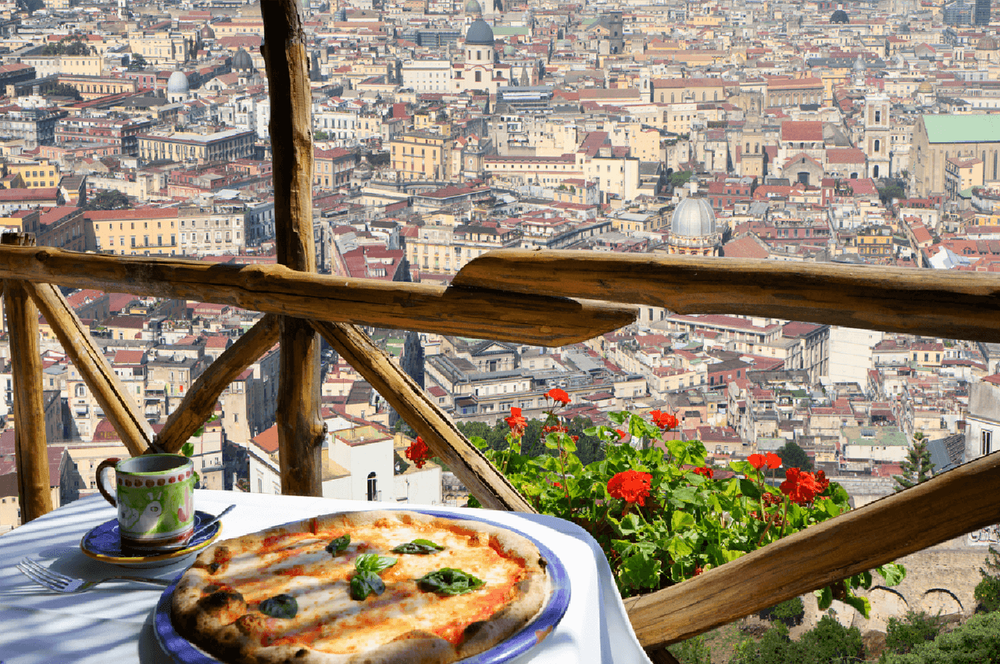
Try the cuoppo, a paper cone of fried fish or vegetables sold straight on the street, then a proper pizza margherita, tomato, mozzarella and basil on a thin base. For something sweet, sfogliatella is best eaten still warm, and babà is sometimes served soaked in limoncello. Other classics are gathered in our pick of Naples culinary specialities.
What to do in Naples with children?
Two stops on the route appeal especially to younger visitors, without any detour from the walk.
San Gregorio Armeno street lines up dozens of nativity-scene workshops, between traditional cribs and more playful figures, a sight that holds children's attention for a good while. A little further on, the Greco-Roman tunnels of underground Naples plunge into the dark and the adventure, an experience that usually appeals to 6 to 12-year-olds.
What should you know before visiting Naples?
The route doesn't mark any public restroom along the way, but that's rarely a problem in Naples.
Stopping at a café terrace is part of the Naples experience, so use the toilets in bars, restaurants or any museum you visit along the way.
Arriving by car, it's best to avoid street parking, free or paid, and to choose a private covered car park or one of the ANM park-and-ride lots outside the historic core, connected to public transport.
As for the season, Naples is best visited between April and October: July and August often climb to 32°C, while November and December are the rainiest months.
Le plein d'inspirations
Explorez le monde en totale liberté, à pied au cœur des villes ou au fil des routes. Nos guides audios transforment chaque destination en une découverte culturelle immersive et unique.










FAQ for visiting Naples
When is the best time to visit Naples?
The best time to visit Naples runs from April to October, when the Mediterranean climate offers ideal conditions for exploring the city. Summers are hot and dry, with maximum temperatures generally reaching around 32°C in July and August, though the sea breeze brings welcome relief. Spring and autumn remain especially pleasant, with mild temperatures and fewer tourists. Winters are fairly mild but rainy, particularly in November and December. If you're looking for the best balance between agreeable weather and moderate crowds, opt for the months of May, June and September to make the most of your Neapolitan stay.
How many days do you need to visit Naples?
To take in the essentials of Naples, ideally plan for three to four days. This will give you time to explore the UNESCO-listed historic centre, wander the lively alleyways, visit the main sites and museums, and soak up the city's unique atmosphere. With two days, you'll be able to see the must-sees, but at a brisk pace. If you have five days or more, you'll have the luxury of adding excursions to Pompeii, Vesuvius or the Amalfi Coast. The Ryo audioguide helps you make the most of your time with narrated routes that lead you through the emblematic neighbourhoods, letting you discover Naples at your own pace while missing none of its hidden treasures.
Which neighbourhood should you stay in when visiting Naples?
The choice of neighbourhood will depend on your priorities. The historic centre remains the most sought-after for its authenticity and its proximity to the main sites. There you'll be at the heart of Neapolitan bustle, among Baroque churches and traditional trattorias. Chiaia offers a more chic and residential atmosphere, perfect if you're after peace and elegance, with its refined boutiques and trendy restaurants. The Spanish Quarter appeals with its working-class character and more affordable rents, while Vomero, perched on the heights, offers tranquillity and panoramic views. For a seaside stay, Posillipo and Mergellina combine sea access with proximity to the centre. Each neighbourhood has its own charm and reflects a different facet of Naples.
How do you get around Naples?
Naples has a varied public transport network including metro, buses, funiculars and trams. The metro remains the quickest way to cross the city, notably Line 1, which serves the main tourist neighbourhoods and some of whose stations are genuine works of art. The funiculars easily take you up to the hilltop neighbourhoods such as Vomero. Buses cover the whole city but can be crowded and their frequency varies. For short distances, walking remains ideal for soaking up the Neapolitan atmosphere. Taxis are plentiful, but make sure the meter is running. As traffic is often chaotic, avoid renting a car to get around in the city. A single ticket lets you use all public transport for a set period.
How do you get to Naples from the airport?
Naples-Capodichino Airport lies about seven kilometres from the city centre, offering several options for reaching your accommodation. The Alibus shuttle is the most economical and convenient means, linking the airport to the central station and the port via several strategic stops. The journey usually takes between twenty and thirty minutes depending on traffic. Official taxis offer fixed fares to different areas of the city, but always check the price before getting in. Some hotels provide private shuttle services, to be booked in advance. Ride-hailing services are also available through the usual apps. If you're travelling light and in no hurry, regular city buses are an even cheaper alternative, though less direct and comfortable.
What is there to do in Naples with the family?
Naples offers plenty of activities suited to families with children. The National Archaeological Museum fascinates young and old alike with its treasures from Pompeii and Herculaneum, while the Città della Scienza offers exciting interactive exhibits. Castles such as the Castel dell'Ovo or the Castel Nuovo spark the imagination of young adventurers. A funicular ride up to Vomero always delights children, with the added bonus of a possible visit to the Castel Sant'Elmo and its spectacular views. The Villa Comunale park offers green spaces and playgrounds facing the sea. Families also enjoy pizza-making workshops, a fun and delicious activity. The Ryo audioguide offers routes tailored to capture children's attention with anecdotes and stories that make discovering Naples fun for the whole family.
Can you visit Pompeii and Vesuvius in the same day?
Technically possible, combining Pompeii and Vesuvius in a single day is ambitious and risks leaving you frustrated. Pompeii deserves at least four hours to explore its fascinating ruins, and climbing Vesuvius takes about three hours round trip from the car park. Add the travel time between the sites and you end up with a marathon day. If you're absolutely set on seeing both, leave very early, start with Vesuvius to enjoy clear views in the morning, then devote the afternoon to Pompeii. However, we'd rather recommend dedicating a full day to each site to truly appreciate them. Both experiences are unique and deserve the time to immerse yourself without rushing. Your visit will only be all the more rewarding and memorable.
Is Naples safe for tourists?
Naples is generally safe for tourists who exercise common sense and normal vigilance. As in any big city, some precautions are in order: keep your valuables out of sight, watch out for pickpockets on crowded transport and at tourist sites, and avoid conspicuously flaunting wealth or jewellery. The central tourist neighbourhoods are busy and safe both by day and in the evening. Some outlying neighbourhoods call for greater caution, especially at night. Neapolitans are generally welcoming and helpful towards visitors. Scams remain rare if you use official services and check prices in advance. The lively atmosphere of the streets can be surprising at first, but it's part of Naples' authentic charm. Stay alert without being paranoid and you'll make the most of your stay.
What should you see in the historic centre of Naples?
The historic centre, listed as World Heritage, is laid out along the long straight streets inherited from the Greek grid, among them the famous Spaccanapoli which slices the old town in a single line. You make your way between hanging laundry, small street shrines and sumptuous churches: the Duomo with the treasure chapel of Saint Januarius, the Gesù Nuovo and its façade of stone spikes, Santa Chiara and its cloister lined with painted majolica, San Lorenzo Maggiore and its Greco-Roman excavations.
A few steps away, the Sansevero Chapel holds the Veiled Christ, a sculpture whose draped marble is astonishing in its virtuosity, and it is well worth descending into underground Naples, that network of tunnels and cisterns carved into the tufa. A little further up, the National Archaeological Museum keeps the treasures unearthed at Pompeii and Herculaneum. The Ryo audio guide offers a dedicated Naples route linking these stops and untangling the city's many layers.
What should you eat in Naples?
Naples is the birthplace of pizza, served here with a soft base and a well-risen rim, baked very fast in a wood-fired oven; the margherita and the marinara remain the two classics, while pizza fritta is eaten standing up, folded into a sheet of paper. The street food does not stop there: cuoppo cones of fried titbits, arancini, taralli and mozzarella di bufala turn up on every corner.
On the sweet side, the flaky sfogliatella with its ricotta cream, the rum-soaked babà and, around Easter, the pastiera made with wheat and orange blossom are all essential stops. A meal ends with a short, strong coffee drunk standing at the counter, often with a glass of water alongside. The working-class quarters of the centre are still the best hunting ground for tasting all of this without ceremony.
Which tours and experiences should you book in Naples, from the underground to the bay?
Naples underground takes you back 2,400 years to Parthenope, with the Greco-Roman aqueduct and the Second World War shelters, while the catacombs preserve frescoes over 2,000 years old. A Neapolitan pizzaiolo teaches you to make pizza in the Galleria Umberto.
In a seven-hour day you can combine the ruins of Pompeii with a hike up Vesuvius. Add the Royal Chapel of the Treasure of San Gennaro, the Vomero district by funicular, a Vesuvius wine tasting, an aperitif cruise on the bay or a guided bike ride.
Find all ten ideas in our top 10 things to do in Naples.
Beyond pizza, which Neapolitan specialities should you discover, from cuoppo to sfogliatella?
On the street, a cuoppo is a paper cone filled with fried fish or vegetables. The Margherita wears the colours of the Italian flag, and Neapolitan ragù, simmered for six hours with beef and pork, coats rigatoni or lasagne made with ricotta and mozzarella.
Taralli are nibbled as an aperitif, and casatiello is served at Easter. Coffee is downed in one at the counter, and the suspended coffee tradition was born here. For dessert, rum babà and ricotta-filled sfogliatella, with a limoncello to finish.
Discover the ten essentials in our guide to Naples' culinary specialities.
Which Naples experiences take you off the beaten track?
Walk Spaccanapoli, the axis inherited from Greek Neapolis, then descend 40 metres underground at Napoli Sotterranea, where it stays 14°C all year. The National Archaeological Museum (MANN) gathers the Farnese Bull, the Alexander Mosaic and the Secret Cabinet: allow at least three hours.
The Veiled Christ in the Sansevero Chapel must be booked weeks ahead. Climb to Castel Sant'Elmo for views over the bay and Vesuvius, then taste a Neapolitan Margherita, born in 1889 and baked in a wood-fired oven for no more than 90 seconds.
Pick your favourites from our lists of 25 things to do in Naples you'll actually remember and 30 fun things to do in Naples.
Is Naples worth visiting for a first trip, and what should you see first?
To plan your first stay, read our complete guide to visiting Naples for the first time.
Vos commentaires, idées et suggestions
Aucun avis pour le moment