






Walk
See Naples and Die
Naples, Italy
Walk
See Naples and Die
Naples, Italy
3.8 km
Distance
1h30
Durée
19
Audios
Loop
Parcours
Shutterstock
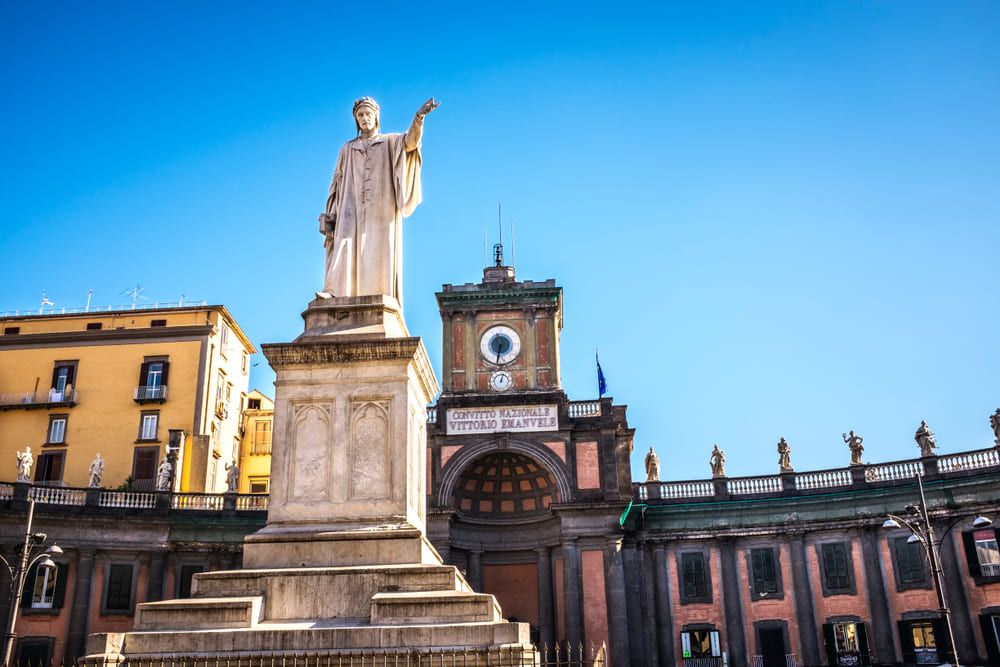
The Naples audio-guided tour brings you to Piazza Dante, one of the most important squares in the city, dedicated to the poet Dante Alighieri. Laid out outside the old walls of the historic centre, it marks the expansion of Naples towards the monumental district in the time of the Spanish viceroys.
The square was first a market, known as Mercatello. In 1757, Charles of Bourbon wished to erect a monument to his glory there: he had the great semicircular portico installed, adorned with twenty-six statues representing as many virtues of the sovereign. The square took its present name in the 19th century, when a statue of Dante Alighieri was placed at its centre, making the place a tribute to the great poet.
The great semicircular portico, its twenty-six statues and the central statue of Dante form a harmonious ensemble, lively day and night. Located on the Via Toledo, one of the city's main arteries, the square is a landmark and a passage towards the historic centre. Nearby opens the Port'Alba, a former gate of the ramparts.
Piazza Dante can be seen freely, in the open air, on the Via Toledo, at the entrance to the historic centre of Naples. It is accessible at any time and served by a metro station of the same name. It is an ideal starting point to explore the lanes of the old town.
It owes its name to the statue of the poet Dante Alighieri placed at its centre in the 19th century; it was previously called Mercatello.
Installed in 1757 by Charles of Bourbon, it is adorned with twenty-six statues depicting the virtues attributed to the sovereign.
Aucun avis pour le moment
