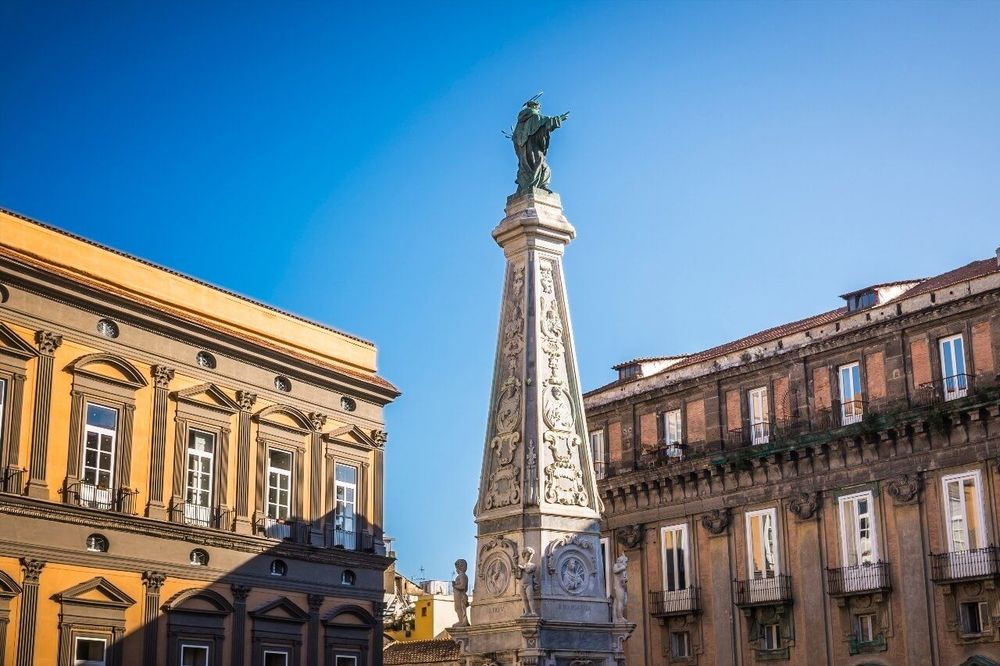
© Shutterstock
 Votre guide Ryo
Visiting Naples for the First Time: The Complete 2026 Guide (Must-Sees, Pompeii and Capri)
Visiting Naples for the first time means accepting a city that won't be tamed by hurrying between two postcard clichés. It has to be earned, understood layer by layer, and it rewards those who embrace its organized chaos rather than fleeing it for Rome or Florence. To guide you through the alleys of Spaccanapoli without your nose glued to your phone at every intersection, the Ryo audio-guided tour of Naples tells the story of the city step by step, in 18 audios and 3.8 km of walking.
You'll be dealing with layers of history stacked over nearly 2,500 years: a Duomo that preserves the blood of a saint said to liquefy three times a year, a chapel where an 18th-century sculptor carved in marble a veil so fine it looks like fabric, galleries dug by the Greeks twenty-four centuries ago beneath your feet, and an active volcano visible from most rooftop terraces. In this guide, you'll find what you need to plan a stay of two days to a week, choose your neighborhood for sleeping, spot real Neapolitan pizza and settle the question that keeps coming up: should you add Pompeii, Capri, or both, to your itinerary?
Understanding Naples Before You Go

Before booking anything, a few basic points of reference help explain why Naples disconcerts as much as it charms.
A City Between Volcano and Sea: Background and History
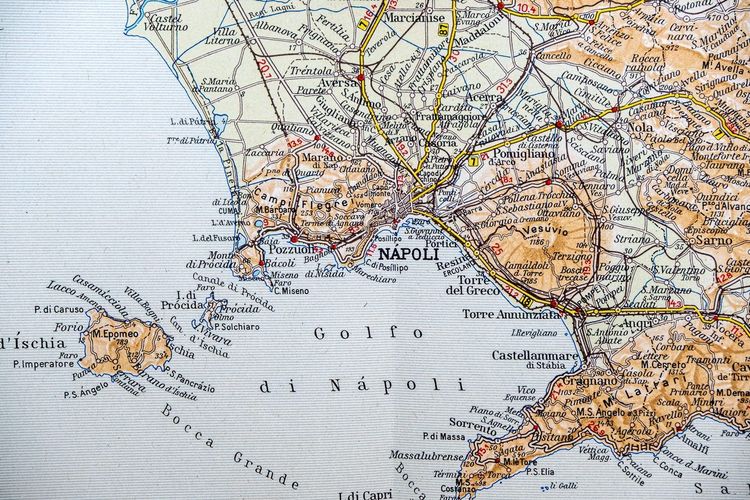
Where is Naples in Italy? On the western side of the Mezzogiorno, a little over 200 km southeast of Rome by road, nestled between the bay that bears its name and Vesuvius which looms over it from the east. The country's third-largest city with around 910,000 inhabitants, it began as a first Greek trading post, Parthenope, founded by settlers from Cumae, then a "new city", Neapolis, built in the 5th century BC. Then came the Romans, the Normans, the Angevins, the Aragonese, the Spanish viceroys and finally the Bourbons.
This succession of powers left a rare architectural patchwork: Greek remains beneath the paving stones, Baroque palaces financed by the Spanish viceroys, more austere façades inherited from the Bourbons. The historic center, a UNESCO World Heritage Site since 1995, still preserves the grid plan of the ancient city, with its three parallel decumani. This density partly explains the city's particular energy: here, the street is as much a place to live as a place to pass through.
Does Naples Have a Bad Reputation? What to Know Before You Go

Naples carries a reputation as a noisy, disorderly, sometimes dangerous city, which still discourages some travelers. The reality is more nuanced: yes, the traffic is chaotic and laundry dries between the buildings above Spaccanapoli, but this energy is precisely what makes the place unique.
Most visitors leave won over by a rawer city, less polished for tourism than its Tuscan or Venetian neighbors. Is Naples worth it for a first trip to southern Italy? Absolutely, if you're willing to step outside the usual standards, keep an eye on your belongings as in any large European city, and let yourself be carried by the local rhythm rather than fighting it.
How Many Days to Plan for a First Visit?

The right length of stay depends mostly on whether you want to add an excursion. Here are the three most common formats.
A Weekend for the Essentials of the Historic Center
Two days are enough to cover the essentials: the Duomo, the Sansevero Chapel, Santa Chiara, Spaccanapoli, a Neapolitan pizza and the climb up to Castel Sant'Elmo for the view. It's a tight but doable format, provided you stay focused on the historic center and give up on excursions. Our article on visiting Naples in 2 days details a condensed itinerary if this format suits you.
3 to 4 Days to Go Deeper, with Capri or Pompeii
With three days, you can add the National Archaeological Museum, the Spanish Quarter and Chiaia without rushing. A classic three-day itinerary generally devotes one day to the historic center, half a day to Vomero and the Spanish Quarter, and a full day to Pompeii or Capri.
Four days allow you to fit in both excursions, provided you leave early in the morning: Pompeii can be visited in half a day from Napoli Garibaldi station, while Capri requires a full day with the boat crossing. To plan the half-day devoted to the city center, keep one simple benchmark in mind: the main Ryo audio-guided tour strings together 18 audio stops for about 1h30 of listening, leaving the afternoon free for something else.
A Week in Campania
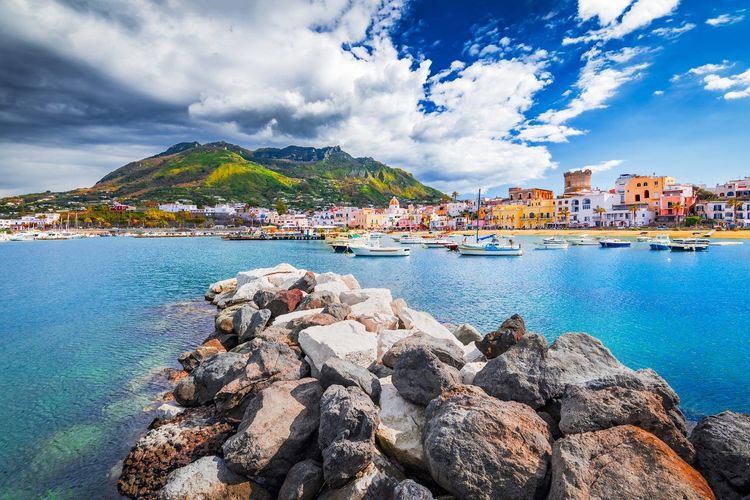
With a full week, Campania unfolds beyond Naples: Pompeii and Vesuvius, Capri, Ischia and its thermal waters, the Phlegraean Fields and their caldera under monitoring, and Paestum further south for lovers of Greek temples. It's the format that lets you truly breathe, with entire days devoted to each site rather than hurried back-and-forths between two trains.
The Historic Center and Spaccanapoli, the Heart of Naples
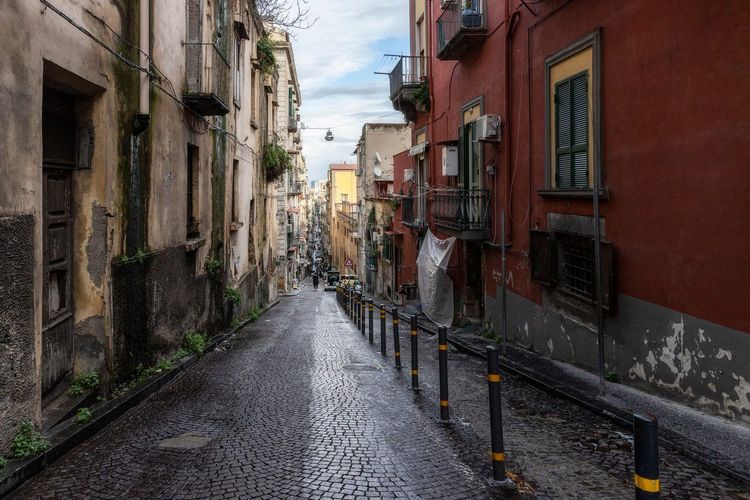
The historic center concentrates most of Naples' heritage around a narrow axis, the former lower decumanus now known as Spaccanapoli, literally "the street that splits Naples" in two.
The Duomo, the Sansevero Chapel and Santa Chiara
The Cathedral of Our Lady of the Assumption, better known as the Duomo di San Gennaro, hosts three times a year (in May, on September 19 and on December 16) a ritual that attracts Neapolitans far more than tourists: the supposed liquefaction of the patron saint's blood, kept in two vials. If the blood stays solid, the city sees it as a bad omen. The crypt and the Treasure Chapel of San Gennaro, which most hurried visitors skim over, nonetheless deserve a lingering visit.
A few minutes' walk away, the Sansevero Chapel houses one of the most photographed sculptures in Italy: the Veiled Christ, carved in 1753 by Giuseppe Sanmartino from a single block of marble, with a shroud so fine it seems wet as it lies over the body. Book your time slot several days in advance: the chapel limits the number of simultaneous visitors and is often full in summer.
Heading back down toward Spaccanapoli, the Basilica and Cloister of Santa Chiara offer an unexpected breath of fresh air: an 18th-century majolica garden covered in ceramics painted with pastoral scenes, completely removed from the bustle of the street. The basilica itself houses the tombs of the Angevin kings, including that of Robert of Anjou behind the high altar.
The Gesù Nuovo Church and the Alleys of Spaccanapoli
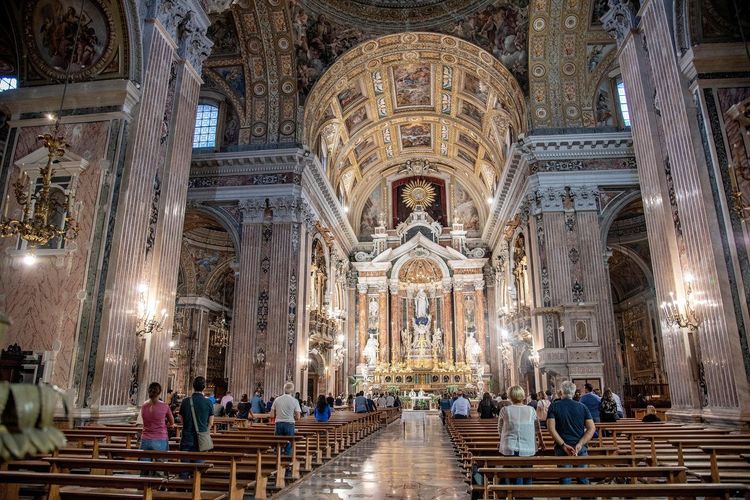
Opposite Santa Chiara, the Gesù Nuovo Church is recognizable from afar by its diamond-point façade, a remnant of an aristocratic palace converted into a church by the Jesuits in the late 16th century. The interior, packed with Baroque frescoes and polychrome marbles, contrasts sharply with the austerity of the exterior.
Continuing east along Spaccanapoli, the artisan nativity scene workshops of Via San Gregorio Armeno give way to street stalls, sfogliatelle vendors and decrepit façades strung with laundry. Walk this axis from west to east in one go: it's the best way to grasp the continuity between the monuments and the neighborhood life that surrounds them.
Piazza del Plebiscito and Underground Naples
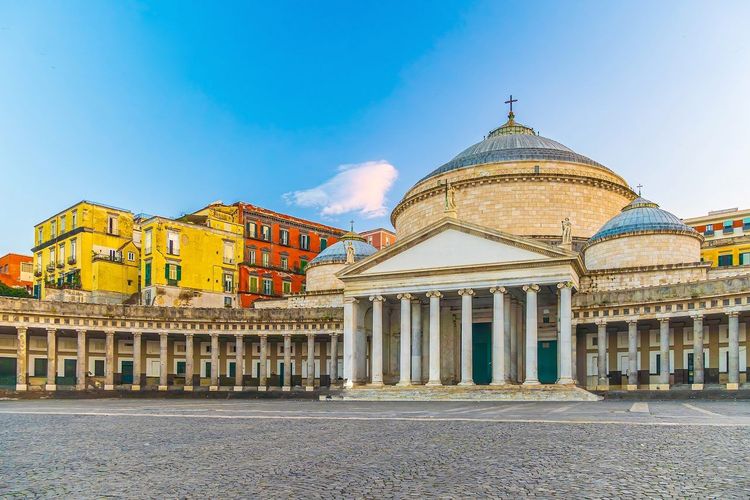
Further southwest, the Piazza del Plebiscito (80132 Napoli, rated 4.7/5 on Google from 91,386 reviews) opens into a large semicircle lined with colonnades, facing the Royal Palace. It is one of the largest squares in Italy, pedestrian-only, often filled with Neapolitans playing ball at the end of the day.
On the other side, the Basilica of San Francesco di Paola, with its dome and peristyle inspired by the Pantheon in Rome, closes the perspective. To step out of the Baroque register, then descend into Underground Naples: a network of tuff quarries, Greco-Roman aqueducts and World War II air-raid shelters, which can be visited on a guided tour from Piazza San Gaetano. The galleries, narrow and cool even in midsummer, offer a striking contrast with the heat of the alleys above.
If you'd rather have these places told to you than read signs, the Ryo audio-guided tour of the Parthenopean city unfolds 18 audios over 5.7 km (about 2h15) through old Naples, with an anecdote at every stop.
Vomero and Castel Sant'Elmo, the Finest View over the Bay
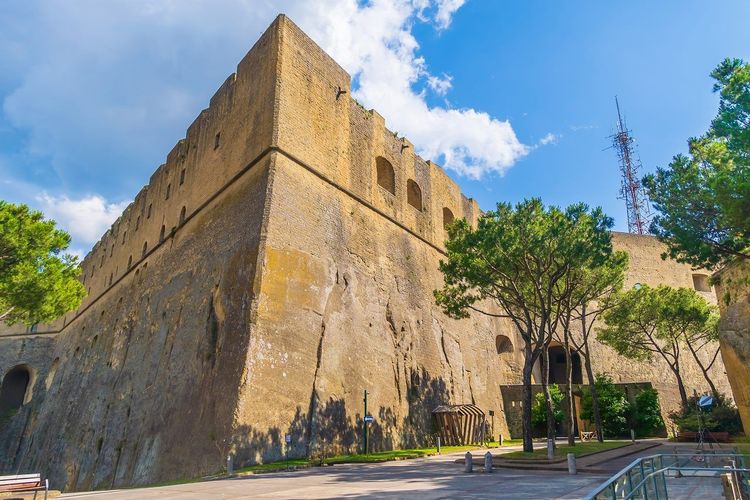
To gain some height, quite literally, head to the Vomero district, perched on the hill that overlooks the historic center.
Taking the Funicular to the Top
Three of the city's four funicular lines go up to Vomero, including the Funicolare Centrale, which departs from Via Toledo, and the Montesanto line, the most direct for Sant'Elmo. The ride lasts a few minutes and costs the price of an urban transport ticket: it's hard to find a better ratio between cost and the spectacle awaiting you at the top.
The Castle, the Certosa and the Panorama over Naples
The Sant'Elmo Castle, whose origins date back to the 14th century but whose six-pointed star plan dates from the works of Viceroy Pedro de Toledo in the 16th century, offers from its ramparts a 360-degree panorama over the Bay of Naples, Vesuvius and, on a clear day, Capri in the distance.
Right next door, the Certosa di San Martino (Largo San Martino 5, 80129 Napoli, rated 4.5/5 on Google from 6,834 reviews), a former charterhouse turned museum, houses one of the finest collections of Neapolitan nativity scenes, including the famous Cuciniello crib, as well as a large cloister whose silence contrasts with the bustle below. You can combine both sites in the same half-day, as they are only a few minutes' walk apart.
Timing tip: go up in the late afternoon. The low light over the bay and Vesuvius makes the view far more spectacular than at noon, and you'll head back down in time for aperitivo.
The Spanish Quarter and Chiaia, Two Faces of Naples
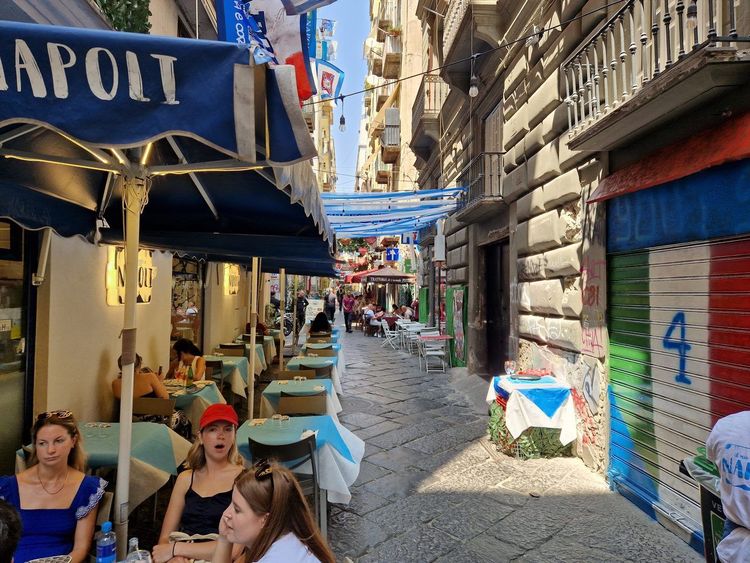
Back down from Vomero, you'll find two neighborhoods in striking contrast, just a few hundred meters from each other.
Quartieri Spagnoli, Alleys and Neighborhood Life
Built in the 16th century to house the Spanish garrison, the Spanish Quarter (Quartieri Spagnoli) forms a grid of narrow alleys where laundry strung from one balcony to the next almost hides the sky. This is where the rawest image of Naples is concentrated: the huge Maradona mural on Largo Maradona, fried snacks sold at the counter, scooters weaving between pedestrians.
The neighborhood has long had a bad reputation at night. By day, it's one of the liveliest in the city: simply keep your belongings in sight and avoid deserted alleys after sunset.
Chiaia, Shopping and Seafront
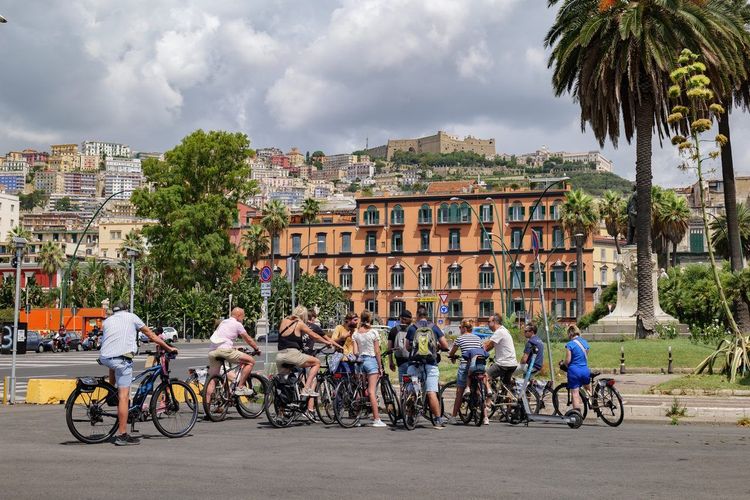
At the other end of the spectrum, Chiaia lines up its elegant boutiques along Via Chiaia and Via dei Mille, before opening onto the Riviera di Chiaia and the Via Partenope seafront, where the grand hotels face the Castel dell'Ovo. Moving from one neighborhood to the other in a few minutes' walk sums up the dual nature of Naples fairly well: working-class and chic, often in the same day.
Finish with the Castel dell'Ovo, the "Egg Castle", set on the islet of Megaride: access is free and its terraces offer one of the best free views of Vesuvius.
The Archaeological Museum and the City's Hidden Treasures
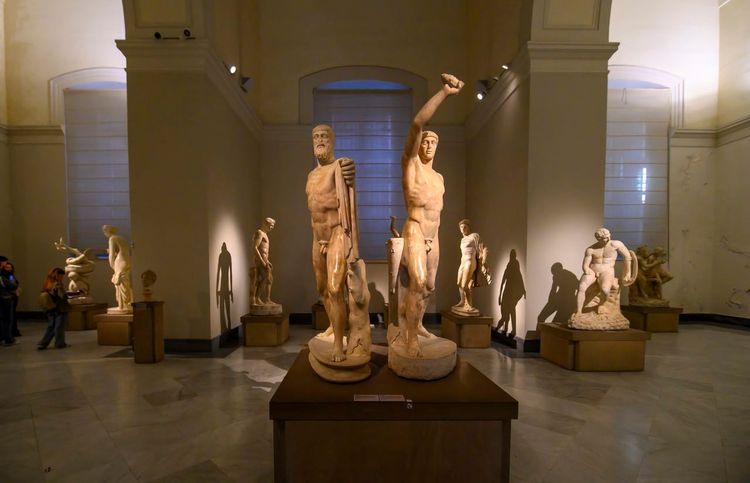
To complement the open-air stroll, a cultural detour is a must if you're planning an excursion to Pompeii.
The National Archaeological Museum of Naples
The National Archaeological Museum of Naples houses one of the richest collections of Greco-Roman antiquities in the world, including a large share of the frescoes, mosaics and objects unearthed at Pompeii and Herculaneum. The Alexander Mosaic, the Farnese collection of ancient sculptures (including the imposing Farnese Bull group) and the secret cabinet reserved for erotic works are among the must-sees.
Allow at least two hours. If you visit it before Pompeii, you'll better understand what you'll see on the site afterwards, since the originals of the finest frescoes and mosaics are here and not in the ruins.
Curiosities and Lesser-Known Treasures
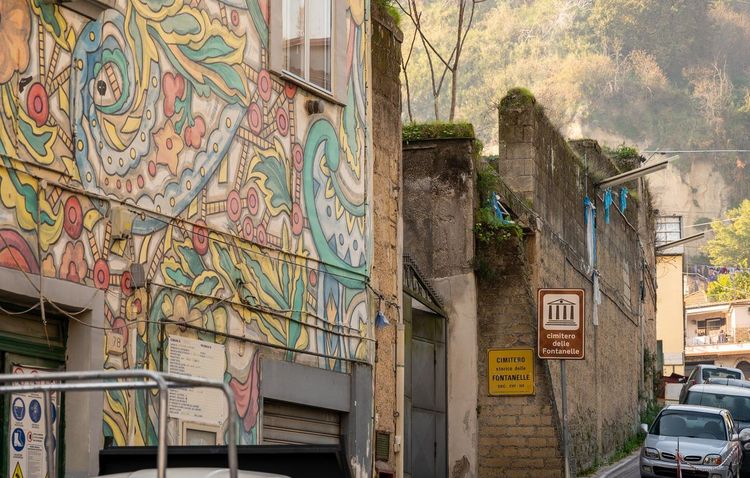
Naples also holds surprises far from the major sites: the Catacombs of San Gennaro, dug into the Capodimonte hill, the Fontanelle Cemetery, a former tuff quarry where thousands of skulls once "adopted" by Neapolitans are lined up, or the Madre contemporary art museum, housed in the Donnaregina palace.
Also take an hour to wander without a fixed route around Via San Gregorio Armeno: you'll often see nativity scene artisans at work, with no ticket or reservation needed.
Where to Stay in Naples for a First Visit
The choice of neighborhood matters as much as the choice of monuments to visit, as the atmosphere varies so much from one area to another.
The Historic Center for Immersion
Staying in the historic center, around Spaccanapoli or the Duomo, puts all the major monuments within walking distance and lets you enjoy the city early in the morning and late at night, before and after the influx of groups. It's the most immersive choice, but also the noisiest: opt for a high floor or a room facing the courtyard if you're sensitive to nighttime noise.
Chiaia for Comfort
The Chiaia district is better suited if you're looking for comfort: newer hotels, quieter streets in the evening, and proximity to the seafront for a digestive stroll. It's also an area well supplied with consistently good restaurants, handy if you're traveling in a group with different tastes.
Posillipo for Families
More off-center, Posillipo appeals to families looking for fresh air and an open view over the bay, away from the density of the center. Our article on Naples with kids details child-friendly activities if you're traveling with them. In exchange, allow more travel time to the historic center, by bus or taxi.
What are the best hotels in Naples for a first visit? Those located a few minutes' walk from Via Toledo or the Duomo generally offer the best balance of accessibility and quiet. As for neighborhoods to avoid in Naples: the area around the central station (Piazza Garibaldi) at night, and the northern suburbs of Scampia or Secondigliano, which are in any case very far from the tourist sites.
A Feast of Neapolitan Flavors

Naples invented modern pizza, and the city continues to fiercely defend its recipe against all international variations. The art of the Neapolitan pizzaiolo has been on UNESCO's Intangible Cultural Heritage list since 2017.
Real Neapolitan Pizza, Between Tradition and Street Food
Authentic Neapolitan pizza is recognizable by its puffy crust, cooked in 60 to 90 seconds in a wood-fired oven exceeding 400°C. Two places come up often in local recommendations: Da Attilio, via Pignasecca, on the edge of the Spanish Quarter, known for its star-shaped pizza with ricotta-stuffed crust, and 400 Gradi, via Concezione a Montecalvario, in the heart of the Spanish Quarter, which also serves pizza fritta, the version fried in oil, born in the poor alleys of the post-war period. On Via dei Tribunali, the lines outside the historic pizzerias will point you to the other institutions.
To go further than a simple tasting, several workshops offer a pizza class with a local pizzaiolo, usually in a small group, with a tasting of your own creation at the end of the session. An activity that appeals as much to children as to adults curious to understand the technique, from kneading to baking.
Bars, Rooftops and Sweet Breaks

For a more unusual break, the Bar Nilo (Via San Biagio dei Librai 129, 80138 Napoli, rated 4.3/5 on Google from 671 reviews), in the heart of Spaccanapoli, houses a shrine dedicated to Diego Maradona, with a lock of hair presented as authentic. Atmosphere guaranteed, even if you only order a coffee.
In the evening, look for a rooftop with a view of the bay: several hotels on the Via Partenope seafront open their rooftop terraces for an aperitivo facing Vesuvius as it fades into the setting light. Where to eat in Naples beyond pizza? Street fried snacks served in a paper cone (cuoppo), pasta alla genovese slow-cooked with onions, the Sunday ragù, crispy ricotta sfogliatelle and rum baba easily round out a multi-day food itinerary.
Pompeii and Vesuvius, the Must-Do Excursion
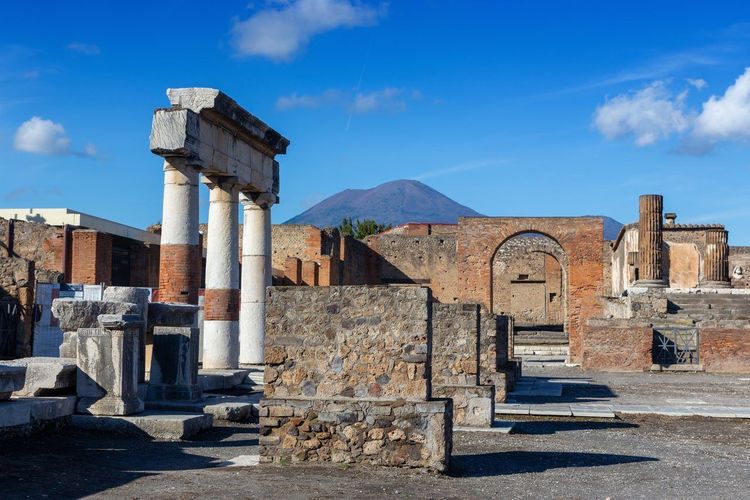
About forty minutes by train from the center of Naples, Pompeii and Vesuvius make up the most requested excursion for first-time visitors to the region.
The Excavations of Pompeii
The Pompeii excavations extend over some 44 hectares of uncovered ground: villas painted with frescoes, baths, an amphitheater, casts of inhabitants frozen by the eruption of AD 79. Allow at least half a day, or a full day if you want to avoid rushing between the main points of interest.
The site exceeded 4 million visitors in 2024, and since November 2024 tickets have been named with a cap of 20,000 entries per day, spread across time slots in high season. So book online, especially for the first Sunday of the month, a free-entry day when the quota is quickly reached. Herculaneum, smaller and less crowded, is an interesting alternative if you're looking for a calmer atmosphere, with multi-story houses and woodwork often better preserved than at Pompeii.
Climbing Vesuvius
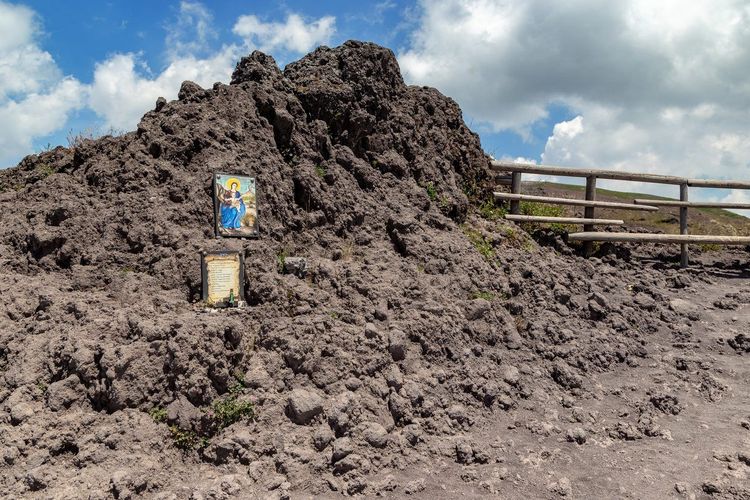
Vesuvius, one of the most closely monitored volcanoes in the world, rises to 1,281 meters. From the access car park, the climb to the crater takes about 1h30 round trip on a stony path with no technical difficulty, with a ticket to be booked online in advance.
From the crater rim, the view plunges onto the Bay of Naples on one side and onto frozen lava flows on the other. Combining Pompeii in the morning and Vesuvius in the afternoon is possible by public transport, but requires tight organization: plan for a full day, especially in the full heat of summer when the climb becomes grueling.
An organization tip: do the historic center tour the day before with the Ryo audio guide, as its 18 audios can be completed in a morning and you'll arrive at Pompeii with the historical background in mind.
Capri, Ischia and the Phlegraean Fields: Extending the Escape
Beyond Pompeii, the Neapolitan region is full of excursions that each deserve a full day.
Capri, the Legendary Island
The island of Capri, reachable in 45 to 80 minutes by boat depending on the type of vessel, owes its reputation to its limestone cliffs plunging into a turquoise sea, to the Blue Grotto and to the Faraglioni, those three emblematic rocks rising offshore. The Piazzetta, a tiny square lined with café terraces, serves as a meeting point before climbing up to Anacapri for a wilder panorama.
Leave early: morning boats let you avoid the midday crush and leave time to tour the island before the last departure in the late afternoon.
Ischia and the Phlegraean Fields, Naples' Other Volcano
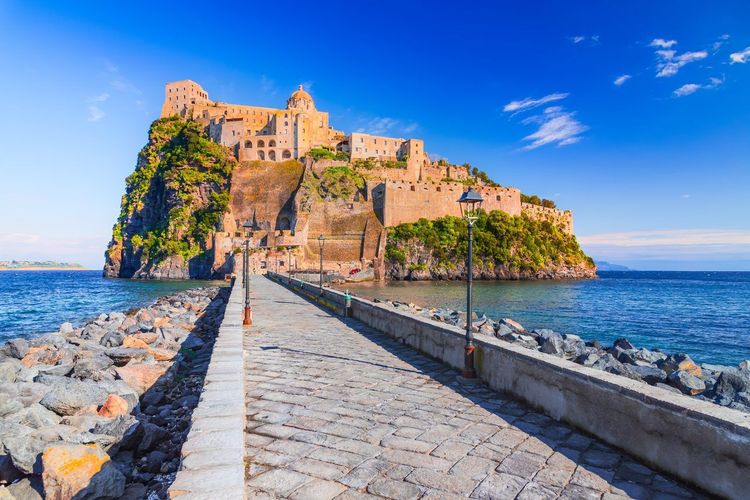
Less crowded than Capri, the island of Ischia attracts visitors with its thermal springs, lush gardens and the Aragonese Castle, linked to the main island by a causeway. The open-air thermal baths, fed by underground volcanic activity, make it an ideal destination for a day of relaxation.
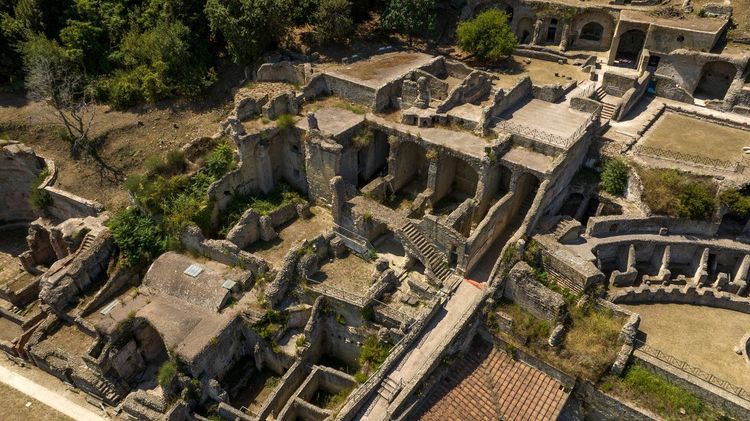
On the mainland, the Phlegraean Fields (Campi Flegrei) form a vast, still-active volcanic caldera whose ground is slowly rising (bradyseism). The famous Solfatara of Pozzuoli has been closed to the public since 2017, with no announced reopening date; in Pozzuoli, however, you can visit the Flavian Amphitheater and the Rione Terra, accessible by metro from central Naples.
Paestum, Ancient Greece at the Gates of Campania
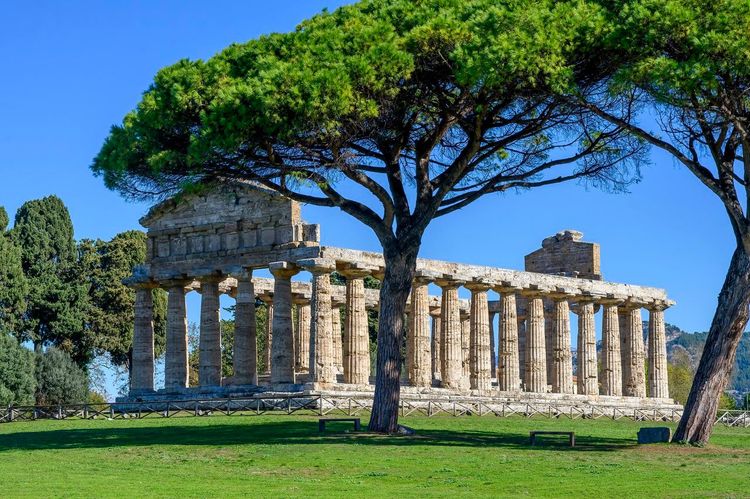
Further south, about 1h30 away by road, Paestum preserves three Doric temples among the best preserved in the world, built by Greek settlers in the 6th and 5th centuries BC. The site, far less crowded than Pompeii, can be visited in half a day and combined with a lunch of mozzarella di bufala, produced in the surrounding plain.
Each of these excursions has its own identity, volcanic, thermal or archaeological: over a week, you can string together three or four without ever feeling like you're seeing the same thing twice.
The Passion for Calcio and the Neapolitan Soul
It's impossible to understand Naples without mentioning football. The passion for calcio goes far beyond sport here: Diego Maradona, who gave the club its first two Italian championship titles in 1987 and 1990, remains revered as a secular saint, and the stadium has borne his name since 2020. The scudetti of 2023 and 2025 have rekindled this fervor: you'll see sky-blue flags on every balcony. If the calendar allows, attending a match at the Diego Armando Maradona stadium, in Fuorigrotta, is a unique experience. This fervor, combined with an identity proudly distinct from the rest of Italy, Neapolitan language first and foremost, gives the city a soul recognizable among a thousand: warm, theatrical, never quite at peace.
How to Get to and Around Naples

It's best to sort out transport questions before departure to avoid unpleasant surprises on arrival.
From the Airport to the City Center
Naples-Capodichino airport is about 7 km from the historic center. The Alibus shuttle connects it directly to the central station (Piazza Garibaldi) and the port (Molo Beverello) in around twenty minutes depending on traffic, for a few euros. Official taxis apply fixed fares to the center, which you should ask about before getting in to avoid any haggling.
By train, Napoli Centrale station is served by high-speed trains from Rome in a little over an hour, a practical option if you're combining the two cities.
Public Transport on Site
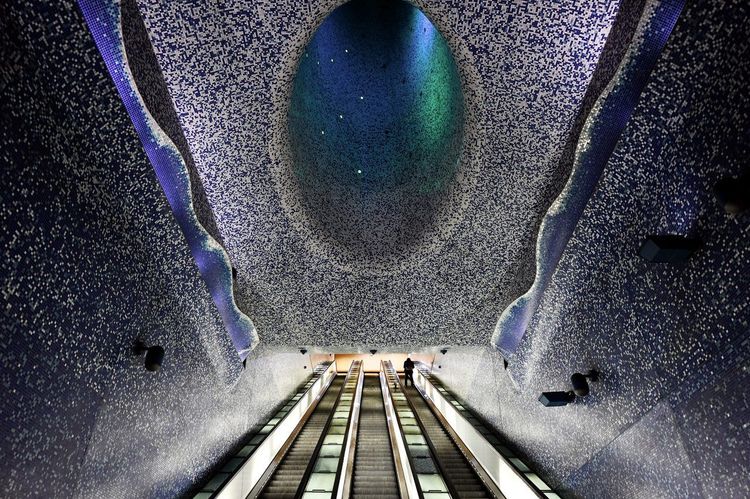
Getting around Naples by public transport relies on a combined network of metro (line 1 and its "art stations", including Toledo, often cited among the most beautiful in Europe), buses, trams and funiculars. An integrated ticket valid for 90 minutes covers most trips in the city center.
To reach Pompeii, Herculaneum or Sorrento, the Circumvesuviana line departs from Porta Nolana and Garibaldi station, with frequent departures during the day. Check your schedules in advance: the signs at the station are not always synchronized with transport apps.
Should You Rent a Car?
Renting a car to get around Naples is rarely a good idea: heavy traffic, poorly signposted limited traffic zones (ZTL), complicated parking and automatic fines. A car does become useful, however, for exploring the Amalfi Coast off-season or the rural areas of Campania, provided you pick it up on the outskirts.
When to Go: The Best Time to Visit Naples
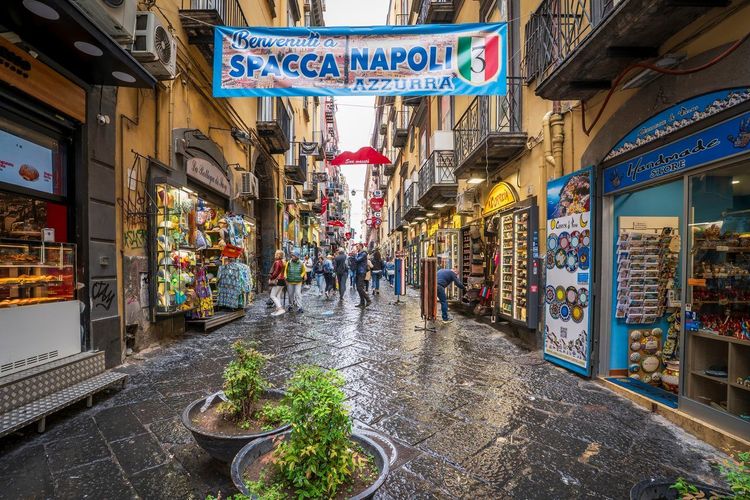
The best time to visit Naples remains spring (April-May) and early autumn (September-October): pleasant temperatures around 20-25°C, more reasonable crowds than in midsummer, and ideal light for strolls in the historic center. July and August bring sometimes crushing heat and dense crowds at the most popular sites like Pompeii or Capri. Winter remains feasible, with lower prices and the San Gregorio Armeno nativity scenes in full swing in December, but boat connections to the islands slow down off-season.
Budget, Safety and Practical Tips
A few practical points will spare you unpleasant surprises once you're there.
Cash, Tipping and Language
Keep some cash on you: some small shops and street food counters still prefer cash. Tipping is not mandatory in Italy, but rounding up the bill at a restaurant is still appreciated, with no percentage calculation.
As for language, standard Italian coexists with Neapolitan, a language in its own right that you'll hear everywhere on the street, without it really complicating communication with visitors.
Safety and Everyday Vigilance
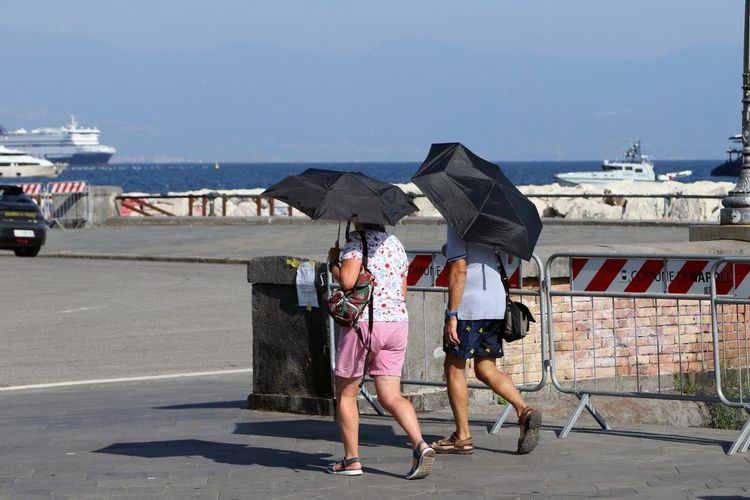
Safety in Naples does not differ fundamentally from that of other major tourist cities: the city remains generally safe for visitors, but pickpocketing and scooter snatch-and-grab thefts do exist, especially around the station and in the crowded streets of the center. Carry your bag in front of you in crowds and avoid flaunting your phone while walking.
In an emergency, number 118 reaches medical emergency services throughout Italy; 112 works as the general emergency number valid across the European Union.
Booking Tickets and Museum Passes
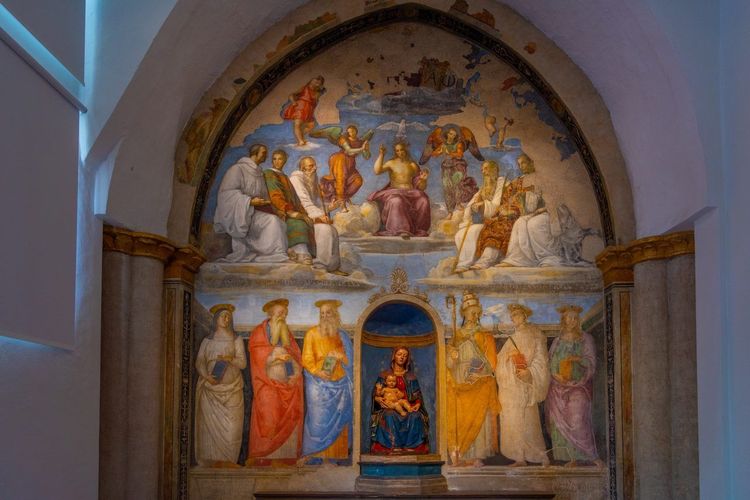
For the most in-demand sites, the Sansevero Chapel and Pompeii above all, booking your tickets in advance avoids queues that can exceed an hour in high season. A museum pass such as the Campania Artecard lets you save on a series of several sites (archaeological museum, Pompeii, Herculaneum) and use regional transport depending on the option chosen.
One last reflex before closing your suitcase: download the Ryo audio guide to Naples, which works on your phone and saves you from paying for a guided tour of the historic center.



FAQ
How many days do you need to visit Naples for the first time?
Two days cover the essentials of the historic center. Allow three to four days to add Pompeii or Capri, and a full week if you want to explore all of Campania, islands included.
Is Naples a safe city for tourists?
Yes, overall, as long as you stay vigilant as in any large city: watch your belongings in crowds, avoid the area around the train station at night, and keep your phone out of sight on crowded streets.
What is the best time to visit Naples?
Spring and early autumn offer the best balance between pleasant weather and manageable crowds. Summer brings intense heat and dense crowds at major sites like Pompeii or Capri.
How do you get around Naples without a car?
The combined network of metro, buses, trams and funiculars covers most of the city. The Circumvesuviana line also connects Naples to Pompeii, Herculaneum and Sorrento without the need to rent a vehicle.
Do you need to book museum tickets in advance?
Yes, particularly for the Sansevero Chapel and Pompeii, where tickets are named and entries are capped. A museum pass simplifies planning across several sites.
Naples or Capri: which should you start with on a first trip?
Start with Naples: the city concentrates most of the heritage and serves as a logistical base from which to branch out to Capri, Pompeii or the other excursions in Campania.
Conclusion
Visiting Naples for the first time requires accepting a bit of disorder in exchange for a density of heritage that is rare in Europe: a listed historic center, an active volcano within reach by train, legendary islands offshore and a cuisine that invented pizza as we know it today. Whether you stay a weekend or a week, keep some time to wander without a fixed route: it's often in those moments that Naples reveals itself best.
To miss nothing of the city center without spending hours on preparation, slip into your pocket the Ryo audio-guided tour of central Naples: 1h30 of listening to connect the main stops of your first stay.