






Walk
See Naples and Die
Naples, Italy
Walk
See Naples and Die
Naples, Italy
3.8 km
Distance
1h30
Durée
19
Audios
Loop
Parcours
Shutterstock
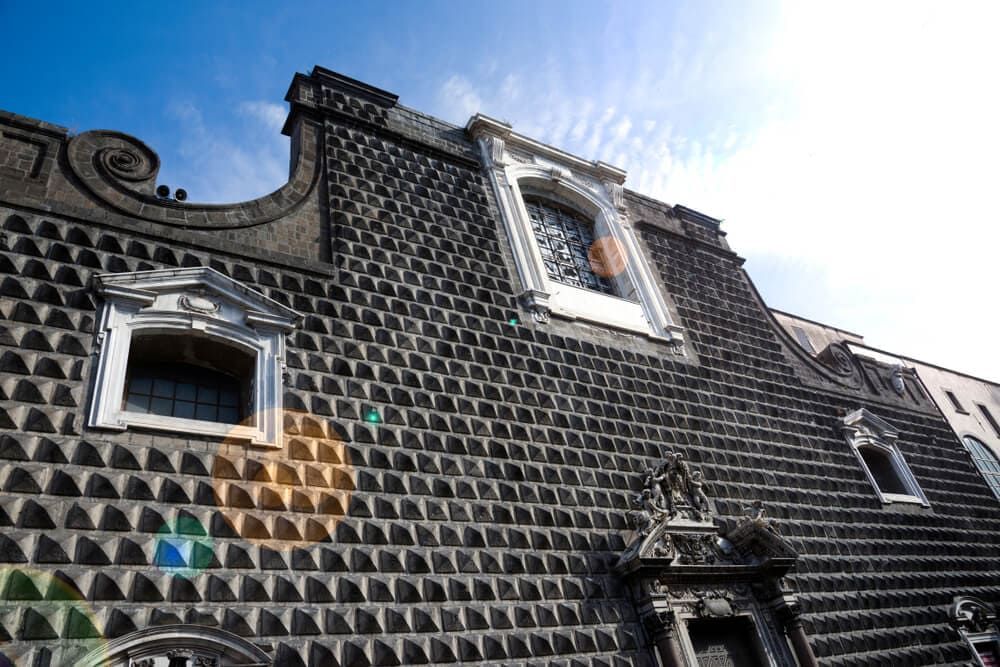
The Naples audio-guided tour leads you before the Church of Gesu Nuovo, one of the most emblematic in the city and a peak of Neapolitan Baroque art. A major place of worship, it is discovered with respect, in the calm proper to this kind of building.
The unusual silhouette and the diamond-point facade of the church are explained by its origin: it was not built as a church, but as a palace. In 1470 the palace of the princes of Salerno was built, for Robert Sanseverino. His successor, opposed to the Inquisition led by the viceroy of Toledo, was forced into exile and saw his property confiscated. The palace was then transformed into the Jesuit church, from 1584, keeping its original facade.
The contrast between the austere facade and the dazzling interior holds all the singularity of the place: polychrome marbles, frescoes and richly decorated chapels offer an exceptional Baroque setting. The church also keeps the memory of Giuseppe Moscati, a canonised doctor much venerated in Naples. The visit is made with respect for the place of worship and prayer.
The Church of Gesu Nuovo is on the square of the same name, in the historic centre of Naples, near the Santa Chiara complex. Access is generally free outside services; hours may vary with the season and celebrations. An active place of worship, it requires proper dress and silence.
Because it comes from a former 15th-century princely palace, transformed into a church at the end of the 16th century while keeping its diamond-point facade.
The memory of Giuseppe Moscati, a canonised Neapolitan doctor much venerated by the faithful, is honoured there in particular.
Aucun avis pour le moment
