






Walk
See Naples and Die
Naples, Italy
Walk
See Naples and Die
Naples, Italy
3.8 km
Distance
1h30
Durée
19
Audios
Loop
Parcours
Shutterstock
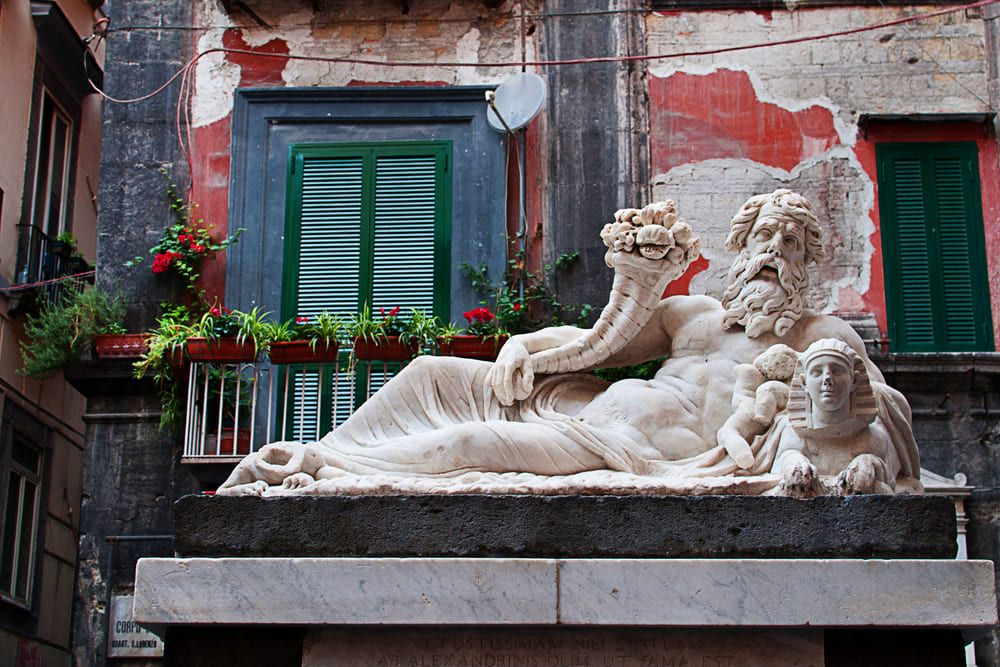
The Naples audio-guided tour reveals the statue of the God Nile, on Piazzetta Nilo, at the start of Via Nilo. This Roman-era work, made between the 2nd and 3rd centuries, is one of the oldest ancient testimonies visible in the city.
According to tradition, the statue was erected by an Egyptian community from Alexandria settled in Naples, who thus celebrated the Nile, considered a deity of fertility, wealth and abundance. It is an allegory of nature as a source of life, the river having made the desert habitable. Over the centuries, the statue lost its head and the putti surrounding it, before being restored.
The statue depicts a reclining man, an allegory of the river Nile, in the pose characteristic of ancient river deities. It recalls the presence, since Antiquity, of communities from all over the Mediterranean basin in Neapolis. The district around it, nicknamed the Nile district, has kept the name, bearing witness to this cosmopolitan history.
The statue of the God Nile can be seen freely, in the open air, on Piazzetta Nilo, in the historic centre of Naples. It is accessible at any time and free of charge. It is a quick stop, during the walk along Spaccanapoli, the axis that crosses old Naples.
It dates from the Roman era, made between the 2nd and 3rd centuries, and is among the oldest ancient remains in Naples.
An allegory of the river Nile, a deity of fertility and abundance, erected according to tradition by an Egyptian community.
Aucun avis pour le moment
