





Walk
See Naples and Die
Naples, Italy
Walk
See Naples and Die
Naples, Italy
3.8 km
Distance
1h30
Durée
19
Audios
Loop
Parcours
Shutterstock
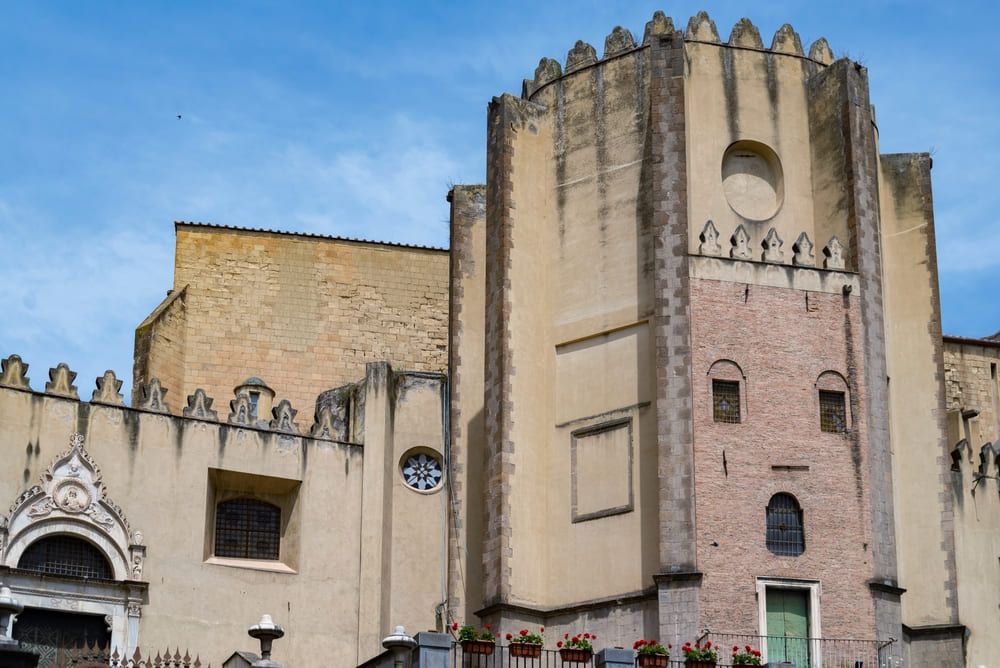
The Naples audio-guided tour leads you to Piazza San Domenico Maggiore, one of the most important in the historic centre, a UNESCO World Heritage site. It marks the former boundary of the Greek walls of Neapolis and is arranged around a major church.
The square was laid out under the reign of Alfonso V of Aragon, in the 15th century, and took the name of the church of San Domenico Maggiore, commissioned by Charles II of Anjou in 1283 and built in the Gothic style. A peculiarity of this church: it is entered through the apse, the semicircular niche at the rear, and not through the main facade, which faces the convent. The building was the seat of the Dominicans and a high point of Neapolitan intellectual life.
At the centre of the square stands the obelisk of Saint Dominic, surrounded by superb palaces and lively cafes. The church of San Domenico Maggiore, a place of worship to be visited with respect, preserves a rich decoration and the memory of great figures, including the philosopher Thomas Aquinas, who taught there. The square is one of the beating hearts of old Naples.
Piazza San Domenico Maggiore can be seen freely, in the open air, in the historic centre of Naples. The church is generally accessible outside services; hours may vary. An active place of worship, it requires proper dress and silence. Cafes and palaces line the square, lively all day.
Because the main facade of the church faces the convent; access from the square is therefore through the apse, at the rear of the building.
It corresponds to the former boundary of the Greek walls of Neapolis and is one of the major points of the UNESCO-listed historic centre.
Aucun avis pour le moment
