




Walk
See Naples and Die
Naples, Italy
Walk
See Naples and Die
Naples, Italy
3.8 km
Distance
1h30
Durée
19
Audios
Loop
Parcours
Shutterstock
The Naples audio-guided tour brings you to the Basilica of Santa Chiara, the largest Gothic building in the city. At the heart of an important religious complex, this place of worship and royal memory is discovered with respect and contemplation.
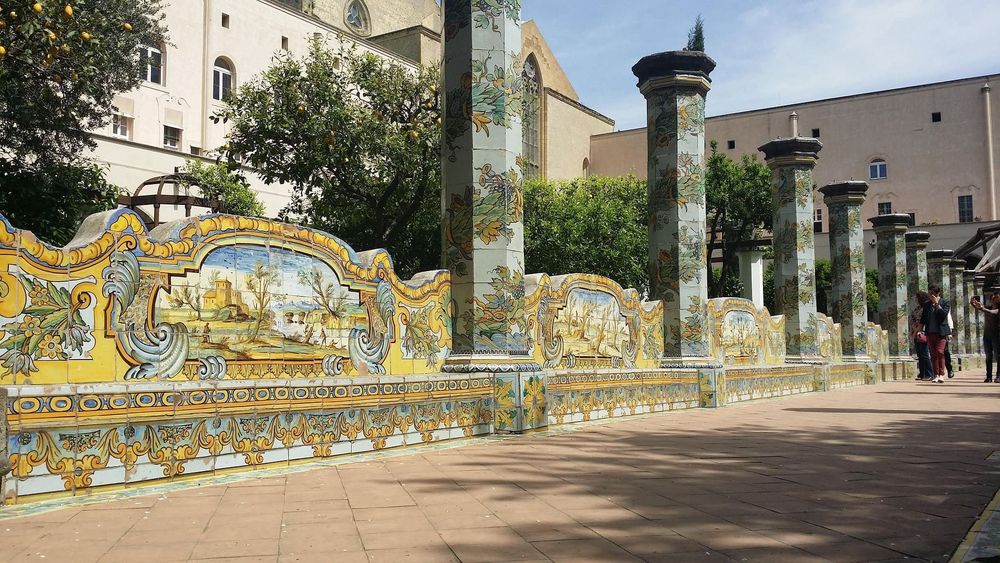
The complex was built at the beginning of the 14th century by Robert of Anjou and his wife, Queen Sancia of Majorca, on the site of former Roman baths. It includes the Gothic basilica, two convents, that of the Poor Clares (the order founded by Saint Clare) and that of the Friars Minor, as well as a sublime cloister adorned with majolica. Completed in 1328, the basilica became the pantheon of the royal House of Anjou. The whole is listed as an Italian National Monument.
Tall and plain, pierced by a single rose window, the basilica strikes by its Gothic simplicity, rare in Naples. The majolica cloister, entirely renovated, with its columns and benches covered in painted tiles, is one of the most beautiful in Italy. There you discover the royal tombs and the peaceful atmosphere of the monastery, in respect of the sacred place.
The Basilica of Santa Chiara is in the historic centre of Naples, near the Church of Gesu Nuovo. Access to the basilica is generally free; the visit of the majolica cloister and the museum is ticketed, with hours that vary by season. An active place of worship, the building requires proper dress and silence.
It is the largest Gothic building in Naples, pantheon of the Angevin kings, with a majolica cloister among the most beautiful in Italy.
Robert of Anjou and Queen Sancia of Majorca, at the beginning of the 14th century, on former Roman baths.
Aucun avis pour le moment