






Walk
See Naples and Die
Naples, Italy
Walk
See Naples and Die
Naples, Italy
3.8 km
Distance
1h30
Durée
19
Audios
Loop
Parcours
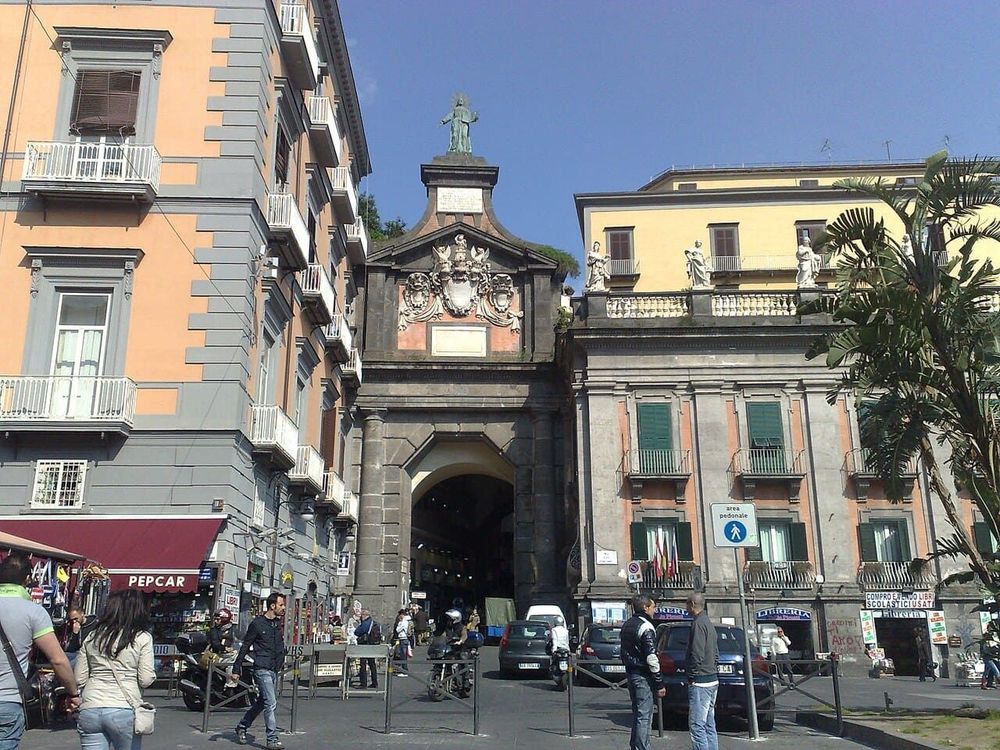
©IlSistemone CC BY-SA 3.0. <https://creativecommons.org/licenses/by-sa/3.0/deed.fr>via Wikipedia Commons
The Naples audio-guided tour takes you through Port'Alba, one of the old gates of the city ramparts. At the end of a small pedestrian street lined with bookshops and music shops, it links Piazza Dante to the historic centre.
Port'Alba was opened in the Angevin wall in 1625 to ease the movement of the inhabitants. It is due to the Spanish viceroy Antonio Alvarez de Toledo, Duke of Alba, from whom it takes its name. On it can be seen the coats of arms of Philip III, of the city and of the viceroy. The statue of San Gaetano, at its top, was added in 1656, as on other gates of the city, following the plague epidemic.
The stone vault of Port'Alba opens onto a picturesque lane, a paradise for lovers of old books, which adds to the charm of the district. The gate, with its coats of arms and its statue, bears witness to the history of the ramparts of Naples and the epidemics that marked the city. The Neapolitans willingly attach a few legends to it, true to their taste for storytelling.
Port'Alba can be seen freely, in the open air, at the corner of Piazza Dante, in the historic centre of Naples. The pedestrian lane that extends it, lined with bookshops, is pleasant to walk, preferably in the afternoon on weekdays. Access is open at any time and free of charge.
It was opened in the Angevin wall in 1625, at the initiative of the viceroy Duke of Alba, whose name it bears.
A statue of San Gaetano, added in 1656 after the plague epidemic, as on other gates of the city.
Aucun avis pour le moment
