






Walk
See Naples and Die
Naples, Italy
Walk
See Naples and Die
Naples, Italy
3.8 km
Distance
1h30
Durée
19
Audios
Loop
Parcours
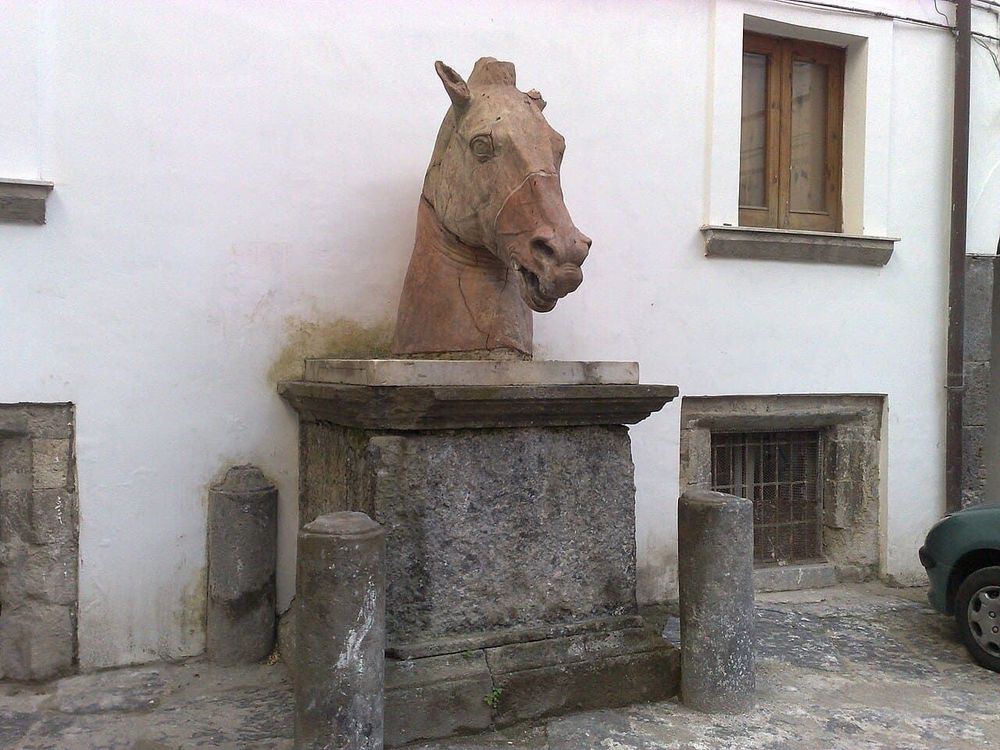
©IlSistemone CC BY-SA 3.0. <https://creativecommons.org/licenses/by-sa/3.0/deed.fr>via Wikipedia Commons
The Naples audio-guided tour points out, on your right, the entrance to the Diomede Carafa Palace, on Via San Biagio dei Librai. This monumental Renaissance palace, former residence of a cardinal, hides in its courtyard a curiosity linked to an old Neapolitan legend.
Dating from the 15th century, the Palazzo Diomede Carafa rises on Spaccanapoli, in the historic heart of the city. The residence of an Italian cardinal, it was transformed into a museum by a wealthy lawyer in the 19th century. In its inner courtyard stands a large horse's head, three times life-size: it is a copy, the original being kept at the National Archaeological Museum, which also displays a reproduction in the Museo metro station.
If the courtyard is accessible, you can go and admire the monumental horse's head, famous in Naples and linked to an ancient legend: the square of Cardinal Sisto is said to have once held a large bronze horse statue, with supposed supernatural properties. The Renaissance facade and the carved portal of the palace are also worth a look, during the walk along Spaccanapoli.
The Diomede Carafa Palace is on Via San Biagio dei Librai, along Spaccanapoli, in the historic centre of Naples. The facade can be seen freely from the street; access to the courtyard depends on opening hours, which may vary. It is a quick stop, in the heart of old Naples.
A large horse's head three times life-size, a copy of a work kept at the National Archaeological Museum.
It dates from the 15th century; the former residence of a cardinal, it was transformed into a museum in the 19th century.
Aucun avis pour le moment
