





Walk
Tuscany’s hidden surprise
Pistoia, Italy
Walk
Tuscany’s hidden surprise
Pistoia, Italy
3 km
Distance
1h20
Durée
23
Audios
Loop
Parcours
Shutterstock
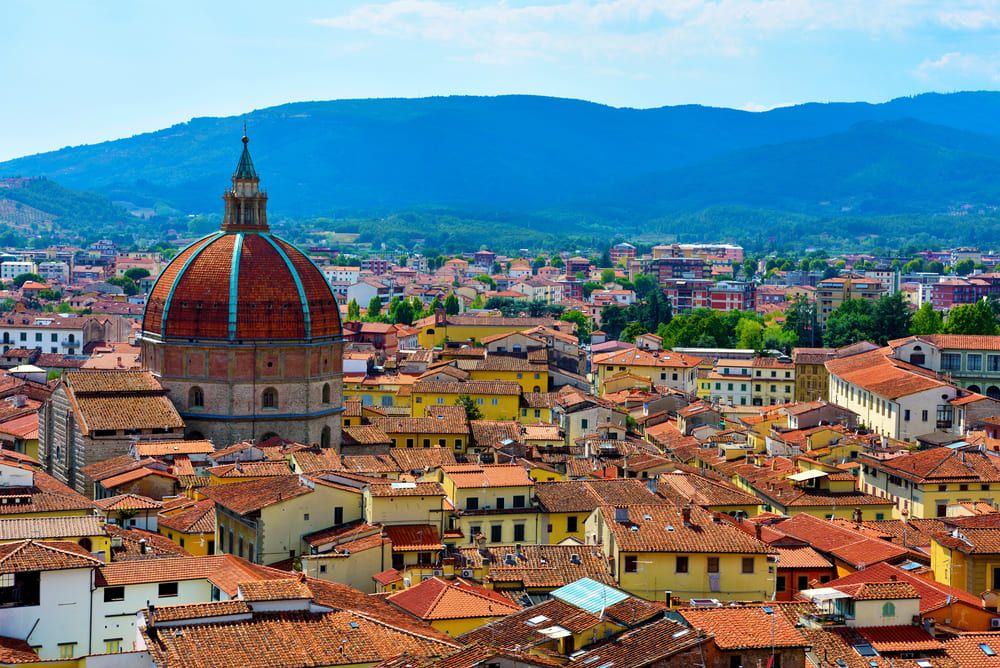
This large dome covered in red tiles, rising to nearly 60 meters, might make you feel like you’re in Florence, but you’re not. You’re standing in front of the Basilica of the Madonna dell’Umiltà. Its dome, designed in the 16th century by Giorgio Vasari, was directly inspired by Brunelleschi’s dome in Florence, which explains that familiar impression.
But the story of this place begins much earlier. Originally, there was a small medieval chapel here. In 1490, while the city was shaken by violent clashes between two rival families, the Panciatichi and the Cancellieri, something unexpected happened.
Red drops, said to resemble tears of blood, began to flow from a fresco of the Virgin, shown seated humbly on a cushion placed directly on the ground. News of the event spread quickly, and according to accounts, the fighting stopped almost immediately. In a city shaped by centuries of rivalry and conflict, this was seen as a powerful sign of peace.
These tensions between families had lasted for generations and were part of the wider political divisions of medieval Italy, deeply influencing Pistoia’s history. After the event, which is said to have lasted several weeks, the people of Pistoia vowed to build a great sanctuary in honor of the Virgin. Construction took nearly a century and involved several architects, before resulting in the building you see today.
Inside, the space is organized around an octagonal plan, a layout often used for pilgrimage sites. Unlike traditional churches designed mainly for collective ceremonies, this structure allows visitors to move freely around the center. Here, everything leads your eye toward the image of the Virgin, placed at the heart of the altar.
Around it, richly decorated chapels were funded by the city’s leading families, reflecting both their devotion and their status. If you step inside, you’ll be able to see the original fresco of the Virgin, which was once painted directly onto the wall of the earlier chapel. It had to be carefully detached from its stone support to be moved to the new altar, and even today, you can still make out traces of what was believed to be the miracle of 1490.
Aucun avis pour le moment
