



Walk
The Vertical City
Matera, Italie
Walk
The Vertical City
Matera, Italie
Distance
3.7 kmDurée
1h30Audios
15Parcours
Loop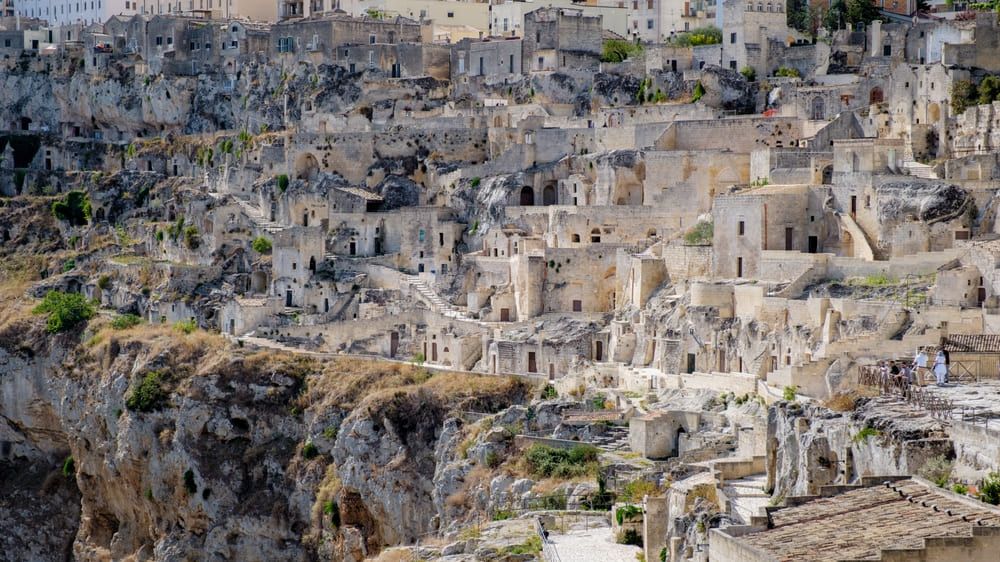
Shutterstock
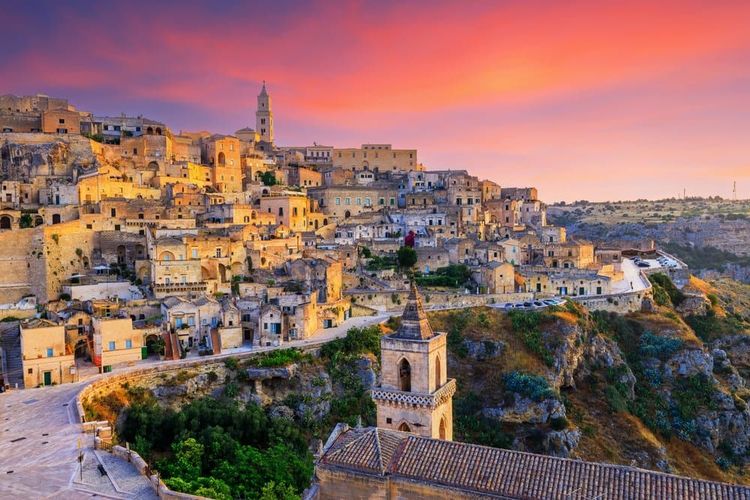
If you follow the narrow alleyway to your left, you will stumble upon Casa Noha, tucked away just steps from Matera's majestic cathedral. Crafted from the city's signature soft limestone, this elegant 16th-century residence was donated by its owners' heirs to the Italian Environment Fund in 2004 and meticulously restored. Yet it offers far more than a glimpse inside a beautiful historic home: it serves as a captivating gateway into Matera's extraordinary past. Inside, an immersive multimedia experience brings the city's story to life, tracing the profound transformations that have reshaped it over the centuries. To truly appreciate the Matera you see today, we have to go back to a pivotal turning point in its history: the 1950s. For generations, Italy had been deeply split between North and South. While northern hubs like Milan, Turin, and Venice prospered through commerce and rapid industrialization, the Mezzogiorno—as southern Italy is known—remained predominantly rural, anchored in agriculture while grappling with poverty and neglected infrastructure. Following Italian unification in 1861, this stark divide evolved into a pressing national challenge known as the "Southern Question." By the mid-20th century, Matera found itself at the heart of a severe crisis. As the local population expanded, living conditions inside the cave dwellings grew perilously overcrowded and unsanitary. Infectious diseases and parasitic illnesses spread rapidly, while infant mortality soared to tragic levels. By 1952, these dire realities had ignited a national scandal, capturing the attention of prominent intellectuals and the press. Responding to the public outcry, the Italian government, under Prime Minister Alcide De Gasperi, enacted a historic measure: a national law mandating the complete evacuation of the Sassi, which had come to be labeled the "shame of Italy." Over the years that followed, nearly 17,000 residents were uprooted from their cave homes and relocated to newly constructed modern quarters on the plateau above. For Italy's young postwar republic, the political stakes were immense; this was a defining test to prove it could address the Southern Question by delivering modernization, proper sanitation, and human dignity to the country's south. Yet this transition extracted a heavy toll on the social fabric of Matera. With its community displaced, the Sassi fell silent, becoming a ghost town left to decay for nearly three decades. Then, in the 1980s, an extraordinary renaissance began. The very caverns once decried as a national disgrace began to draw renewed admiration. Driven by dedicated locals, visionary artists, and targeted restoration projects, the ancient stone city slowly awoke, culminating in its proud designation as a UNESCO World Heritage Site in 1993. Just a short walk down this street stands a magnificent testament to this revival: MUSMA, the Museum of Contemporary Sculpture, where more than 300 artistic works are displayed inside the ancient, atmospheric cave chambers of the Sassi. What a remarkable rebirth!
Aucun avis pour le moment
