





Walk
Through ramparts and secret alleyways
Lucca, Italy
Walk
Through ramparts and secret alleyways
Lucca, Italy
3.5 km
Distance
1h30
Durée
17
Audios
Loop
Parcours
Shutterstock
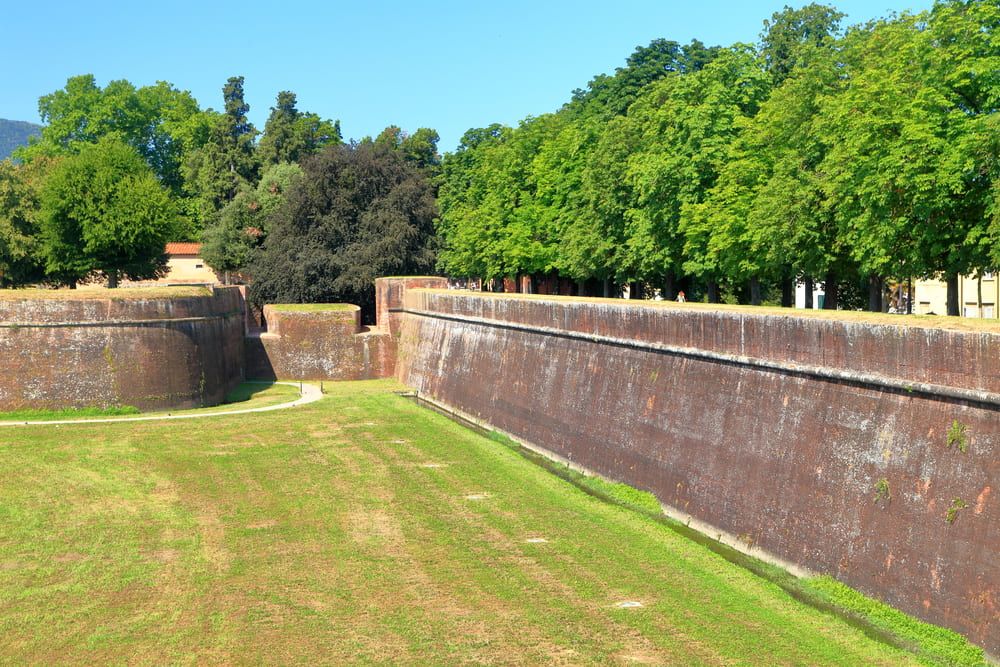
The walls of Lucca are the emblem of the town, an intact Renaissance enclosure become a magnificent tree-lined promenade. The Lucca audio-guided tour stops here to evoke these unique ramparts, which encircle the historic centre.
The walls of Lucca are among the finest and best preserved of the Renaissance fortifications in Europe. Built from the sixteenth to the seventeenth century to protect the town, this powerful brick enclosure, several kilometres long, entirely encircles the historic centre with its ramparts, bastions and broad walls. Remarkably, it never had to undergo a real siege and was therefore preserved intact. In the nineteenth century, the top of the walls was transformed into a promenade planted with trees, which today makes the complete tour of the old town. On foot or by bicycle, you wander under the foliage, with fine views over Lucca and the countryside. The walls are the emblem and the pride of the town.
Here you wander, on foot or by bicycle, along the intact Renaissance enclosure with ramparts, bastions and broad walls, transformed in the nineteenth century into a tree-lined promenade that makes the complete tour of the old town, with fine views. The walls are the emblem of Lucca. It is a must-see stop, to be explored on foot.
The walls encircle the historic centre of Lucca, reachable on foot by several ramps and stairs. The promenade on the top is an open-air public space, freely accessible, which makes the complete tour of the town; you can walk along it on foot or by bicycle. It is particularly pleasant in fine weather.
This powerful Renaissance enclosure, built from the sixteenth to the seventeenth century, never had to undergo a real siege and was therefore preserved intact; its top was transformed in the nineteenth century into a tree-lined promenade.
They encircle the historic centre of Lucca, in Italy.
Aucun avis pour le moment
