





Walk
Tuscany’s hidden surprise
Pistoia, Italy
Walk
Tuscany’s hidden surprise
Pistoia, Italy
3 km
Distance
1h20
Durée
23
Audios
Loop
Parcours
Shutterstock
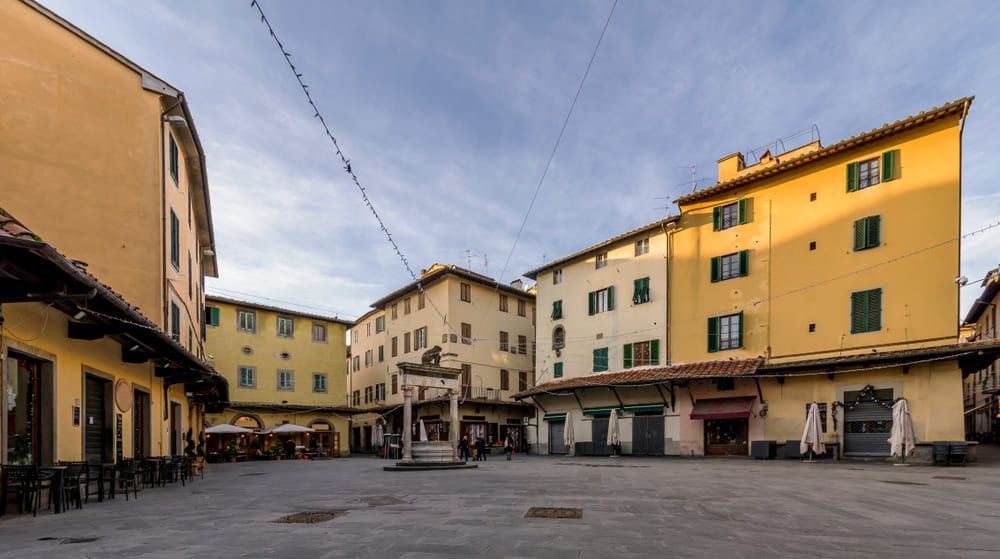
You’ve now arrived at Piazza della Sala. At first glance, it feels like a lively little square, surrounded by old façades and narrow streets, but its history goes much further back than it might seem. In the Early Middle Ages, this area was the center of Lombard power in the city.
The word “Sala” referred to an administrative domain, a place of management and control. Over time, the square evolved into a commercial hub, a role it has never really lost. In the center, you’ll see the Pozzo del Leoncino, the “little lion” well.
The well itself dates back to the Middle Ages, but its most distinctive feature was added later, in 1529. This small lion is not just decorative, it’s the Marzocco, the symbol of Florence. Look at its posture: it holds the coat of arms of Pistoia under its paw, a very clear sign of dominance.
At the time, Florence had control over the city, and this lion was a way of making that power visible in public space. The well has had quite a turbulent history. It was damaged during the bombings of 1943, then restored in Florence.
For several decades, it wasn’t even here, it was moved to Piazza del Duomo and only returned once the square had regained its original appearance. Every morning, Piazza della Sala hosts a fruit and vegetable market with roots going back nearly a thousand years. The atmosphere is simple and authentic: stalls, conversations, fresh produce, a real slice of everyday life.
Then, in the early afternoon, everything changes. The market disappears, and the square fills with terraces, bars, and a much livelier atmosphere as the evening sets in. So, what will it be, the morning market, or a drink on the terrace?
Aucun avis pour le moment
