



Walk
The Vertical City
Matera, Italie
Walk
The Vertical City
Matera, Italie
Distance
3.7 kmDurée
1h30Audios
15Parcours
Loop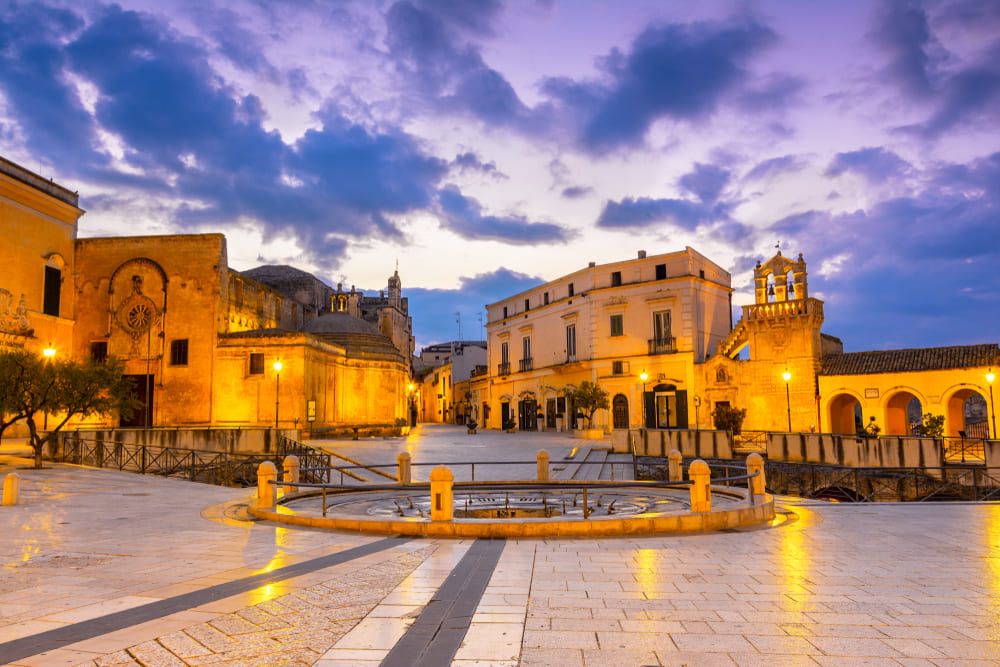
Shutterstock
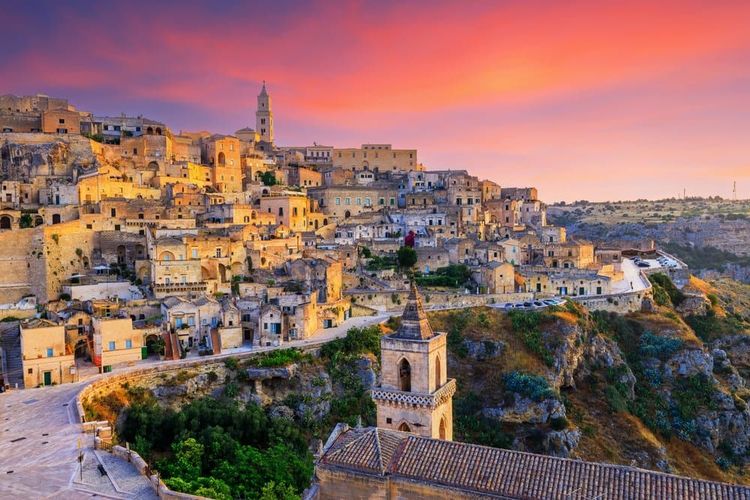
In Matera, you might find yourself walking across your neighbor's roof without even knowing it! Take a look around Piazza Vittorio Veneto. You're in the heart of the Piano, Matera's modern shopping district. But just beyond this bustling square, a completely different city awaits, one that seems to tumble down the rocky hillside. For your first glimpse, head toward the Luigi Guerricchio Belvedere, beneath the three arches. From the railing, the view opens up over the Sassi, the ancient districts of Sasso Barisano and Sasso Caveoso, carved into two vast rocky ravines. Between them rises Civita, the medieval heart of Matera. But how did people end up living on these steep, rocky slopes in the first place? The answer takes us all the way back to prehistoric times. The soft limestone found here, known locally as tufo, was easy to carve and provided natural shelter from harsh weather and predators. As more people settled here, though, space began to run out. Rather than spreading their city outward, the inhabitants came up with a remarkably clever solution: they built upward, creating Matera's extraordinary vertical landscape. First, they hollowed out rooms in the rock, then added stone facades to the front. Over time, an entire maze of homes, alleyways, ramps, and staircases took shape, with one level built right on top of another. Which brings us back to something rather surprising: the street you're walking along might actually be the roof of someone's home! Living in Matera certainly meant getting used to the sound of your upstairs neighbors' footsteps. But building a city into the side of a ravine was only half the challenge. The other was finding a reliable supply of water. Rain is rare in this dry landscape, but when it comes, it can be torrential. So the people of Matera came up with an ingenious way to make every drop count. They turned the entire city into a giant rainwater collection system, carefully sloping rooftops, streets, and terraces to channel the precious water through terracotta pipes and into underground reservoirs. Nothing went to waste! Hidden right beneath Piazza Vittorio Veneto is perhaps the most astonishing example of this engineering: the Palombaro Lungo. Imagine an enormous underground cathedral, except instead of worshippers, it was designed to hold water. This colossal cistern stretches 164 feet (50 meters) in length and reaches a depth of 52 feet (16 meters). But what's truly astonishing is its capacity: more than five million liters of water! Carving a giant reservoir into porous limestone, however, presented a problem of its own. What was stopping all that precious water from simply seeping into the rock? The answer was cocciopesto, a waterproof mortar made from lime and crushed roof tiles, which craftsmen used to coat the entire interior. Through small openings at street level, residents could then draw water from the reservoir, providing a vital lifeline for thousands of people through Basilicata's scorching summers. It's a remarkable example of how generations of Matera's inhabitants learned to live with the landscape rather than fight against it. And as you look out across the Sassi, it's incredible to think that this maze of caves, rooftops, and winding streets was once an entire world of its own, shaped by the people who called it home.
Aucun avis pour le moment
