





Walk
The town that watches over Saint Nicholas
Bari, Italy
Walk
The town that watches over Saint Nicholas
Bari, Italy
3.5 km
Distance
1h30
Durée
20
Audios
Loop
Parcours
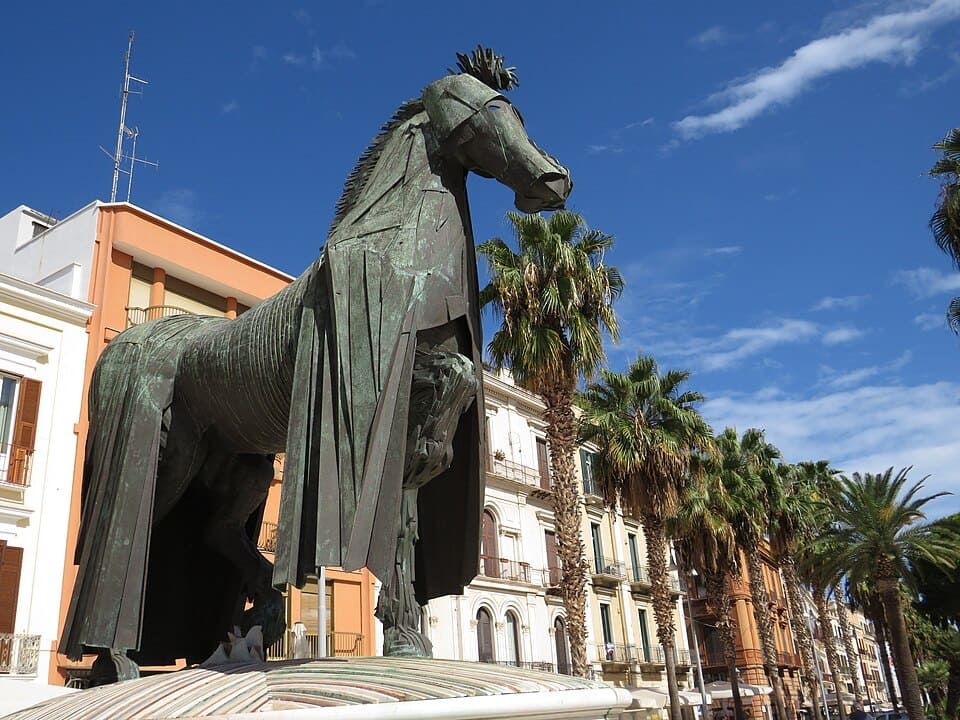
©Enric, CC BY-SA 4.0. <https://creativecommons.org/licenses/by-sa/4.0/deed.fr>via Wikipedia Commons
The sculpture Cavallo con gualdrappa, a caparisoned horse, is a contemporary work of art in Bari. The Bari audio-guided tour stops here to evoke this bronze statue, by an Italian artist, which adorns the public space.
The statue Cavallo con gualdrappa, the horse with a ceremonial cover, is a bronze sculpture created by the Italian artist Mario Ceroli in the 1980s. Donated to the city, it represents a horse adorned with a gualdrappa, that rich caparison that once covered ceremonial mounts. Installed in the public space, it illustrates the place of contemporary art in the urban setting of Bari.
You admire the bronze sculpture of the caparisoned horse, a contemporary work that adorns the public space of Bari. The statue Cavallo con gualdrappa brings a touch of modern art to the setting of the city. It is an original stop for lovers of sculpture and contemporary art, during a walk.
The statue Cavallo con gualdrappa lies in the public space of Bari, reachable on foot. It is an open-air work, freely visible at all times, with no ticket office, and on the level. The place is discovered during a walk in the city.
The Italian artist Mario Ceroli, in the 1980s; it is a bronze sculpture representing a caparisoned horse, donated to the city.
In the public space of Bari, during a walk in the city.
Aucun avis pour le moment
