





Walk
Where Sicily’s Soul Comes Alive
Palermo, Italy
Walk
Where Sicily’s Soul Comes Alive
Palermo, Italy
7.7 km
Distance
3h00
Durée
24
Audios
Loop
Parcours
Shutterstock
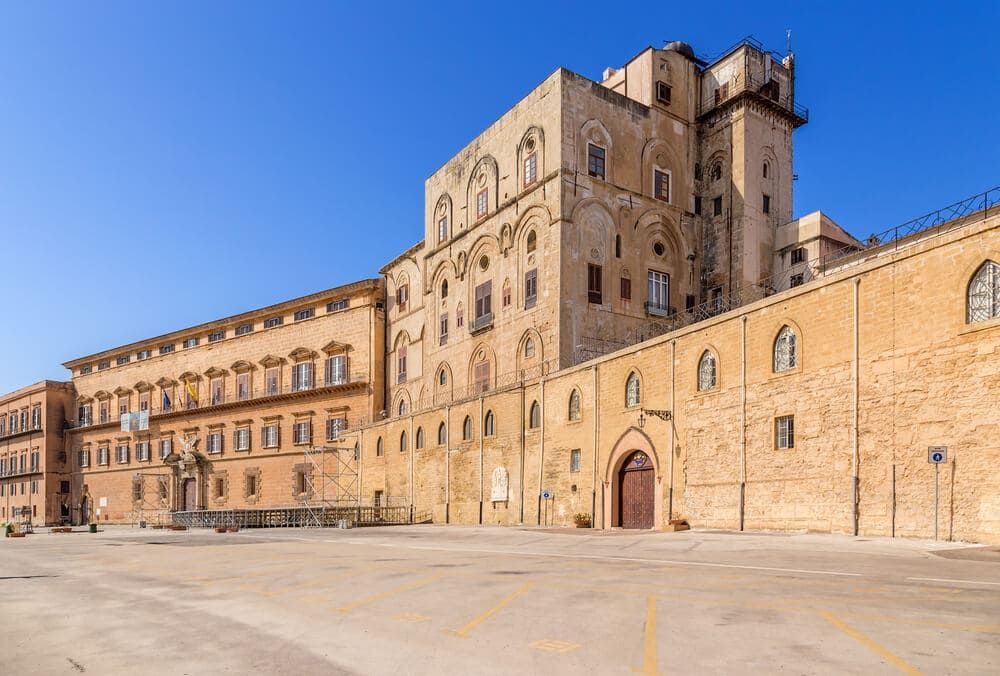
The Palace of the Normans is a condensation of the multicultural history of Sicily, an emblematic monument of Palermo perched on a height. The Palermo audio-guided tour stops here to evoke this former Arab-Norman royal palace, today seat of the Sicilian regional assembly.
Impossible to visit Palermo without passing by the Palace of the Normans, a true condensation of the multicultural history of Sicily. Built on a strategic height of the town, this emblematic monument was originally erected by the Arabs, then profoundly transformed and enlarged by the Norman kings in the twelfth century, who made of it their sumptuous royal palace. It thus testifies to the fascinating meeting of the civilisations that marked Sicily: Arab, Byzantine and Norman mingle in an architecture and an art unique in the world. Its jewel is the Palatine Chapel, an absolute masterpiece, entirely lined with dazzling Byzantine mosaics on a gold background, topped with a ceiling of carved wood of Islamic art, in a perfect harmony of the cultures. Reworked several times over the centuries, the palace also keeps fine royal halls and apartments. Today, it shelters the seat of the Regional Assembly of Sicily, perpetuating its vocation of centre of power. Listed as UNESCO world heritage, it is one of the major monuments of the town. An Arab-Norman jewel and a heart of power, the Palace of the Normans is a must-see stop of the discovery of Palermo.
You admire the former royal palace erected by the Arabs then transformed by the Norman kings in the twelfth century, condensation of the Arab, Byzantine and Norman civilisations of Sicily, whose jewel is the Palatine Chapel, a masterpiece lined with Byzantine mosaics on a gold background under a ceiling of Islamic art, with its royal halls, today seat of the Regional Assembly and listed by UNESCO. The Palace of the Normans is an Arab-Norman jewel of Palermo. It is a must-see stop, to be explored on foot.
The Palace of the Normans lies on a height of the centre of Palermo, reachable on foot. The visit of the palace and the Palatine Chapel follows its own hours and conditions, which vary, and may be limited on certain days because of the activity of the Regional Assembly. It is best to check them before coming.
A former royal palace erected by the Arabs then transformed by the Norman kings in the twelfth century, a true condensation of the Arab, Byzantine and Norman civilisations of Sicily; its jewel is the Palatine Chapel, lined with Byzantine mosaics on a gold background under a ceiling of Islamic art, and it today shelters the seat of the Regional Assembly, listed by UNESCO.
On a height of the centre of Palermo, in Italy.
Aucun avis pour le moment
