





Walk
The Echo of the Temples in the Ancient Capital
Kyoto, Japan
Walk
The Echo of the Temples in the Ancient Capital
Kyoto, Japan
5.4 km
Distance
2h15
Durée
25
Audios
Loop
Parcours
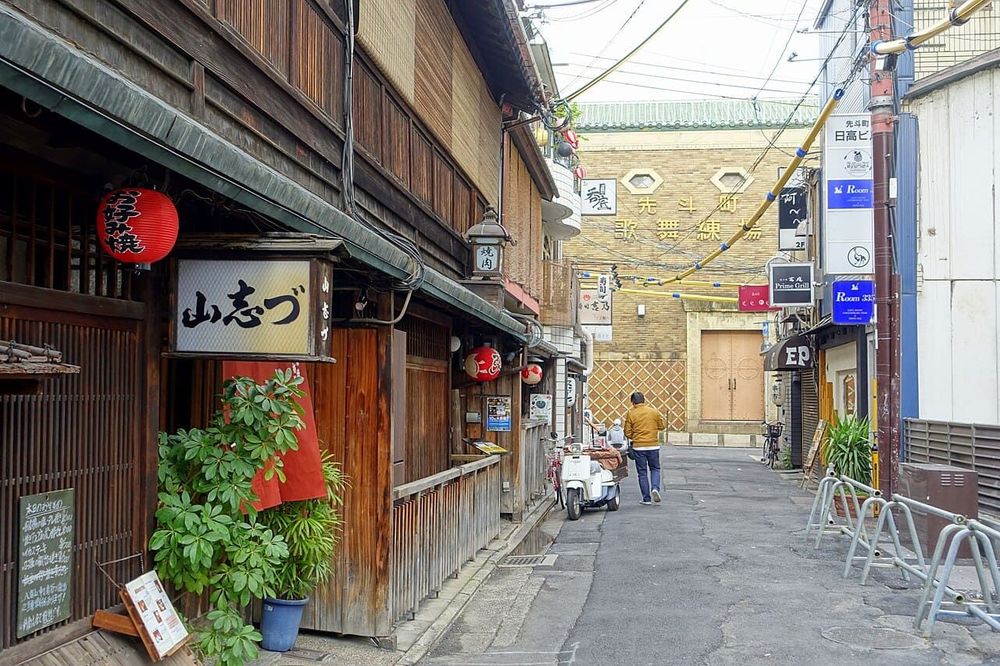
©Daderot CC0 1.0 <https://creativecommons.org/publicdomain/zero/1.0/deed.fr>via Wikipedia Commons
By the Kamo River, in the Pontochō district, hides one of the most secret places in Kyoto: the Pontochō Kaburenjo. It is the theatre of the district, where geishas perform and great dance shows are held. The Kyoto audio-guided tour stops here to evoke the refined world of the city's traditional arts.
The Pontochō district has been renowned for its nightlife and its traditional arts since the seventeenth century. Its theatre, the Kaburenjo, hosts notably the Kamogawa Odori, a dance show presented by the geishas and apprentice geishas of the district. This place perpetuates a refined artistic know-how, passed down from generation to generation, in the heart of one of Kyoto's most emblematic districts.
The theatre is discovered at the end of the Pontochō lane, near the Kamo River, in an intimate setting. During the performance seasons, you can attend traditional dance shows, a rare and precious experience. Even from the outside, the building and its district offer a dive into the Kyoto of the geishas and the performing arts.
The Pontochō Kaburenjo theatre lies in the Pontochō district, by the Kamo River, in the centre of Kyoto, reachable on foot. The exterior can be freely discovered; access to performances is during the dedicated seasons, such as the Kamogawa Odori, whose dates and conditions vary by year. It is best to enquire in advance to attend a performance.
It is the theatre of the Pontochō district, by the Kamo River, where geishas perform, notably during the Kamogawa Odori dance show.
Yes, during the dedicated seasons such as the Kamogawa Odori; the dates and conditions vary by year, to be checked in advance.
Aucun avis pour le moment
