





Walk
The Echo of the Temples in the Ancient Capital
Kyoto, Japan
Walk
The Echo of the Temples in the Ancient Capital
Kyoto, Japan
5.4 km
Distance
2h15
Durée
25
Audios
Loop
Parcours
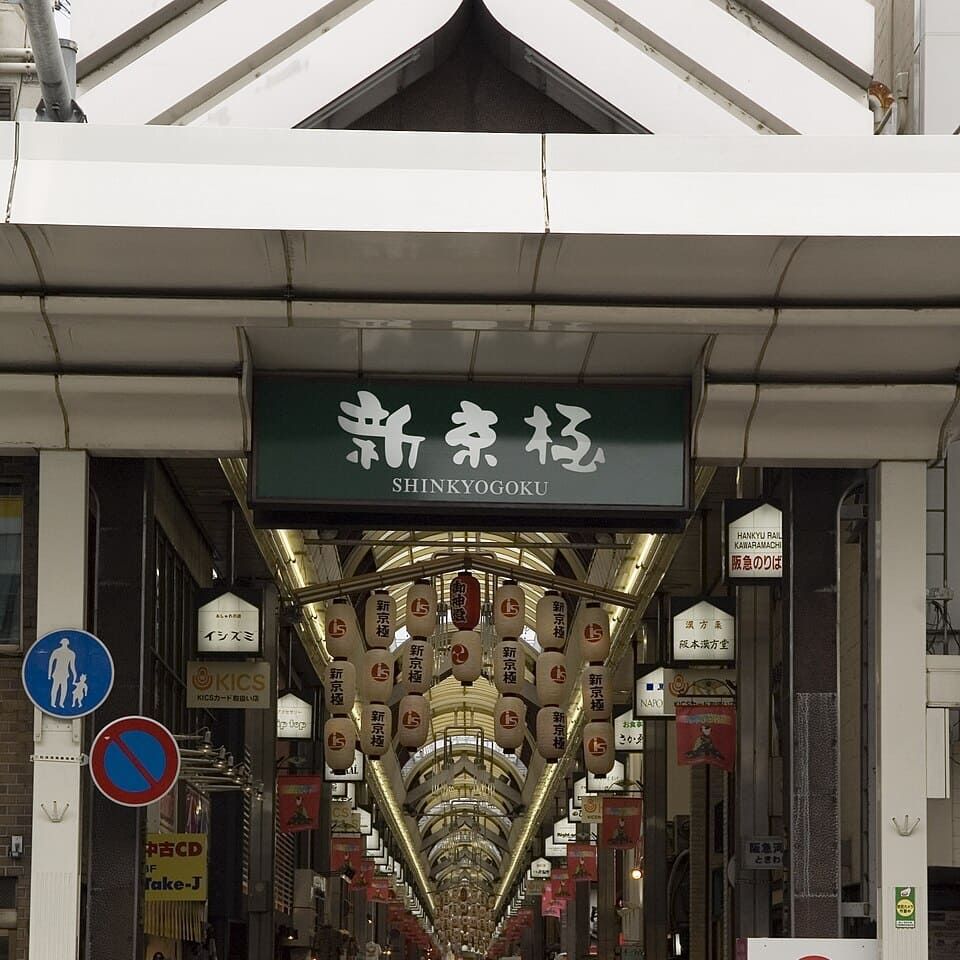
©galaygobi CC BY-SA 2.0. <https://creativecommons.org/licenses/by-sa/2.0/deed.fr>via Wikipedia Commons
Neighbour to Teramachi, Shinkyōgoku Street is a lively shopping arcade, more recent than its famous cousin. Its creation tells of a pivotal moment in Kyoto's history, when the former capital sought to reinvent itself. The Kyoto audio-guided tour stops here to evoke this revival through commerce and entertainment.
Shinkyōgoku came into being in 1872, at the start of the Meiji era, in a difficult time for Kyoto. When the emperor moved to Tokyo, the former capital lost some of its influence. To give the city new energy, a former temple zone was transformed into a street devoted to commerce and leisure. Shinkyōgoku thus became a symbol of Kyoto's revival in the modern era.
The Shinkyōgoku arcade is full of shops, restaurants and entertainment venues, in a young and popular atmosphere. Covered and pedestrian, it forms with Teramachi a shopping labyrinth ideal for strolling under cover. You also come across a few discreet temples, vestiges of the district's original vocation, which add a touch of history to the bustle.
Shinkyōgoku Street lies in the centre of Kyoto, parallel to Teramachi, reachable on foot and by public transport. Covered and pedestrian, it is freely accessible; the shops each have their own hours, often until the evening. Walking remains the best way to explore the arcade and move from one street to the other.
In 1872, at the start of the Meiji era, when a former temple zone was transformed into a shopping street to give Kyoto new energy after the emperor's departure for Tokyo.
Shinkyōgoku is more recent, created in 1872, and more oriented towards entertainment, while Teramachi, older, keeps traditional shops; the two neighbouring arcades form a single shopping labyrinth.
Aucun avis pour le moment
