





Walk
The Echo of the Temples in the Ancient Capital
Kyoto, Japan
Walk
The Echo of the Temples in the Ancient Capital
Kyoto, Japan
5.4 km
Distance
2h15
Durée
25
Audios
Loop
Parcours
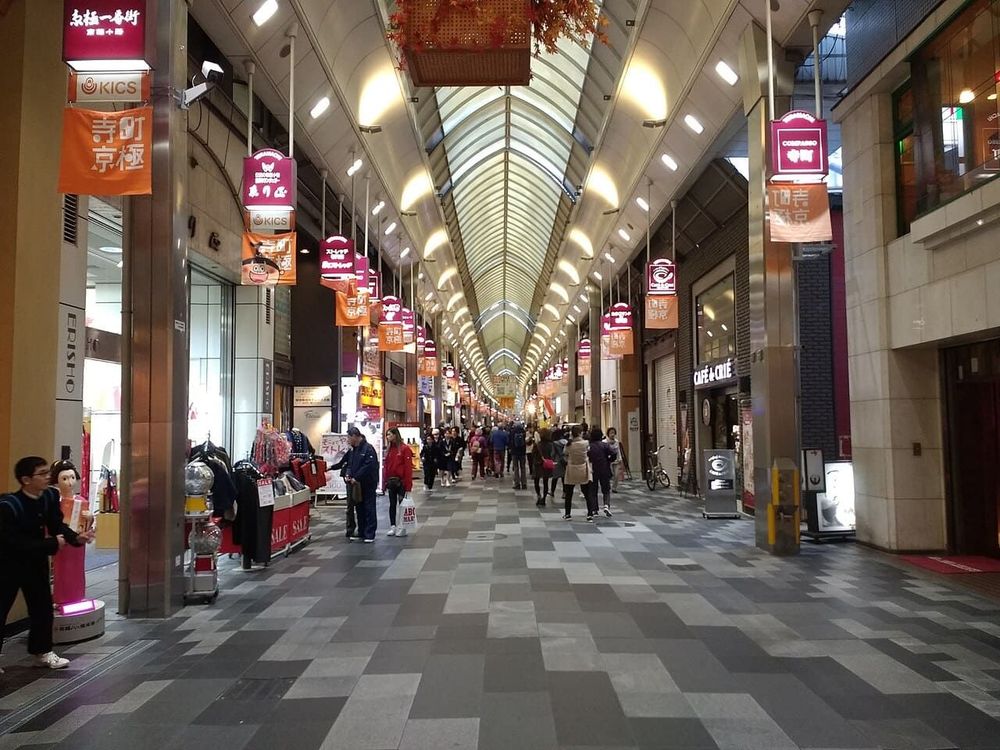
©Mx. Granger CC0 1.0 <https://creativecommons.org/publicdomain/zero/1.0/deed.fr>via Wikipedia Commons
Under its covered arcade, in the heart of Kyoto, Teramachi Street is today a lively shopping artery. But its name, which means the town of temples, betrays a much older history. The Kyoto audio-guided tour takes it to reveal how a street devoted to worship became one of the great shopping axes of the city.
The name Teramachi recalls that a multitude of temples were once gathered there. Over time, the street was transformed into one of the great shopping arcades of Kyoto, forming with its neighbour Shinkyōgoku a true labyrinth of shops and restaurants. A few temples nonetheless remain between the shops, discreet witnesses of the place's original vocation.
Teramachi is renowned for its shops of stationery, antiques, tea and traditional crafts, among the most interesting of Kyoto's covered arcades. You stroll under cover, between old stalls and modern shops, coming across here and there a discreet temple. It is an excellent starting point to explore the commercial and historic centre of the city.
Teramachi Street lies in the centre of Kyoto, between the great avenues, reachable on foot and by public transport. Covered and pedestrian, it is freely accessible; the shops each have their own hours. Walking remains the best way to enjoy the arcade and its shops, sheltered from the weather.
It means the town of temples, referring to the many temples once gathered along this street, now become a great shopping arcade.
Shops of stationery, antiques, tea and traditional crafts, under a covered arcade, with a few discreet temples remaining between the shops.
Aucun avis pour le moment
