





Walk
From Mayan heritage to colonial elegance
Mérida, Mexico
Walk
From Mayan heritage to colonial elegance
Mérida, Mexico
5.6 km
Distance
2h30
Durée
28
Audios
Loop
Parcours
Shutterstock
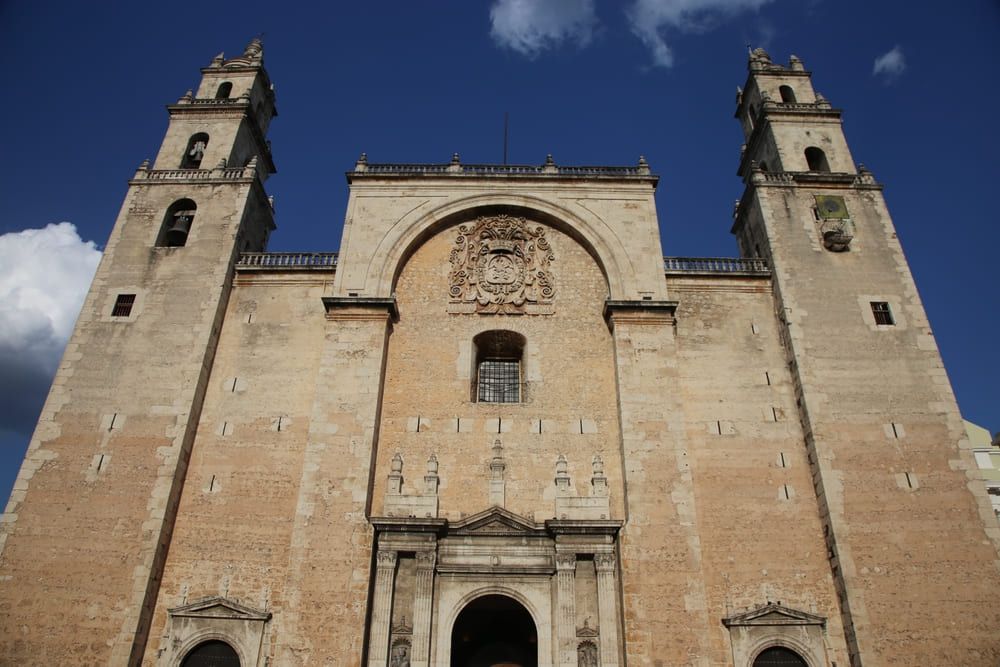
On the Plaza Grande stands San Ildefonso Cathedral, one of the oldest and most imposing monuments of Mérida. Its construction began in the sixteenth century, shortly after the founding of the city. The Mérida audio-guided tour stops here to evoke this major witness of the colonial era, one of the oldest cathedrals on the American continent.
The construction of San Ildefonso Cathedral, also called the cathedral of Yucatán, began in 1562 and was completed in 1598. Dedicated to Saint Ildefonsus, it is among the oldest cathedrals on the American continent. Built in part with the stones of the Maya temples of the ancient city of T'hó, on which Mérida was built, it illustrates the encounter, often brutal, between two worlds.
The cathedral appeals through its plain and massive façade, its towers and its stripped interior, typical of the first great churches of New Spain. Here you discover notably a large crucifix and an atmosphere of contemplation, in the heart of the Plaza Grande. It is an essential stop to understand the colonial and religious history of Mérida.
San Ildefonso Cathedral lies on the Plaza Grande, in the heart of the historic centre of Mérida, reachable on foot. A working Catholic place of worship, it can be visited with respect for services; entry is generally free, but hours vary with masses and celebrations. It is best to check them before coming.
Its construction took place from 1562 to 1598; dedicated to Saint Ildefonsus, it is one of the oldest cathedrals on the American continent.
Because it is the cathedral of the state of Yucatán, of which Mérida is the capital; it is also called San Ildefonso Cathedral, after the saint to whom it is dedicated.
Aucun avis pour le moment
