





Walk
A backdrop to Adventure and Legends
Campeche, Mexico
Walk
A backdrop to Adventure and Legends
Campeche, Mexico
4.3 km
Distance
2h00
Durée
22
Audios
Loop
Parcours
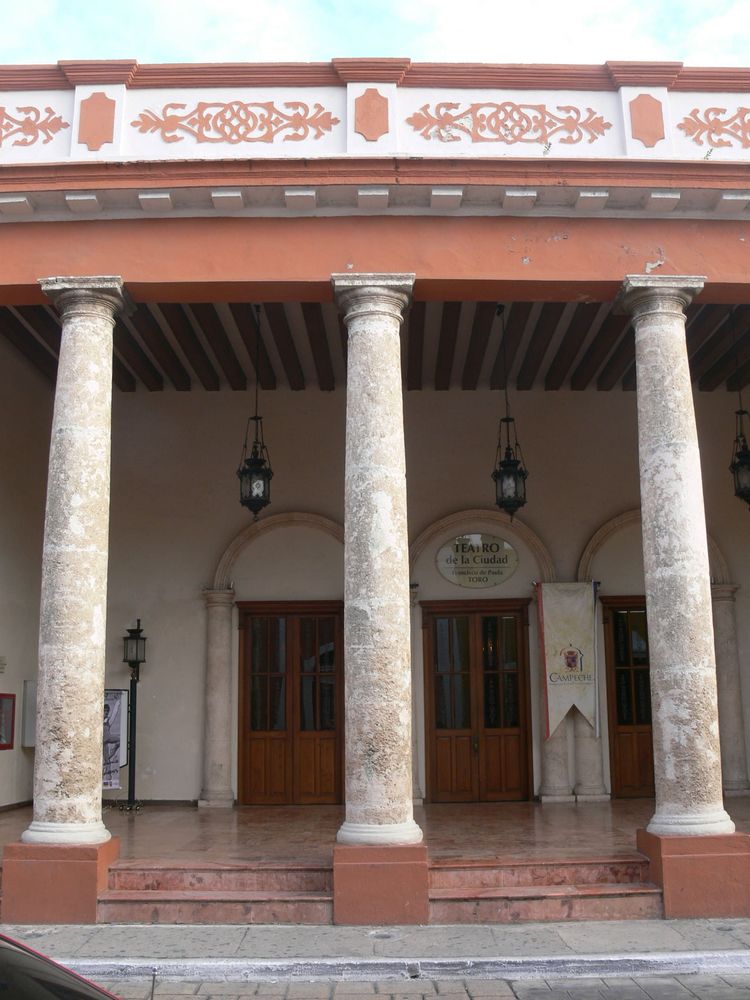
©Wolfgang Sauber, CC BY-SA 3.0 <https://creativecommons.org/licenses/by-sa/3.0/deed.fr>via Wikipedia Commons
The Teatro de la Ciudad Francisco de Paula Toro is a neoclassical jewel of the nineteenth century, one of the first lyric theatres built in Mexico. The Campeche audio-guided tour stops here to evoke this symbol of Campeche culture, born of the will of general Francisco de Paula Toro, whose novelistic construction mingles an imprisoned French architect, a cholera epidemic and a conflict with the Church.
These columns belong to the Teatro de la Ciudad Francisco de Paula Toro, a true neoclassical jewel of the nineteenth century and one of the first lyric theatres built in Mexico, symbol of the culture and the history of Campeche. The project was born of the will of general Francisco de Paula Toro, who wished to endow his city with a theatre worthy of the great capitals, at the term of adventures worthy of a novel. The chosen architect, the Frenchman Théodore Journot, was then imprisoned in Campeche for obscure reasons; rather than remain behind bars, he negotiated an agreement with the shareholders: he would draw the theatre in exchange for his liberty, fifty pesos per month and a bonus at the end of the works. He thus signed his contract from his cell and recovered his liberty. But in 1833, a cholera epidemic struck the city and interrupted the construction site; under the pressure of the local Catholic Church, that saw in the theatre a place of sin, the shareholders had to cede part of the space for the construction of a church dedicated to the Virgin of the Anguishes. The epidemic finally calmed, and the theatrical project could resume, giving birth to this fine building that still marks today the cultural life of the city.
Here you admire a neoclassical jewel of the nineteenth century, one of the first lyric theatres of Mexico, willed by general Francisco de Paula Toro; its novelistic construction mingles an imprisoned French architect who drew the plans from his cell, a cholera epidemic and a conflict with the Church. The Theatre of the City is a symbol of the culture of Campeche. It is a fine stop, to be explored on foot.
The Teatro de la Ciudad Francisco de Paula Toro lies in the historic centre of Campeche, reachable on foot. It is a performance hall in activity, whose programme, hours and access follow the conditions in force, which vary. It is best to enquire before coming.
Willed by general Francisco de Paula Toro, this neoclassical jewel of the nineteenth century was one of the first lyric theatres of Mexico; the French architect Théodore Journot, imprisoned in Campeche, drew its plans from his cell in exchange for his liberty, and a cholera epidemic in 1833, doubled with a conflict with the Church, delayed the construction site before its completion.
In the historic centre of Campeche, in Mexico.
Aucun avis pour le moment
