





Walk
The City of Angels
Puebla, Mexico
Walk
The City of Angels
Puebla, Mexico
7.5 km
Distance
3h00
Durée
27
Audios
Loop
Parcours
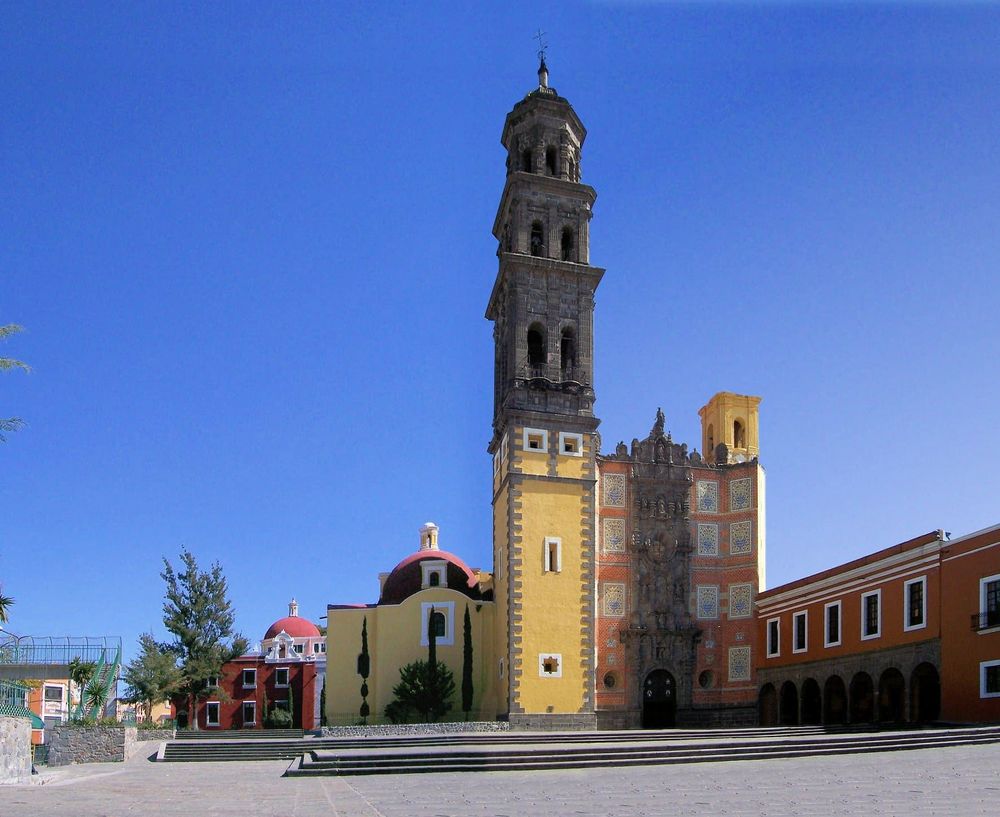
©Ramon Leon Rosas - CC BY-SA 2.5 <https://creativecommons.org/licenses/by-sa/2.5/deed.fr>via Wikipedia Commons
The Convent of San Francisco is one of the oldest and most beautiful religious ensembles of Puebla, with a façade adorned with ceramics. The Puebla audio-guided tour stops here, with respect, to evoke this historic sanctuary, a witness of the beginnings of the colonial town.
The Convent of San Francisco is one of the oldest religious ensembles of Puebla, founded by the Franciscans shortly after the creation of the town in the sixteenth century. The Franciscans were among the first religious orders to settle in Mexico after the Spanish conquest, playing a major role in the evangelisation and the organisation of the new towns. The convent, reworked and embellished several times over the centuries, stands out by its magnificent façade, where the stone mingles with the red brick and the azulejos, these glazed ceramic tiles typical of Puebla, a town renowned for its tradition of talavera. Its church, its tower, its cloister and its chapels compose a fine baroque ensemble. The sanctuary also shelters the venerated body of a local blessed, object of devotion. Surrounded today by a peaceful garden, the convent constitutes a haven of serenity laden with history, away from the bustle of the centre. A historic sanctuary and a witness of the origins of Puebla, the Convent of San Francisco is discovered with respect. It is a stop to be discovered with respect of the discovery of the town.
You admire, with respect, one of the oldest religious ensembles of Puebla, founded by the Franciscans in the sixteenth century, with a magnificent façade mixing stone, red brick and azulejos typical of the talavera of Puebla, with its church, its tower, its cloister and its baroque chapels, sheltering the venerated body of a blessed, surrounded by a peaceful garden. The Convent of San Francisco is a historic sanctuary of Puebla. It is a stop to be discovered with respect.
The Convent of San Francisco lies on the edge of the historic centre of Puebla, reachable on foot. A place of worship, it can be visited with respect for services; access and hours follow their own conditions, which vary. It is best to check them before coming and to respect the sacred character of the place.
One of the oldest religious ensembles of Puebla, founded by the Franciscans in the sixteenth century, shortly after the creation of the town; with a magnificent façade mixing stone, red brick and talavera azulejos, it includes a church, a cloister and baroque chapels, and shelters the venerated body of a blessed.
On the edge of the historic centre of Puebla, in Mexico.
Aucun avis pour le moment
