





Walk
A backdrop to Adventure and Legends
Campeche, Mexico
Walk
A backdrop to Adventure and Legends
Campeche, Mexico
4.3 km
Distance
2h00
Durée
22
Audios
Loop
Parcours
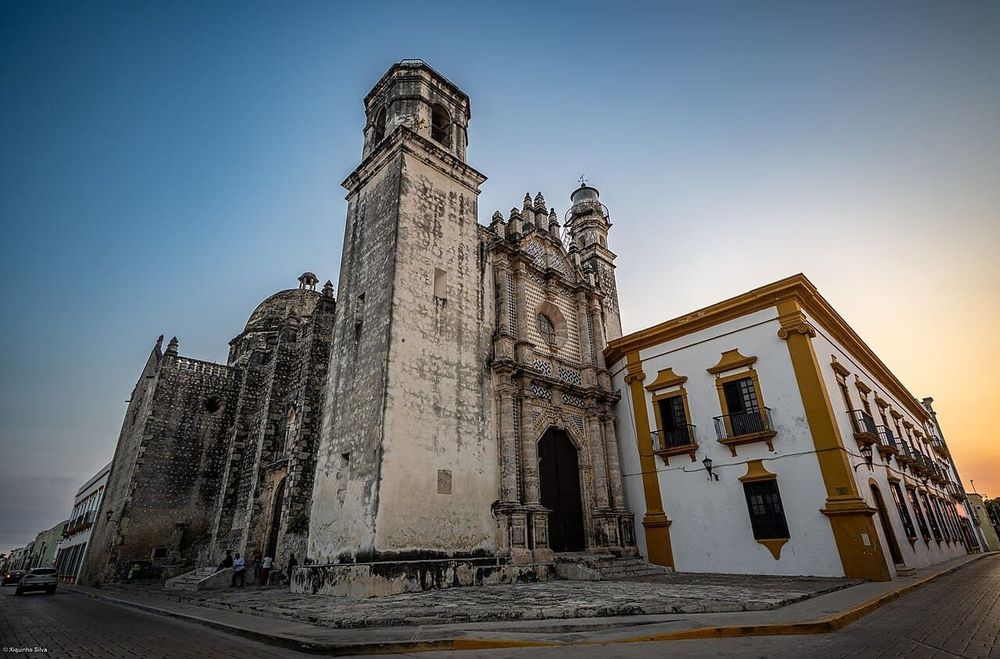
©xiquinhosilva, CC BY 2.0 <https://creativecommons.org/licenses/by/2.0/deed.fr>via Wikipedia Commons
The Ex Templo de San José is a former Jesuit temple of Campeche, remarkable for its façade of blue and white Talavera ceramics and its two towers. The Campeche audio-guided tour stops here, with respect, to evoke this building inaugurated in 1716, the only colonial temple of Mexico to integrate a maritime lighthouse, become after 1914 a cultural place hosting exhibitions in the heart of the fortified town.
This temple was inaugurated in 1716 by the Jesuits, arrived that year in Campeche. It was conceived to replace a small ermita dedicated to Saint Joseph, patron of the ship's carpenters, within the corporation of the artisans of the city. The Jesuits undertook to transform this modest chapel into a true temple of scale, marking the influence of their order on the local architecture. The building, both baroque and neoclassical, is a fine example of the talaveresque style, with its façade adorned with blue and white Talavera ceramics. These Mexican artisanal ceramics, with a milky white background and motifs painted by hand, especially in cobalt blue, were born in the sixteenth century of the mixture of Spanish, Arab, Chinese and indigenous influences; recognised in the Intangible Cultural Heritage of Humanity by UNESCO since 2019, they give the building all its charm. The temple is also distinguished by its two towers, one of which shelters a maritime lighthouse since 1865, which makes it the only colonial temple of Mexico endowed with a functional lighthouse. A place of worship until 1914, it was then reassigned to various civil and cultural functions, and hosts today temporary exhibitions, in the respect of its history.
Here you admire a former Jesuit temple inaugurated in 1716, with its magnificent façade of blue and white Talavera ceramics classified by UNESCO; its two towers, one of which shelters a lighthouse since 1865, make it the only colonial temple of Mexico endowed with a functional lighthouse, and it hosts today exhibitions. The Ex Templo de San José is a jewel of the heritage of Campeche, to be discovered with respect. It is a fine stop, to be explored on foot.
The Ex Templo de San José lies in the historic centre of Campeche, reachable on foot. It is no longer a place of worship but a cultural space hosting exhibitions; the access and the hours follow the conditions in force, which vary. It is best to enquire before coming.
Because it is the only colonial temple of Mexico to integrate a functional maritime lighthouse, installed in one of its two towers since 1865; inaugurated in 1716 by the Jesuits, it is also distinguished by its façade of blue and white Talavera ceramics, classified in the Intangible Cultural Heritage of UNESCO, and hosts today exhibitions.
In the historic centre of Campeche, in Mexico.
Aucun avis pour le moment
