





Walk
From Mayan heritage to colonial elegance
Mérida, Mexico
Walk
From Mayan heritage to colonial elegance
Mérida, Mexico
5.6 km
Distance
2h30
Durée
28
Audios
Loop
Parcours
Shutterstock
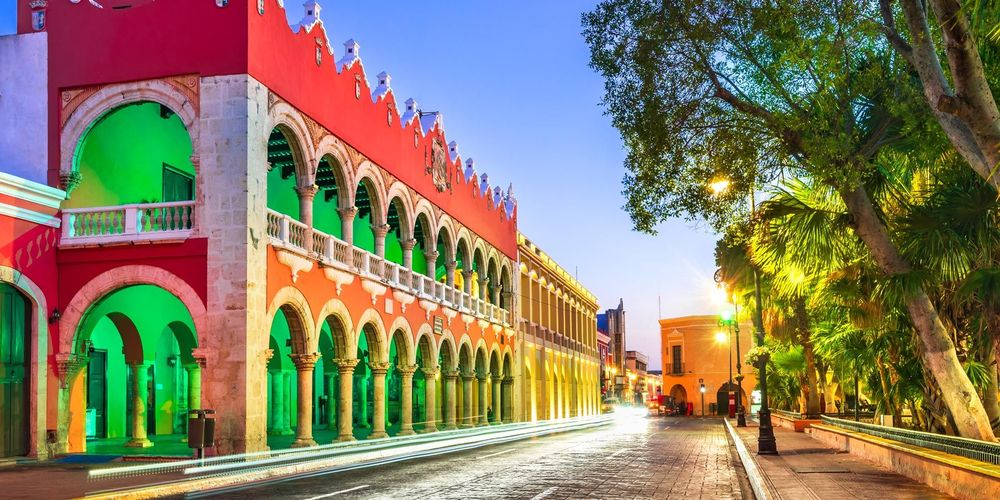
Mérida, today the capital of the state of Yucatán, has a history that stretches back centuries and rests on foundations far older than the modern city itself. Long before the arrival of the Spanish, this region was home to an important Maya city known as T’ho, or Ichcaanzihó, a ceremonial center made up of pyramids, plazas and causeways linking different neighborhoods, and part of a dense network of Maya settlements across the peninsula, whose people already spoke a language and followed traditions that are still alive today. In 1542, the conquistador Francisco de Montejo the Younger founded the Spanish city of Mérida directly on the ruins of T’ho, dismantling Maya temples and reusing their stones to build the first colonial structures, including the Cathedral of San Ildefonso, one of the oldest in the Americas.
Mérida quickly became a major administrative, political and religious center for the Spanish crown in Yucatán, organized around a central square and governed by a rigidly hierarchical society. During the colonial period, the city grew slowly, shaped by its relative geographic isolation and by constant tensions between colonial authorities and Maya communities, who faced heavy taxation, forced labor and the loss of their lands. These tensions reached a breaking point in the nineteenth century with the Caste War, which began in 1847 and saw many Maya groups rise up against the political and economic power of local elites, leading to extreme violence, large-scale displacement and deep divisions across the peninsula, with some regions remaining beyond government control for decades.
At the end of the nineteenth and the beginning of the twentieth century, Mérida was dramatically transformed by the henequén boom, an agave used to make industrial rope and often called green gold. This sudden wealth turned the city into one of the most prosperous in Mexico, brought strong European influences and led to the construction of grand mansions, theaters and the Paseo de Montejo, inspired by Parisian boulevards. After the Mexican Revolution, the collapse of the henequén market brought this era of prosperity to an end, but over time the city reinvented itself as a cultural, academic and tourist center.
Today, Mérida is known for the careful preservation of its historic center, the vitality of its Maya and Creole traditions, and its distinctive identity, where pre-Hispanic heritage, the colonial past and contemporary life exist side by side every day.
Aucun avis pour le moment
