





Walk
A backdrop to Adventure and Legends
Campeche, Mexico
Walk
A backdrop to Adventure and Legends
Campeche, Mexico
4.3 km
Distance
2h00
Durée
22
Audios
Loop
Parcours
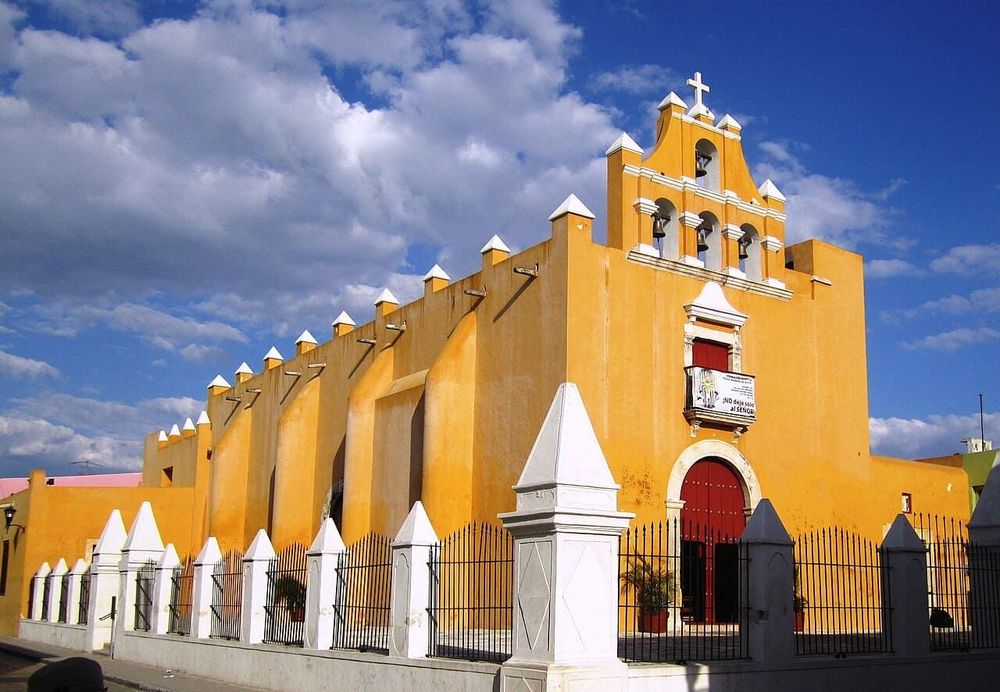
©Elelicht, CC BY-SA 3.0 <https://creativecommons.org/licenses/by-sa/3.0/deed.fr>via Wikipedia Commons
The Iglesia del Dulce Nombre de Jesús, nicknamed "the yellow church", is one of the oldest places of worship of Campeche. The Campeche audio-guided tour stops here, with respect, to evoke this church born in the sixteenth century as a spiritual refuge of the marginalised populations of the city, become the main parish before the cathedral, and recognisable by its vibrant yellow façade and its great buttresses.
Affectionately nicknamed "the yellow church" by reason of its dazzling façade, this church testifies to the colonial history and the spiritual richness of Campeche. Its history goes back to the sixteenth century: originally, a small capilla abierta, or open chapel, had been founded for the marginalised populations of the city, mainly the morenos, that is the indigenous, the slaves and the mestizos. This place, destined to serve as a spiritual refuge for the groups excluded from the main parish, constitutes one of the rare visible examples of the religious segregation of the era, that should be looked at with distance and respect. It is only at the beginning of the seventeenth century that the place became a complete church, and even the main parish of Campeche, before the completion of the cathedral. In 1685, during the devastating attack led by the pirate known under the name of Lorencillo, the church was partially burned, but quickly restored, preserving its authenticity. Its architecture is distinguished by a simple but imposing façade, painted in bright yellow, that contrasts with the pastel colours of the surrounding buildings and makes it one of the most photographed buildings of the city. You also notice there great buttresses that, besides their function of support, recall the era when the church served as a refuge in case of attack.
Here you discover "the yellow church", one of the oldest places of worship of Campeche, born in the sixteenth century as a spiritual refuge of the marginalised populations and become the main parish before the cathedral; its bright yellow façade and its great buttresses, that also served as a refuge, make it one of the most photographed buildings. The Iglesia del Dulce Nombre de Jesús is a place of memory and prayer, to be visited with respect. It is a fine stop, to be explored on foot.
The Iglesia del Dulce Nombre de Jesús lies in the historic centre of Campeche, reachable on foot. It is a place of worship in activity, whose access is made in the respect of the services and of contemplation; the hours of visit vary. It is best to enquire before coming and to adopt correct attire.
Because it is one of the oldest places of worship of the city: born in the sixteenth century as an open chapel for the marginalised populations, a spiritual refuge of the groups excluded from the main parish, it became in the seventeenth century the main parish of Campeche before the completion of the cathedral; its bright yellow façade and its buttresses make it an emblematic building.
In the historic centre of Campeche, in Mexico.
Aucun avis pour le moment
