





Walk
The City that rose from the sea
Alesund, Norway
Walk
The City that rose from the sea
Alesund, Norway
3.6 km
Distance
1h50
Durée
18
Audios
Loop
Parcours
Shutterstock
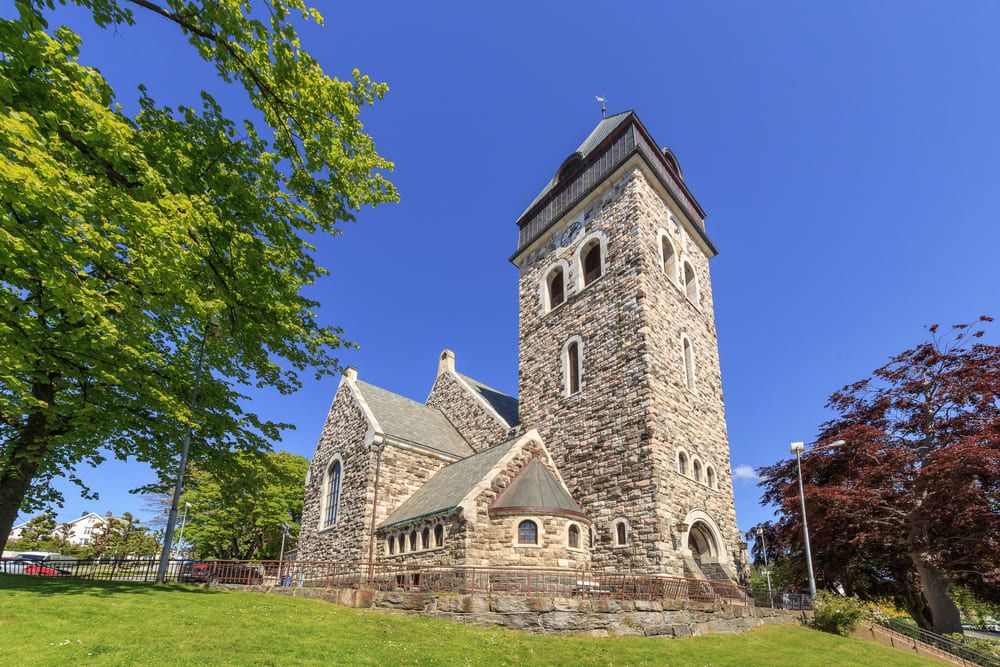
The Church of Ålesund is the main religious building of the town, rebuilt after the great fire of 1904. The Ålesund audio-guided tour stops here, with respect, to evoke this sanctuary of the 1910s, a witness of the rebirth of the town and its heritage.
You are here facing the main church of Ålesund. A first church had been built at this location in 1855, but it was entirely destroyed during the great fire of 1904, which ravaged almost all of the town. The current church was rebuilt in the 1910s, on the plans of the Norwegian architect Sverre Knudsen, within the framework of the rebirth of the town. Built in stone, it stands out by its architecture inspired by the medieval and national romantic Norwegian style, which contrasts with the dominant Art Nouveau of the civil buildings of the town. Inside, the building is remarkable by its magnificent frescoes that adorn the walls and the choir, as well as by its stained-glass windows, which bathe the space in a coloured light and create an atmosphere of contemplation. The church testifies to the faith of the inhabitants and their will to rebuild a worthy place of worship, after the catastrophe. A major sanctuary and a symbol of the rebirth of Ålesund, the church is discovered with respect.
You admire, with respect, the main church of Ålesund, rebuilt in the 1910s by the architect Sverre Knudsen after the destruction of the previous one during the fire of 1904, with stone architecture inspired by the medieval and national romantic style, with an interior adorned with magnificent frescoes and stained-glass windows. The Church of Ålesund symbolises the rebirth of the town. It is a stop to be discovered with respect.
The Church of Ålesund lies in the heart of the town, reachable on foot. A place of worship, it can be visited with respect for services; access and hours follow their own conditions, which vary. It is best to check them before coming and to respect the sacred character of the place.
Because the first church, built in 1855, was entirely destroyed during the great fire of 1904; the current church was rebuilt in the 1910s by the architect Sverre Knudsen, in stone, in a medieval and national romantic style, adorned with frescoes and stained-glass windows.
In the heart of Ålesund, in Norway.
Aucun avis pour le moment
