





Walk
The City that rose from the sea
Alesund, Norway
Walk
The City that rose from the sea
Alesund, Norway
3.6 km
Distance
1h50
Durée
18
Audios
Loop
Parcours
Shutterstock
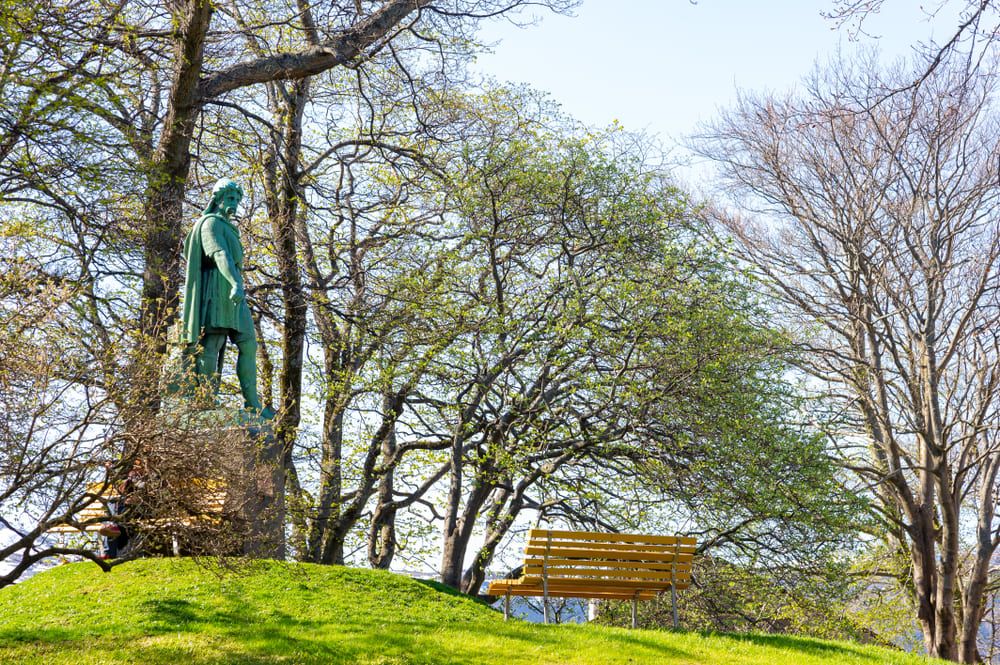
The statue of Rollo pays tribute to the famous Viking chief, founder of the Duchy of Normandy, native of the region of Ålesund. The Ålesund audio-guided tour stops here to evoke this bronze work, given by the city of Rouen, which recalls the link between Norway and Normandy.
This imposing moustache belongs to Rollo, a Viking chief of the ninth century. This bronze statue of two metres sixty-five in height pays tribute to one of the most fascinating figures of the Middle Ages: the founder of the Duchy of Normandy. According to tradition, Rollo was native of the region of Sunnmøre, of which Ålesund is the main town. A leader of a Viking band, he led expeditions in France before obtaining from the king of France, at the beginning of the tenth century, a vast territory that would become Normandy, in exchange for his protection and his conversion to Christianity. His descendants, the dukes of Normandy, profoundly marked the history of Europe, up to William the Conqueror. Given to the town of Ålesund in 1911 by the city of Rouen, capital of Normandy, this statue is the replica of the one that stands in Rouen, and symbolises the historic link between Norway and Normandy. A witness of the Viking epic and of this kinship, the statue of Rollo is an interesting stop of Ålesund.
You admire the bronze statue of two metres sixty-five representing Rollo, a Viking chief of the ninth century and founder of the Duchy of Normandy, who was native of the region of Sunnmøre; given in 1911 by the city of Rouen, a replica of the one in Rouen, it symbolises the historic link between Norway and Normandy. The statue of Rollo evokes the Viking epic in Ålesund. It is a stop to be discovered, to be explored on foot.
The statue of Rollo lies in the heart of Ålesund, reachable on foot. It is an open-air statue, freely visible. You discover it during a walk in the centre.
A Viking chief of the ninth century, founder of the Duchy of Normandy, who was native of the region of Sunnmøre of which Ålesund is the main town; the statue, given in 1911 by the city of Rouen, is the replica of the one in Rouen and symbolises the link between Norway and Normandy.
In the heart of Ålesund, in Norway.
Aucun avis pour le moment
