





Walk
Short tour -The Hill of the Gods
Oslo, Norway
Walk
Short tour -The Hill of the Gods
Oslo, Norway
5.1 km
Distance
2h00
Durée
20
Audios
Loop
Parcours
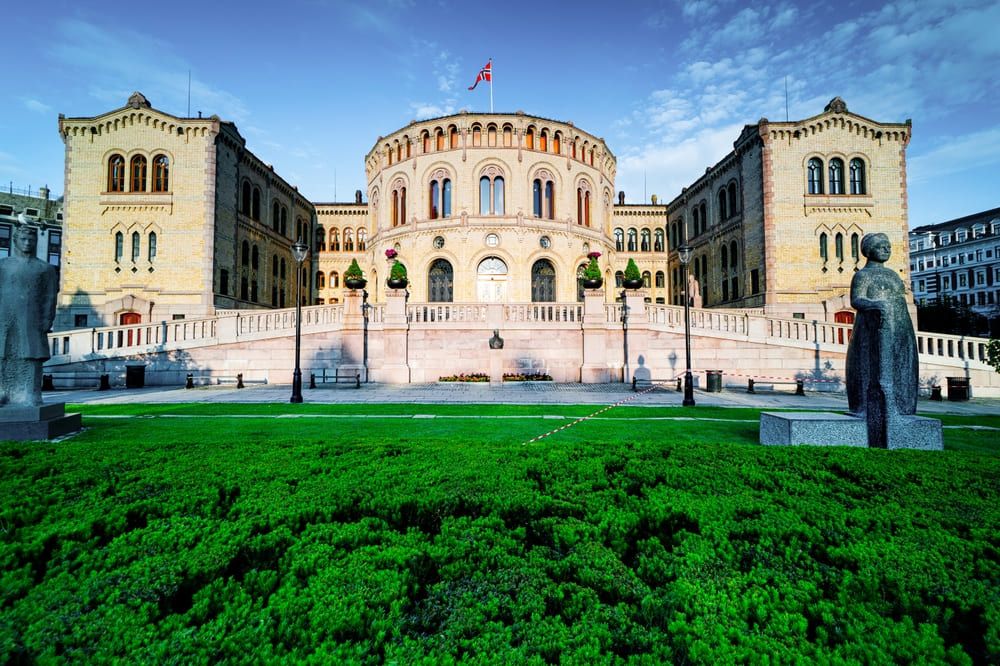
The Parliament, the Storting, is the seat of Norwegian democracy, in the heart of Oslo. The Oslo audio-guided tour stops here to evoke this nineteenth-century building, a symbol of the political life of the country.
The Parliament of Norway, called the Storting, sits in a fine nineteenth-century building, located on the Karl Johan avenue, in the heart of Oslo. This yellow brick building, with a recognisable façade topped with a rounded central part, shelters the national assembly where the laws of the country are debated and voted. It embodies Norwegian parliamentary democracy, one of the oldest and most solid of Europe. Located not far from the Royal Palace, at the other end of the avenue, it forms with it a symbolic axis between royalty and popular representation. The Parliament is a major building of the political life and the identity of Oslo.
You admire the fine nineteenth-century yellow brick building, with a recognisable façade topped with a rounded central part, seat of the Storting on the Karl Johan avenue. The Parliament embodies Norwegian democracy. It is a stop for those curious about history and politics, to be explored on foot.
The Parliament of Norway lies on the Karl Johan avenue, in the heart of Oslo, reachable on foot and by public transport. You mainly admire its façade from the avenue; it is an official building whose access follows its own conditions and hours. You discover it during a walk in the centre.
The Storting; this national assembly, where the laws are debated and voted, sits in a nineteenth-century yellow brick building on the Karl Johan avenue, in the heart of Oslo.
On the Karl Johan avenue, in the heart of Oslo, in Norway.
Aucun avis pour le moment
