





Walk
The City that rose from the sea
Alesund, Norway
Walk
The City that rose from the sea
Alesund, Norway
3.6 km
Distance
1h50
Durée
18
Audios
Loop
Parcours
Shutterstock
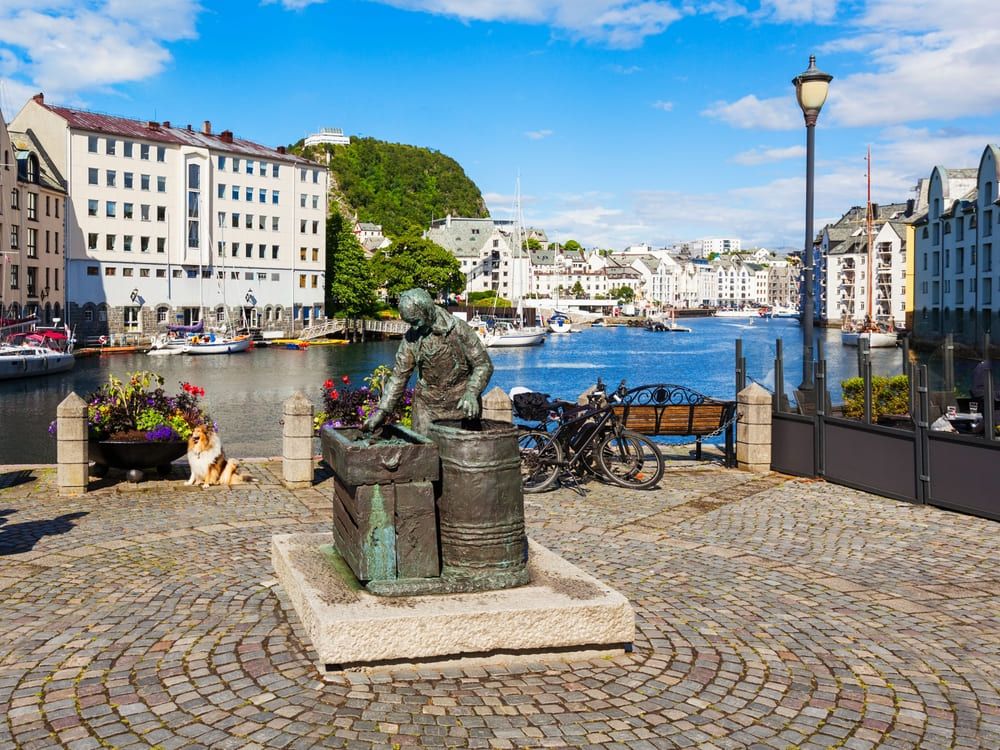
The Sildekona and Fiskergutten statues, on the Apotekertorget square, pay tribute to the maritime identity of Ålesund and to its workers. The Ålesund audio-guided tour stops here to evoke these two bronze works, dedicated to the world of fishing and the herring industry.
On the Apotekertorget square stand two statues that pay tribute to the maritime identity of the town and to its workers, in particular those of the herring industry, long at the heart of the economy of Ålesund. On the left, Sildekona, the Herring Woman, erected in 1991, is a bronze work of the artist Bjørn Tore Skjølsvik: it represents a standing woman worker, evoking the essential role played by the women in the work of the fish, the salting and the preparation of the herring, which supported entire families. At her side, Fiskergutten, the Young Fisherman, embodies for its part the world of fishing and the youth that went to sea. Together, these two figures honour the memory of these anonymous workers, men and women, who built the prosperity of the town thanks to the sea. Witnesses of the maritime and working-class past of Ålesund, the Sildekona and Fiskergutten statues are a touching stop of the discovery of the town.
You admire, on the Apotekertorget square, the two bronze statues that honour the workers of the sea: Sildekona, the Herring Woman, erected in 1991 by Bjørn Tore Skjølsvik, representing a fish worker, and Fiskergutten, the Young Fisherman, embodying the world of fishing, witnesses of the maritime past and the herring industry of Ålesund. The Sildekona and Fiskergutten statues honour the workers of the town. It is a touching stop, to be explored on foot.
The Sildekona and Fiskergutten statues lie on the Apotekertorget square, in the heart of Ålesund, reachable on foot. They are open-air statues, freely visible. You discover them during a walk in the centre.
They pay tribute to the maritime identity of the town: Sildekona, the Herring Woman, erected in 1991, represents a fish worker and the role of the women in the herring industry, and Fiskergutten, the Young Fisherman, embodies the world of fishing that made the prosperity of Ålesund.
On the Apotekertorget square, in the heart of Ålesund, in Norway.
Aucun avis pour le moment
