




Walk
Short tour - A humble Arabia
Mascate, Oman
Walk
Short tour - A humble Arabia
Mascate, Oman
3.8 km
Distance
1h50
Durée
14
Audios
Loop
Parcours
Shutterstock
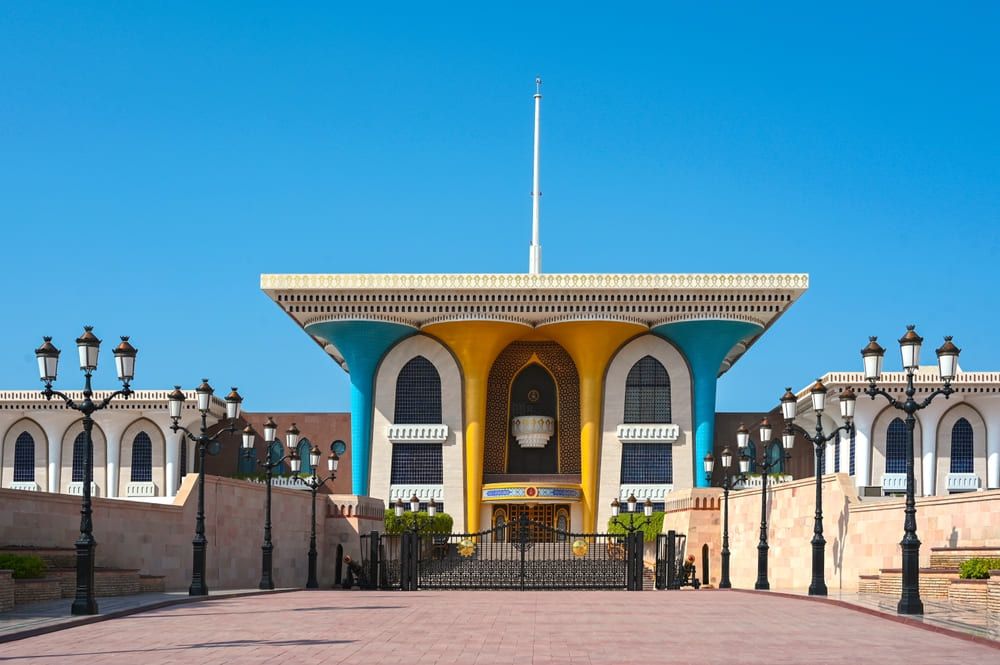
The Al Alam Palace is the official ceremonial palace of the Sultan of Oman, a colourful jewel of old Muscat. The Muscat audio-guided tour stops here to evoke this emblematic monument, framed by Portuguese forts, facing the bay.
The Al Alam Palace is the official ceremonial palace of the Sultan of Oman, one of the most emblematic monuments of Muscat. Its name means the palace of the flag, and it occupies a highly symbolic location, in the heart of old Muscat. The palace stands facing the bay, between the two Portuguese forts that once guarded the entrance of the port: Al Mirani to the west and Al Jalali to the east. It also faces the National Museum. The current building, with a modern but Omani-inspired architecture, stands out by its colourful façade, adorned with high flared columns painted in bright blue and gold, which make it a spectacular and photographed place. The palace is not a permanent residence but is used for official receptions and state ceremonies. A symbol of power and Omani hospitality, the Al Alam Palace is a must-see stop of old Muscat.
You admire the official ceremonial palace of the Sultan of Oman, the palace of the flag, with a colourful façade adorned with high flared columns in bright blue and gold, which stands facing the bay, between the Portuguese forts Al Mirani and Al Jalali, facing the National Museum. The Al Alam Palace is a symbol of Muscat. It is a must-see stop, to be explored on foot.
The Al Alam Palace lies in the heart of old Muscat, facing the bay, reachable on foot and by public transport. You admire its façade and the esplanade from outside; it is an official palace that is not visited inside, but whose surroundings are freely accessible. The light is particularly beautiful at the end of the day.
Its name means the palace of the flag; it is the official ceremonial palace of the Sultan of Oman, which stands in the heart of old Muscat, between the Portuguese forts Al Mirani and Al Jalali, and is used for receptions and state ceremonies.
In the heart of old Muscat, facing the bay, in Oman.
Aucun avis pour le moment