




Walk
The Navel of the World
Cusco, Pérou
Walk
The Navel of the World
Cusco, Pérou
5.1 km
Distance
2h20
Durée
23
Audios
Loop
Parcours
Shutterstock
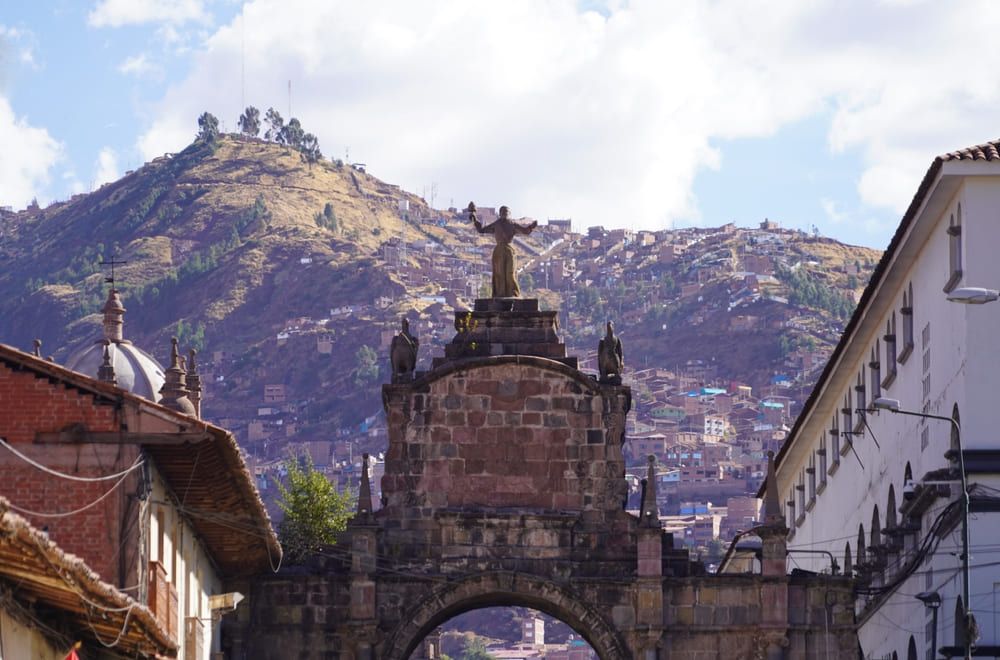
Flanked by two condors, the statue of Liberty watches over you as you pass through the Arco de Santa Clara, often considered one of the most beautiful triumphal arches in Peru. Built in 1835 by Marshal Andrés de Santa Cruz, it originally commemorated the beginnings of the Peru-Bolivian Confederation. But this monument also opens the door onto one of the great political dramas in South American history: the collapse of Spanish rule and the arrival of the famous Simón Bolívar.
To understand what happened, we need to go back to the early 1820s. Rebellion against Spain was spreading across South America, but Peru, with its immense reserves of gold and silver, remained tightly locked in the grip of the Spanish Empire. In 1821, a general arrived in Lima and proclaimed Peru’s independence: José de San Martín, fresh from helping liberate Argentina and Chile.
There was just one problem. Spanish forces still held firmly to the Andes and had no intention of giving up. If independence was going to mean anything, they still had to be driven out.
San Martín realized he couldn’t do it alone. So in 1822, he met the continent’s other great liberator, Simón Bolívar. Their meeting took place behind closed doors, but the outcome was clear.
San Martín, who favored a constitutional monarchy, understood that there was little room for two heroes and stepped aside, leaving Bolívar free to take the lead. Bolívar did nothing by half measures. Congress granted him full powers, effectively making him a military dictator.
And if the Spanish were going to be forced out, it seemed to require an iron hand. In 1824, two legendary battles appeared to prove him right. The first came at Junín in August, more than 4,000 meters (13,100 feet) above sea level.
It became known as the “battle without smoke” because, for 45 minutes, the cavalry fought entirely with lances and sabers—not a single gunshot was fired. Then came Ayacucho in December, where Bolívar’s right-hand man, General Antonio José de Sucre, decisively defeated the viceroy’s army and brought 333 years of Spanish domination to an end. Then, on June 25, 1825, came Bolívar’s triumphant arrival in Cusco.
He entered the city to cheering crowds and was presented with a gold crown set with diamonds. He visited Sacsayhuamán, traveled through the Sacred Valley, and, most importantly, signed a series of historic decrees. That same year, he abolished forced Indigenous labor, ended the colonial tribute, and ordered the return of lands that had been seized.
But the honeymoon didn’t last. In 1826, Bolívar sought to introduce a so-called “Constitution for Life.” To many Peruvians, the liberator was beginning to look dangerously like a new oppressor. Facing growing opposition, he left the country that same year and died in 1830 on his way into voluntary exile, leaving behind the bitter words: “I have plowed the sea.” But independent Peru had been born—and every July 28, the country still celebrates its independence.
Aucun avis pour le moment
