





Walk
The Navel of the World
Cusco, Pérou
Walk
The Navel of the World
Cusco, Pérou
5.1 km
Distance
2h20
Durée
23
Audios
Loop
Parcours
©Chalisimo5, CC BY-SA 4.0 httpscreativecommons.orglicensesby-sa4.0, via Wikimedia Commons
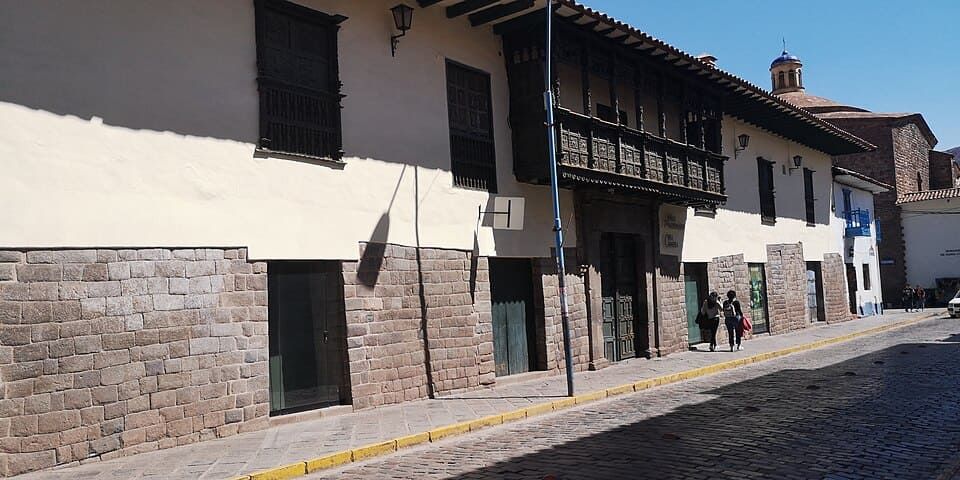
On your right, this museum holds some of the clues to Peru’s greatest mystery: what exactly was Machu Picchu? Forget the familiar image of a military fortress or a “lost city.” Historians today generally agree that it was a llaqta—a royal retreat commissioned by Emperor Pachacútec in the 15th century. Picture an elite mountain residence combined with an agricultural center and sacred sanctuary, set between the peaks of the Andes and the Amazon rainforest.
Machu Picchu is fascinating not only because of its spectacular setting, but because its history is unusually silent. The Incas had no alphabetic writing system comparable to ours. Instead, they used quipus— knotted wool cords used to record numerical and accounting information.
And because the conquistadors passed nearby without ever discovering the site, Machu Picchu appears in no Spanish chronicle. Today, this museum houses the world’s largest collection of artifacts from Machu Picchu, returned by Yale University in 2011. As you explore the galleries, you’ll find hundreds of objects, along with numerous human remains.
DNA analysis of these bones revealed that the people buried there came from a remarkably diverse community, with origins in the Andes, the coast, and the Amazon. When the emperor wasn’t staying at Machu Picchu, this cosmopolitan population of servants and artisans maintained the site year-round. Don’t expect to find a mummy here, though.
If you want to meet the famous Juanita, you’ll have to head to Arequipa. And despite what you may have heard, the Incas did not carry out human sacrifices constantly. The gods were far more commonly honored with offerings of coca leaves, corn, chicha, and llamas.
Only during major catastrophes, such as earthquakes or devastating droughts, did the empire resort to the solemn ritual known as capacocha. Children, accompanied by offerings of gold and silver, were taken to the summits of snow-covered peaks, where the extreme cold preserved their bodies for centuries. Before you leave, take a look at the balcony of Casa Concha.
There’s nothing Inca about it—and that’s exactly what makes it interesting. This 18th-century Baroque balcony rises above the remains of a former imperial palace, showing once again how the Spanish city was quite literally built on top of the Inca one.
Aucun avis pour le moment
