





Walk
The City of Dragons
Ljubljana, Slovenia
Walk
The City of Dragons
Ljubljana, Slovenia
3.7 km
Distance
1h30
Durée
27
Audios
Loop
Parcours
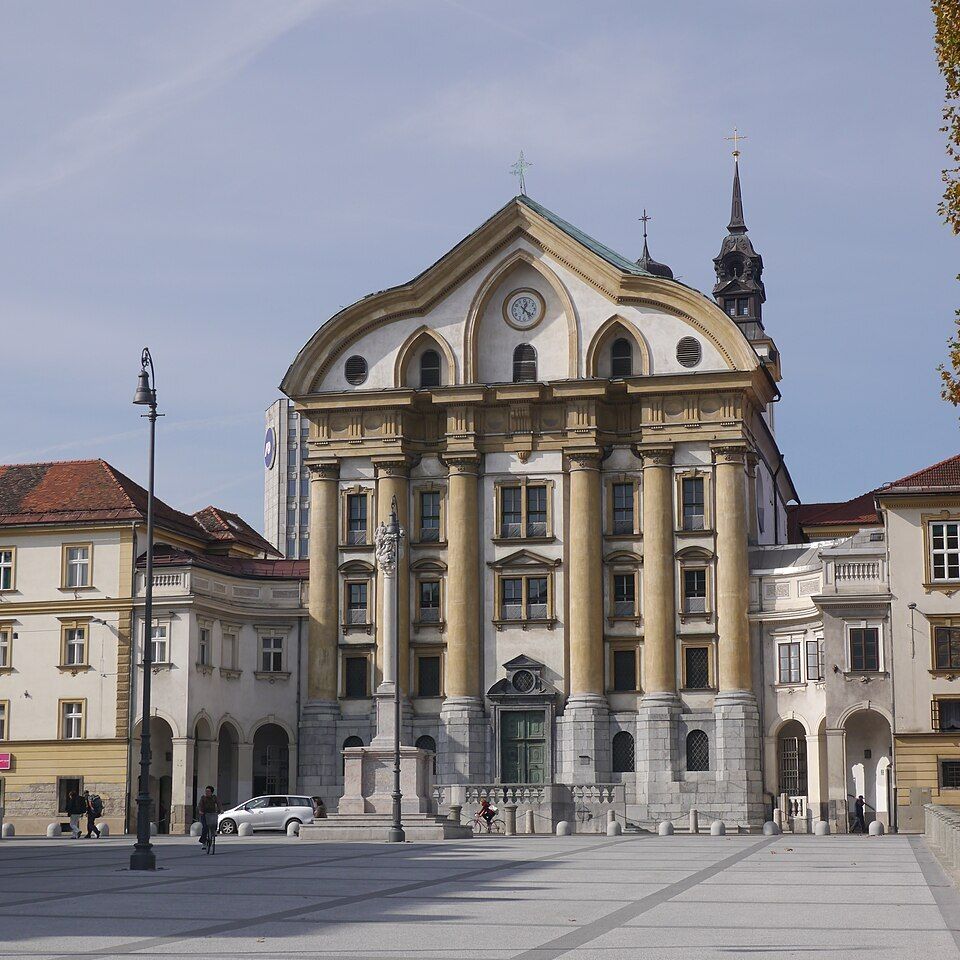
©Jay Galvin CC BY-SA 2.0. <https://creativecommons.org/licenses/by-sa/2.0/deed.fr>via Wikipedia Commons
The Ljubljana audio-guided tour invites you to quiet contemplation before the Ursuline Church of the Holy Trinity, recognisable by its façade with undulating lines. Built at the beginning of the eighteenth century, shortly after the arrival of the nuns, it is one of the finest examples of baroque in Slovenia.
The Ursuline order, dedicated to the education of young girls, deeply marked the cultural and spiritual life of Ljubljana, and this vast monastic complex is its most visible witness. The façade, with its twin columns and its curved pediment, displays all the elegance of the baroque. The church remains today open to worship and to visits, with respect for the contemplation of the faithful.
The undulating façade, one of the finest in the city, deserves to be lingered over. Inside, the baroque decor, the marble altar and the atmosphere of contemplation invite silence and contemplation. Located on Congress Square, the Ursuline Church is a major landmark of the religious heritage of Ljubljana, to be discovered with respect.
The Ursuline Church stands on Congress Square, in the heart of Ljubljana. An active place of worship, it is visited with respect for the contemplation of the faithful; access is generally free during opening hours, which may vary according to the daily services. Appropriate dress is appreciated.
At the beginning of the eighteenth century, shortly after the arrival of the nuns; it is one of the finest examples of baroque in Slovenia.
To the education of young girls, lastingly marking the cultural and spiritual life of Ljubljana.
Aucun avis pour le moment
