


Walk
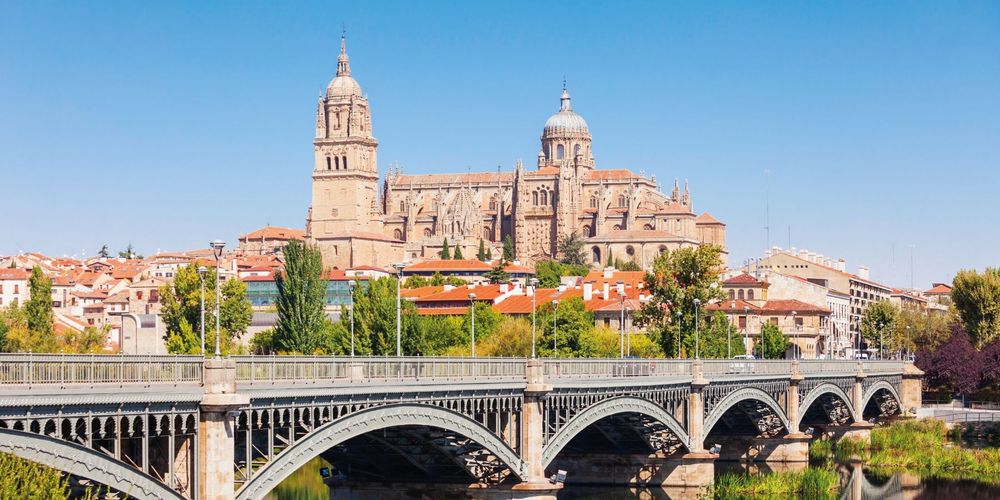
Long live the Golden City !
Salamanca, Spain
Walk
Long live the Golden City !
Salamanca, Spain
3.4 km
Distance
1h20
Durée
22
Audios
Loop
Parcours

Let’s take a quick break to mention some other highlights that didn’t fit into the itinerary. Salamanca is much more than just a university town—it’s also a deeply religious city, full of spiritual heritage. Beyond its two must-see cathedrals, the city is home to countless pieces of religious architecture, such as the Convent of Las Ursulinas.
Tucked away from the usual tourist route, this church was founded in 1490 by Archbishop Alfonso Fonseca. From the outside, it’s quite understated, but step inside and the Gothic design truly shines—especially when you look up and catch the stunning vaulted ceilings covered in star-like patterns. About 800 meters away, you’ll find the Colegio Arzobispo Fonseca, built in 1538.
Its simple facade might not impress at first glance, but prepare to be surprised inside the cloister. The interior boasts another gorgeous display of star-vaulted ceilings that’s really something to see. Before we move on with your visit, how about a little food break?
At Plaza Mayor, you’ll find Salamanca’s oldest café: the Novelty, opened in 1905. It’s been a favourite hangout for notable figures, including writer Gonzalo Torrente Ballester, whose statue is still inside. Today, the café serves up delicious Spanish and local specialties like horchata, sangría, or the hearty lentil stew called Lentejas de Armuña.
Whether you catch the old town lit up at night or glowing in the late afternoon sun, Salamanca’s charm works around the clock. There are some great spots to admire it from different angles. For a view immersed in greenery, head to the garden of Calixto y Melibea, nestled on the slope of the old city wall near the Tormes River.
Or, for a bird’s-eye perspective, climb the towers of La Clerecía. As the 2002 European Capital of Culture, Salamanca gave new life to its former prison by transforming it into a contemporary arts center: the Domus Artium 2002. This space now hosts innovative exhibitions and workshops by emerging artists, all of which are free to visit!
If Salamanca has won your heart, why not explore a bit more of the province while you’re here? The region is packed with history, art, and natural beauty. You could start with the village of Arapiles, where French and Anglo-Portuguese forces clashed in a legendary 1812 battle.
Then wander through charming medieval towns like Ciudad Rodrigo, Béjar, Ledesma, or La Alberca—the first rural town in Spain declared a national historic monument. If you want to explore the great outdoors, check out the Camino de Hierro, a hiking trail that follows an old railway line, or the breathtaking landscapes of the Arribes del Duero Natural Park. Finally, consider visiting the nearby cities of Zamora, Ávila, and Segovia—a trio of urban gems that round out the experience.
So, there are plenty of reasons to stick around and soak up everything this incredible region has to offer.
Aucun avis pour le moment