





Walk
A well-kept Roman secret
Mérida, Spain
Walk
A well-kept Roman secret
Mérida, Spain
6.5 km
Distance
2h40
Durée
19
Audios
Loop
Parcours
Shutterstock
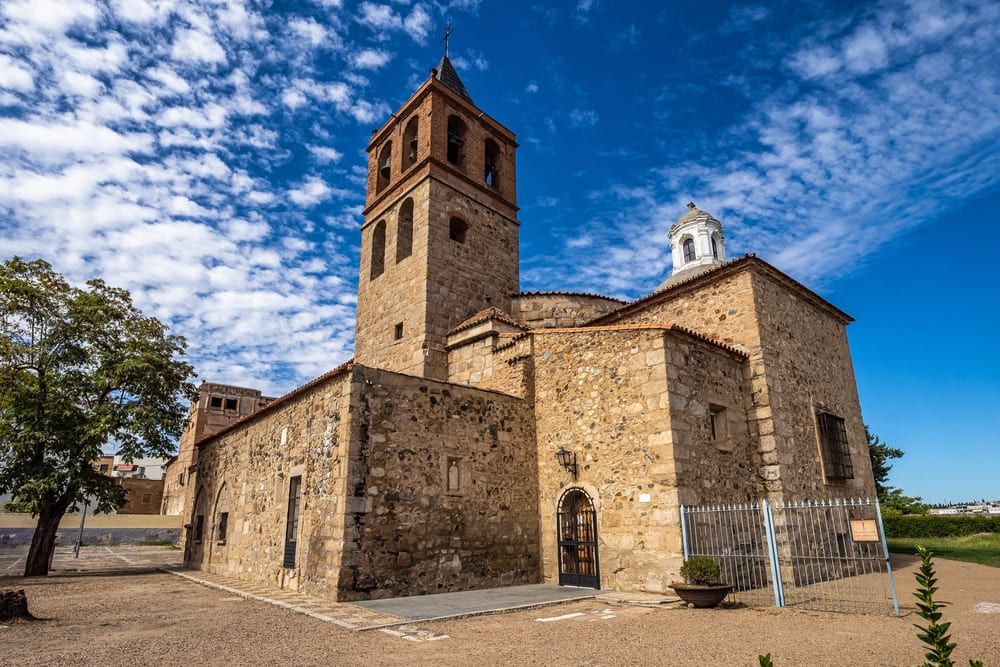
The basilica of Saint Eulalia is one of the cradles of Christianity in the Iberian peninsula, dedicated to the young martyr patron of Mérida. The Mérida audio-guided tour stops here, with respect, to evoke this sanctuary with a remarkable portico, raised on a Christian site of the first centuries, a place of memory and contemplation very dear to the people of Mérida.
Here you are now, with respect, in front of the fine basilica of Saint Eulalia and its remarkable entrance portico. The building is considered as one of the primordial nuclei of the birth of Christianity in the Iberian peninsula. According to the researchers, the present church rises on the location of a former Christian temple erected in Hispania after the peace granted to the Christians by the emperor Constantine. Let us recall that Constantine was the first Roman emperor to put an end to the persecutions and to grant freedom of worship, by the edict of Milan, in 313; this freedom also applied to the other religions of the Empire. It is he who refounded Byzantium, that took the name of Constantinople. The basilica is dedicated, with contemplation, to Saint Eulalia, a young virgin martyr of Mérida, died around 304, during the last great persecutions, for having refused to renounce her faith despite her very young age. Her memory was very early venerated and celebrated, notably in a hymn of the poet Prudentius, and she became the patron saint of the town. The sanctuary, several times rebuilt after destructions, presents today a fine Romanesque architecture, raised on the vestiges of the earlier buildings; you see its stratified history in its archaeological basement. Inside, in the gravity of the place, you measure the weight of this very ancient Christian memory. A martyrial basilica and a cradle of Christianity, the basilica of Saint Eulalia is discovered with respect.
Here you discover, with respect, one of the cradles of Christianity in the Iberian peninsula, raised on the location of a Christian temple of the first centuries; dedicated to Saint Eulalia, a young virgin martyr of Mérida died around 304 and patron of the town, the basilica presents a remarkable portico, a fine Romanesque architecture and an archaeological basement that reveals its different eras. The basilica of Saint Eulalia is a place of memory of Mérida. It is a stop to be discovered with respect.
The basilica of Saint Eulalia lies in the centre of Mérida, reachable on foot. A place of worship and memory, it can be visited with respect for services; entry and hours follow the conditions of the place, which vary, access to the archaeological site being able to be subject to a fee. It is best to enquire before coming and to respect the sacred character of the building.
A young virgin martyr of Mérida, died around 304 during the last great persecutions, for having refused to renounce her faith despite her very young age; venerated very early, notably in a hymn of the poet Prudentius, she became the patron saint of the town, and the basilica dedicated to her, one of the cradles of Christianity of the peninsula, rises on the location of a Christian temple of the first centuries.
In the centre of Mérida, in Spain.
Aucun avis pour le moment
