





Walk
A well-kept Roman secret
Mérida, Spain
Walk
A well-kept Roman secret
Mérida, Spain
6.5 km
Distance
2h40
Durée
19
Audios
Loop
Parcours
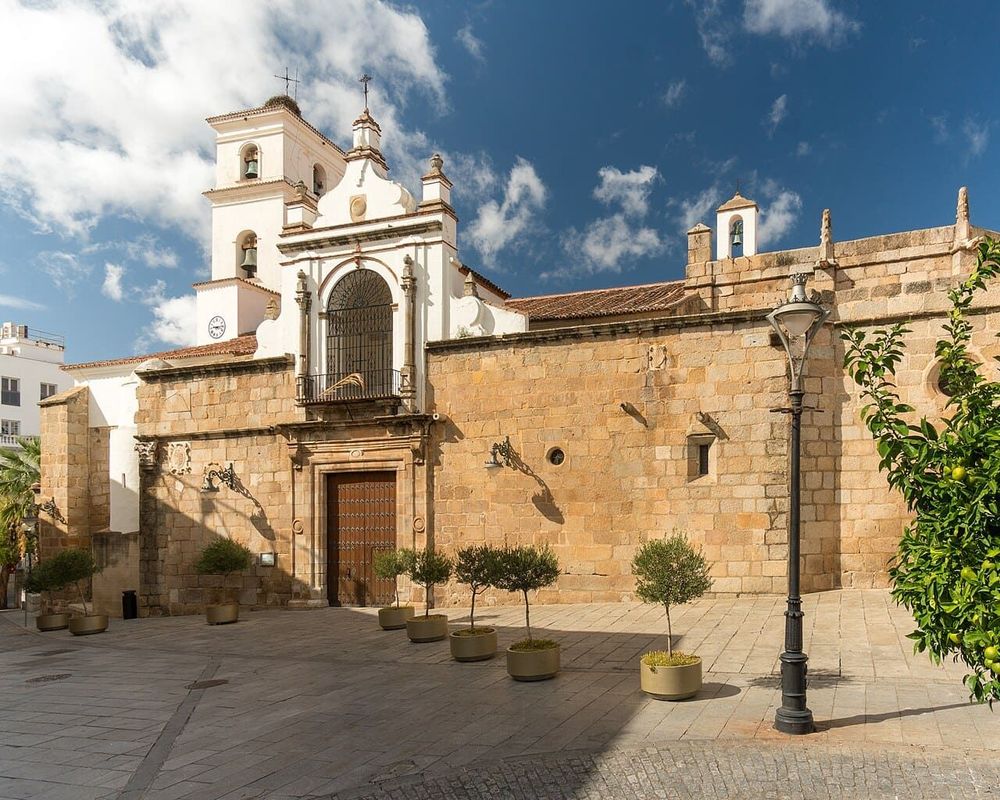
©Fernando CC BY-SA 4.0. <https://creativecommons.org/licenses/by-sa/4.0/deed.fr>via Wikipedia Commons
The co-cathedral Santa María la Mayor is the oldest building of the Plaza de España, a Christian sanctuary whose origins go back to the Visigothic era. The Mérida audio-guided tour stops here, with respect, to evoke this co-cathedral of the thirteenth century, that shares the seat of the archdiocese with the cathedral of Badajoz.
The co-cathedral Santa María la Mayor that you see here is the oldest building of the Plaza de España. We speak of co-cathedral because it shares the seat of the archdiocese of Mérida-Badajoz with the cathedral of Badajoz, without being its sole seat. The history of a religious building on this site goes back far, to the fall of the Western Roman Empire, when Mérida was a prosperous town of Visigothic Hispania: a great sanctuary stood there then, seat of the archbishopric. With the Muslim arrival, the Christians had to leave the town taking the relics of their churches, notably those of the patron saint of Mérida, Saint Eulalia. After the Reconquest, the present building was raised in the thirteenth century, on the location of the former temple, in a Romanesque and Gothic style enriched over the centuries. Quite discreet, almost merged into the neighbouring buildings of the square, the co-cathedral reveals inside, in the calm conducive to contemplation, fine altarpieces, chapels, tombs and a rich artistic heritage. You also notice elements of reuse of Roman and Visigothic era, witnesses of the strata of history of this twice-millennial town. A spiritual heart of Mérida, it hosts the great celebrations and discreetly watches over the Plaza de España. An ancient co-cathedral and a Christian memory of the town, the co-cathedral Santa María is discovered with respect.
Here you discover, with respect, the oldest building of the Plaza de España, a co-cathedral that shares the seat of the archdiocese with Badajoz; raised in the thirteenth century on the location of a former Visigothic sanctuary, in a Romanesque and Gothic style, it keeps inside altarpieces, chapels and tombs, as well as elements of Roman and Visigothic reuse. The co-cathedral Santa María is a spiritual heart of Mérida. It is a stop to be discovered with respect.
The co-cathedral Santa María lies on the Plaza de España, in the heart of Mérida, reachable on foot. A place of worship in activity, it can be visited with respect for services; entry and hours follow the conditions of the parish, which vary. It is best to check them before coming and to respect the sacred character of the place.
Because Santa María la Mayor shares the seat of the archdiocese of Mérida-Badajoz with the cathedral of Badajoz, without being its sole seat; the oldest building of the Plaza de España, raised in the thirteenth century on the location of a former Visigothic sanctuary, it keeps altarpieces, chapels, tombs and elements of Roman and Visigothic reuse.
On the Plaza de España, in the heart of Mérida, in Spain.
Aucun avis pour le moment
