





Walk
Long live the Golden City !
Salamanca, Spain
Walk
Long live the Golden City !
Salamanca, Spain
3.4 km
Distance
1h20
Durée
22
Audios
Loop
Parcours
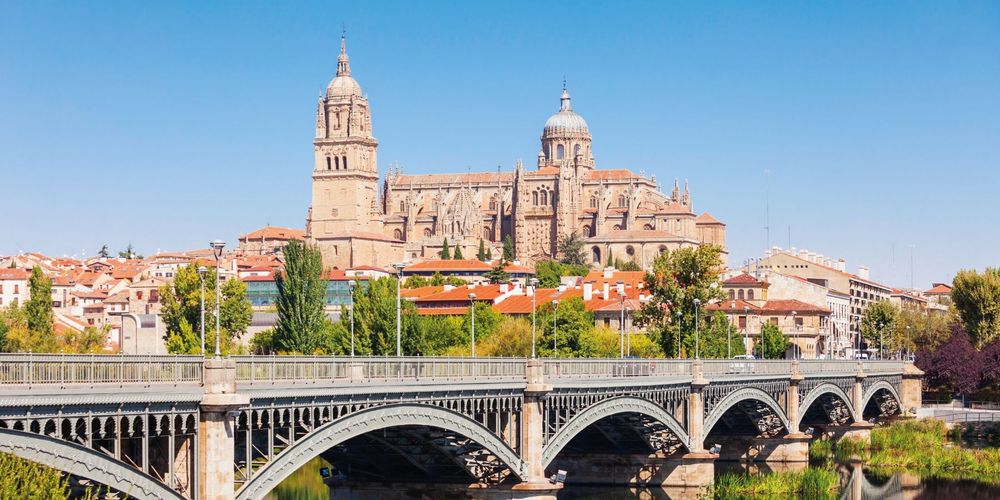
From one monument to the next, it quickly becomes clear that Salamanca’s history is anything but simple. It’s a rich and complex story, shaped by four major chapters and countless civilisations leaving their mark along the way. It all began nearly 2,700 years ago, when a Celtic tribe called the Vaccaei settled on the hill of San Vicente.
Around 150 years later, the Carthaginian general Hannibal arrived with his army and took control of the area—much to the locals' dismay. But their time in what was then known as Helmantica was short-lived. The Romans soon arrived and transformed the city into a strategic stronghold.
They built the Roman bridge to boost trade, and Salamanca became a key stop on the Via de la Plata, the ancient road that linked the north and south of Spain. From the 5th century onwards, Salamanca was caught between a wave of invasions—first by Germanic tribes, then by the Muslims. This back-and-forth period of decline came to a halt thanks to King Alfonso VI.
He drove out the Moors, repopulated the area, and founded the University of Salamanca, which marked a major turning point in the city’s history. The university’s rise, the boom in the wool trade, and overall prosperity launched Salamanca into Spain’s Golden Age—the period of cultural and political influence led by the Catholic monarchy in the 16th and 17th centuries. As the city edged closer to the third millennium, it struggled with the scars left by the Peninsular War and the Spanish Civil War.
Many buildings had fallen into ruin, and the university lost much of its prestige. But slow and steady restoration efforts eventually paid off. In 1988, Salamanca received one of its greatest honours: being declared a UNESCO World Heritage Site.
Not long after, in 2002, it was named European Capital of Culture. That’s what we call a crowning achievement.
Aucun avis pour le moment
