





Walk
Short tour - The beautiful Catalan capital
Barcelona, Spain
Walk
Short tour - The beautiful Catalan capital
Barcelona, Spain
3.3 km
Distance
1h20
Durée
18
Audios
Loop
Parcours
Shutterstock
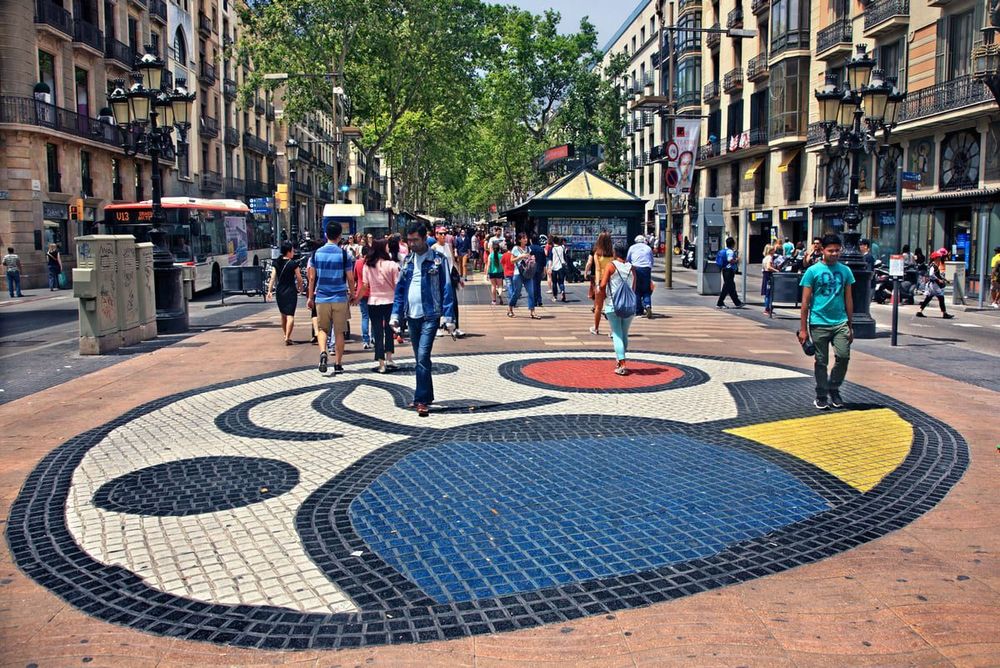
The Barcelona audio-guided tour has you reach the most famous avenue of the city, La Rambla. This huge tree-lined pedestrian way, framed by two traffic lanes, is the living artery par excellence of Barcelona, walked day and night by inhabitants and visitors.
Seen from the sky, La Rambla gently zigzags through the city, because it is built on the bed of a dried-up river. The Catalan word rambla derives from the Arabic ramla, which means sand, and refers to a watercourse often dry. This was the case in Barcelona: it was decided to cover this stream to lay out an avenue, which gradually became the emblem of the city.
There you come across street artists, old-fashioned kiosks, flower stalls and a cosmopolitan crowd. La Rambla links Plaça Catalunya to the port and serves some of the city's flagship places, such as the Boqueria market, the Liceu theatre and the Miró mosaic. It is an essential walk, to be taken slowly to savour its atmosphere.
La Rambla links Plaça Catalunya to the port of Barcelona, in the heart of the city. This pedestrian way can be walked freely at all hours and on the level. Very busy, it calls for vigilance against pickpockets. Several metro stations serve it along its whole route.
From the Arabic word ramla, meaning sand, which refers to a watercourse often dry: the avenue is built on the bed of a former river.
Street artists, kiosks, the Boqueria market, the Liceu theatre and the Miró mosaic, all the way to the port.
Aucun avis pour le moment
