





Walk
Mountain Slopes, Timeless Soul
La Orotava, Spain
Walk
Mountain Slopes, Timeless Soul
La Orotava, Spain
2.5 km
Distance
1h00
Durée
17
Audios
Loop
Parcours
Shutterstock
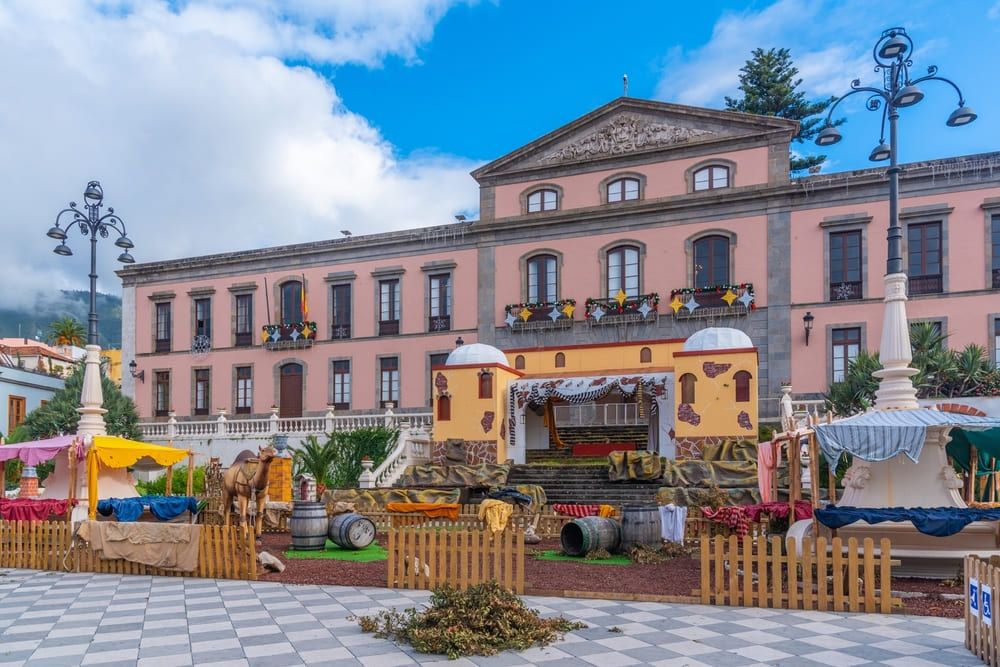
The Plaza del Ayuntamiento is the town hall square of La Orotava, famous for its spectacular sand carpets of Corpus Christi. The La Orotava audio-guided tour stops here to evoke this emblematic place, dominated by the town hall and laden with traditions.
The Plaza del Ayuntamiento is the main square of La Orotava, dominated by the town hall. The town hall building was built in 1870, on the site of the former convent of the Poor Clares, testifying to the evolution of the town through the centuries. But this square is above all world-famous for a spectacular tradition: each year, during Corpus Christi, the people of Orotava make there magnificent ephemeral carpets, composed of coloured sands coming from the nearby Teide volcano, as well as carpets of flowers and petals. These ground works of art, immense and meticulous, represent religious scenes and ornamental motifs, and are the object of a know-how transmitted from generation to generation. This tradition, among the most famous of the Canaries, attracts each year numerous visitors. A place of life and festivity in the heart of the town, the Plaza del Ayuntamiento is a must-see stop of La Orotava.
You admire the main square dominated by the town hall built in 1870 on the site of the convent of the Poor Clares, and above all the place of the spectacular ephemeral carpets of Corpus Christi, made of coloured Teide sands and flower petals, ground works of art representing religious scenes, a famous tradition of the Canaries. The Plaza del Ayuntamiento is an emblematic place of La Orotava. It is a must-see stop, to be explored on foot.
The Plaza del Ayuntamiento lies in the heart of La Orotava, reachable on foot. It is a freely accessible public square; the town hall follows its own hours. The famous sand carpets are made during Corpus Christi, generally in spring or early summer. It is best to inquire about the dates before coming.
Each year, during Corpus Christi, spectacular ephemeral carpets composed of coloured sands of the Teide volcano and flower petals are made there, representing religious scenes; the square is dominated by the town hall built in 1870 on the former convent of the Poor Clares.
In the heart of La Orotava, in Tenerife, in Spain.
Aucun avis pour le moment
