





Walk
Short tour - The beautiful Catalan capital
Barcelona, Spain
Walk
Short tour - The beautiful Catalan capital
Barcelona, Spain
3.3 km
Distance
1h20
Durée
18
Audios
Loop
Parcours
Shutterstock
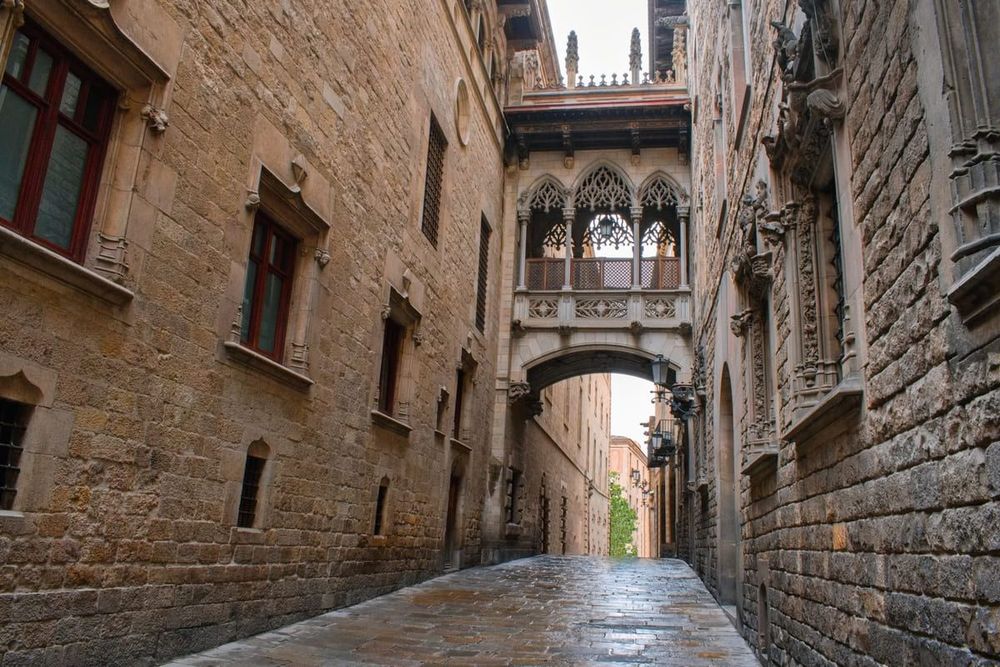
The Barcelona audio-guided tour has you look up at the superb suspended stone bridge of Carrer del Bisbe, often the image one keeps in mind of the Gothic quarter. It blends so well into the setting that one can hardly believe it was only added in the twentieth century.
The bridge is part of the neo-Gothic elements added in the 1920s to embellish the district and evoke the era of splendour of Catalan culture, radiant in the thirteenth century. It links the Palau de la Generalitat to the former house of the canons, which became the official residence of the president of the Generalitat of Catalonia. When the architect Joan Rubió presented his project, it was at first mocked, and a caricature of the time made fun of the uses this bridge might have.
Finely worked, the stone bridge spans the narrow Carrer del Bisbe and composes one of the most photographed perspectives of Barcelona. On approaching, you notice the sculpted details, including a skull pierced by a dagger to which a popular legend is attached. It is an essential and photogenic stop of the Gothic quarter, to be admired by looking up.
The Pont del Bisbe spans Carrer del Bisbe, in the heart of the Gothic quarter of Barcelona, between Plaça de Sant Jaume and the cathedral. It can be contemplated freely from the street, at all hours and on the level. It is one of the most photographed corners of the old town.
No, despite its Gothic appearance, it was added in the 1920s, as part of the neo-Gothic embellishment of the district.
The Palau de la Generalitat to the former house of the canons, which became the residence of the president of the Generalitat of Catalonia.
Aucun avis pour le moment
